The term “383 stroker boat motor” often signals a desire for robust power in compact, reliable packages. This guide focuses on five capable outboard motors that fit small to mid-sized boats, including dinghies, inflatable boats, and light fishing skiffs. Each option is evaluated for suitability, fuel efficiency, and ease of use. Whether you need steady trolling power, quick planing, or reliable cold-start performance, these selections aim to match different boating needs and budgets.
| Product | Brand | Engine Type | Key Benefit |
|---|---|---|---|
| NAZEAOB 18HP Outboard | NAZEAOB | 2-stroke, 18HP | Heavy-duty, high load capacity |
| YIYIBYUS 2.3HP Outboard | YIYIBYUS | 2-stroke, 2.3HP | Compact and efficient |
| Gosangom 3.5HP Outboard | Gosangom | 2-stroke, 3.5HP | Lightweight and portable |
| FXEIPOL 9HP Outboard | FXEIPOL | 4-stroke, 9HP | High power with air cooling |
| Goudergo 6.5HP Outboard | Goudergo | 4-stroke, 6.5HP | Balanced power and efficiency |
NAZEAOB 18HP Outboard Motor

Best for: heavier loads and faster travel on small to mid-sized boats. This 18HP 2-stroke engine supports substantial payloads up to 2,204 pounds, making it suitable for fishing boats or tenders that routinely carry gear and passengers. The aluminium alloy construction offers corrosion resistance and durability in varied water conditions.
Why selected: Combines strong pull with robust build. The engine operates at 4,500–5,500 RPM for a balance of speed and control, which helps planing without excessive fuel use.
Caution: Heavier loads reduce speed; plan for lighter loads if achieving top speeds is essential.
YIYIBYUS 2.3HP Outboard Motor

Best for: compact boats like dinghies, inflatables, or small fishing craft where light weight and simplicity matter. The motor weighs less and uses a 52cc 2-stroke design with non-contact electronic ignition for easy starts.
Why selected: High efficiency and reliable power in a very small form factor, ideal for quick trips and tight spaces.
Caution: Smaller displacement limits top speed and load capacity; not ideal for larger vessels or heavy gear.
Gosangom 3.5HP Outboard Motor

Best for: lightweight, portable propulsion for rubber boats, inflatables, or kayaks. Its aluminum alloy body and water-cooled CDI system deliver dependable performance for short trips.
Why selected: The combination of a compact footprint and a 3.5HP output makes it an economical choice for casual boaters.
Caution: Lower horsepower means slower planing and reduced payload capacity compared to higher-horsepower options.
FXEIPOL 9HP Outboard Motor
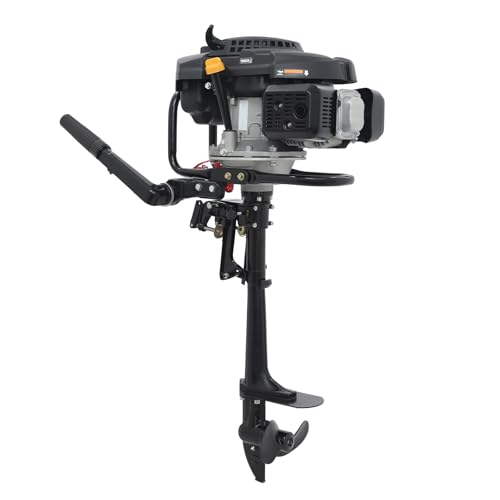
Best for: small to mid-sized boats needing stronger propulsion with durable, air-cooled 4-stroke performance. This 9HP model suits inflatable boats and light canoes requiring reliable thrust and easier cold starts.
Why selected: High power output relative to size; 224cc displacement supports robust momentum, with CDI ignition and a practical tilt/reverse design for maneuverability.
Caution: Heavier than ultra-light models; ensure mounting and transom strength matches the motor’s mass.
Goudergo 6.5HP Outboard Motor

Best for: inflatable boats, dinghies, and light fishing skiffs that require a steady 6.5HP output with efficient fuel use. The 123cc engine delivers 4.8kW at 5000–6000 RPM and supports all-day trolling or cruising.
Why selected: A balanced choice between power, efficiency, and a three-position tiller control allowing forward, neutral, and reverse with variable speed control.
Caution: Heavier-than-very-light motors; verify that your boat and transom can handle continuous operation at higher RPMs.
Buying Guide: Key Purchase Considerations
Engine type and power: Choose between 2-stroke for light weight and simple maintenance or 4-stroke for smoother operation and better fuel efficiency. Match horsepower to your boat’s size and intended use.
Weight and mounting: Confirm the transom load capacity and shaft length compatibility with your boat. Lighter boats benefit from smaller engines, while heavier craft benefit from more power but require stronger mounts.
Fuel system and efficiency: Consider fuel consumption per hour and the availability of spare parts and service for your region. CDI ignition and air cooling influence reliability in varying climates.
Starting and control: Look for easy-start features, safe reverse, and tiller handles with integrated throttle controls. Three-position gear shifts (F/N/R) aid maneuverability in tight spots.
Durability and environment: Aluminum alloy constructions resist corrosion in saltwater. Water cooling helps prevent overheating during extended use.
FAQ
- What is the best engine for a small inflatable boat? A compact, lightweight model like the 2.3HP or 3.5HP options is often ideal for inflatables and short trips.
- Do 2-stroke outboards provide good fuel economy? They can be lighter and cheaper but generally use more fuel at higher speeds than modern 4-stroke designs.
- Is a higher HP always better? Not necessarily. Match HP to your boat weight, water conditions, and planned loads to avoid reduced efficiency or handling issues.
- Should I choose air-cooled or water-cooled engines? Air-cooled engines are simpler and lighter; water-cooled designs maintain cooler temperatures on longer runs.
- What maintenance is essential for outboard motors? Regular oil or fuel mix checks (for 2-strokes), spark plug checks, propeller inspection, and cooling system maintenance are key.
Note: This article presents product features and intended use cases based on the listed specifications. Always verify compatibility with your boat and consult a marine technician if needed.