Answering the common buyer question: which outboard engines offer the best value without compromising reliability? This guide highlights economical 2- and 4-stroke outboards that balance upfront cost with practical performance. The top picks are best for small to mid-sized boats, inflatable crafts, and occasional marina use. Each option is evaluated on price-friendly features, fuel efficiency, and ease of maintenance, helping readers compare value across brands and configurations.
Summary table of selected products:
- Product: 6.5HP 4-Stroke Outboard Motor — Best for small boats and dinghies
- Product: FiueStur 12HP 2-Stroke Outboard Motor — Best for inflatable boats and light fishing boats
- Product: PERFERATE 12HP 2-Stroke Outboard Motor — Best for budget cruisers needing steady thrust
- Product: NAZEAOB 18HP Outboard Motor — Best for stronger propulsion on compact craft
- Product: RYIRSHOH 18HP Outboard Motor — Best for versatile water use and three-gear control
6.5HP 4 Stroke Outboard Motor

Brand: Goudergo
Key features: 6.5HP, 123cc, 3-position tiller control (F/N/R), fuel-efficient water-cooled design, 0.52 gal/h consumption, 3.2-gallon remote tank. The motor is designed for small boats and inflatables, delivering dependable power with efficient fuel use.
Best for: Small boats, inflatables, dinghies, and light fishing skiffs that require reliable, low-cost propulsion. Choose this if you want straightforward operation and a compact footprint at a modest price.
Limitation: May be underpowered for heavier loads or larger craft; optimal on lighter, smaller setups.
FiueStur 12 HP 2-Stroke Outboard

Brand: FiueStur
Key features: 12HP, 169cc, water-cooled, three-gear control, corrosion-resistant aluminum, suitable for inflatable boats and small craft up to 661 pounds. Includes three-speed cruising and simple tiller control for maneuverability.
Best for: Budget-conscious boaters with inflatable or small wooden/fiberglass boats needing steady mid-range power and simple operation. Avoid this if you require high-end finish or very heavy load support.
PERFERATE 12HP 2 Stroke Outboard
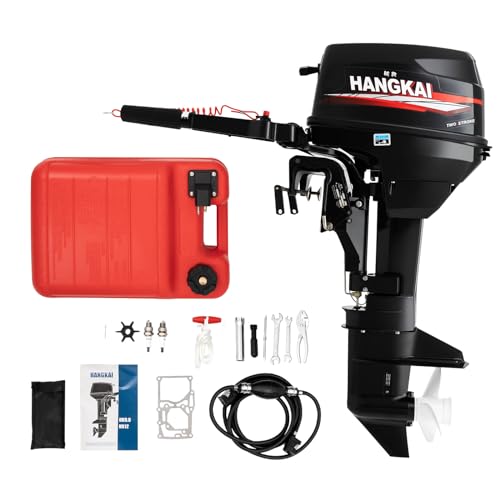
Brand: PERFERATE
Key features: 12HP, 169cc, short shaft, CDI ignition, water cooling, suitable for fishing boats and small yachts. The three-speed CVT-like setup enables smoother cruising and stable maneuvering at controlled speeds.
Best for: Budget-minded boaters seeking reliable 12HP propulsion with simple CDI ignition and cooling for extended use. Choose this if you want predictable performance at a lower price point.
Limitation: Heavier use may require careful fuel management and regular maintenance; verify hull compatibility for short shaft installations.
DUIBAII 18 HP HangKai Outboard

Brand: DUIBAII
Key features: 18HP, 2-stroke, water cooling, CDI ignition, short shaft, robust aluminum construction. Designed for versatile use across fishing boats, wooden and inflatable craft, with strong throttle response.
Best for: Boaters needing stronger propulsion on small/medium boats and steamlined CDI ignition for quick starts. Better for faster travel in open water; avoid if you need low fuel consumption on lengthy trips.
Limitation: Higher fuel consumption potential due to 18HP rating; ensure fuel planning aligns with trip duration.
RYIRSHOH 18HP Long Shaft Outboard

Brand: RYIRSHOH
Key features: 18HP, 246cc, long shaft, three-gear F-N-R, CDI ignition, water cooling. Durable aluminum alloy construction with corrosion resistance and a three-blade propeller for better efficiency in varied conditions.
Best for: Boaters needing robust propulsion on mid-sized crafts with longer shaft compatibility and flexible gear control. Choose this if you require balanced speed and maneuverability. Limitation: three-gear control may require more skill to manage precise speeds in tight spots.
Buying Guide
What should I prioritize for economical outboards?
- Horsepower vs. boat size: Match engine power to vessel weight and typical load to optimize performance and fuel use.
- Fuel efficiency: Look for engines with efficient cooling and CDI ignition to reduce consumption.
- Fuel capacity and range: Consider your typical trip length and available fuel options when selecting tank size and efficiency.
- Durability and maintenance: Aluminum construction and corrosion resistance extend life in saltwater or fresh environments.
- Installation considerations: Shaft length (short vs long) and transom compatibility affect fit and operation.
What installation and operation considerations matter?
- Transom height: Ensure the shaft length matches your boat’s transom height for proper propeller immersion.
- Gear control: Three-gear (F/N/R) systems enable precise docking and cruising; infinite throttle may improve control on some models.
- Starting system: CDI ignition provides reliable start-up, but ensure proper wiring and battery capacity for cold starts.
- Cooling system: Water cooling prevents overheating; verify cooling availability in your operating environment (fresh vs. saltwater).
How to compare options quickly?
- Best for small boats and inflatables: 6.5HP or 12HP compact models with easy handling.
- Best for moderate loads and longer trips: 18HP models offering stronger propulsion and longer run times.
- Best value pick: Engines with aluminum construction, CDI ignition, and water cooling at a balance of power and price.
FAQ
- Q: Are 2-stroke engines more economical than 4-stroke for outboards?
- A: It depends. 2-stroke engines often deliver more power per weight and can be lighter and cheaper, but they may have higher fuel consumption and emissions compared to some modern 4-stroke designs.
- Q: Is a longer shaft always better?
- A: Not always. A long shaft suits boats with higher transoms; a short shaft is better for smaller transoms or lower clearance.
- Q: What maintenance helps extend outboard life on a budget?
- A: Regular cooling system checks, fuel system maintenance, clean air intakes, and proper storage when not in use.
- Q: Can I mix and match brands for best value?
- A: Yes, but ensure compatibility with your boat transom, fuel system, and control cables to avoid installation issues.
- Q: How do I choose among 12HP and 18HP options?
- A: Consider vessel weight, desired speed, typical load, and fuel planning. 12HP is often sufficient for smaller boats; 18HP provides faster cruising for heavier loads.