Answering the spot-on question “which thru-hull depth sounder fits my boat?” this guide highlights five dependable models designed to deliver reliable depth measurements through the hull. These devices are best for anglers, offshore cruisers, and boat owners who want real-time depth data, temperature readings, and clear alarms. The top picks balance visibility, ease of installation, and durability across fiberglas and metal hulls. The brief product table below helps you compare key features at a glance.
| Product | Display | Transducer | Best For |
|---|---|---|---|
| DepthTrax 2B Boat Mount in Dash Digital Depth Finder | Largest in-dash display | 200 kHz, dual mount transom or glue-in | Owners needing a bright, easily readable dashboard readout |
| Faria Beede 13795 Chesapeake Depth Sounder Thru-Hull | Oversized back-lit display | Thru-hull | Low-light visibility and simple alarms |
| Faria 13751 Chesapeake Black Depth Sounder | Standard depth readout | In-hull transducer | Standard installations with 199 ft depth cap |
| HawkEye DT2BX-TM In-Dash Depth Sounder | Very large dash display | Transom mount transducer | All-season dashboards with temperature readings |
| HawkEye DT2BX-TH In-Dash Depth Sounder | Integrated temp readings | Thru-hull transducer | Thru-hull installations with temperature data |
DepthTrax 2B Boat Mount in Dash Digital Depth Finder

Best for boat owners who want a large, in-dash display with bright visibility. The DepthTrax 2B provides uninterrupted depth readings from 2.5 to 600 feet and can operate up to 60 mph. The 200 kHz transducer supports dual mounting options: transom mount or glue-in, even through solid fiberglass hulls and up to 1/8-inch aluminum hulls. A 3-stage Advanced Warning System delivers audible alarms, a bright red LED indicator, and LCD alarm readouts. This makes it ideal for high-speed runs where quick alerts matter. Caution: mounting requires alignment with your hull’s thickness and may demand a precise drilling or bonding process.
Who it’s best for: Operators needing a bright, single-display depth readout on high-speed boats, with flexible transducer mounting. Why chosen: versatility across hull types and robust depth range for coastal cruising and offshore use.
Faria Beede Chesapeake Depth Sounder Thru-Hull

Best for sailors seeking visibility in low-light conditions. This model features an oversized, back-lit display designed for easy readability under various lighting. It includes alarms for elevation with both visual and audible cues, helping the crew monitor depth without staring at the screen. The thru-hull installation is a strong choice for boats with deep-keel designs, though it may require professional installation depending on your hull configuration. Caution: ensure your hull has adequate space for a thru-hull unit and proper sealing to prevent leaks.
Who it’s best for: Boats that need a large, legible display with alarms, especially in dim environments. Why chosen: simple alarms and high-contrast readability improve situational awareness on deck or bridge.
Faria 13751 Chesapeake Black Depth Sounder

Best for standard hull setups requiring a compact depth gauge. The 13751 model offers a 1-year depth capability up to 199 feet and fits a standard 22-1/16″ gauge hole, simplifying replacement or retrofitting on many vessels. In-hull transducers typically provide reliable readings with less exposure to external damage, though the depth limitation is a consideration for deeper waters. Caution: depends on hull material and thickness for optimal transducer performance.
Who it’s best for: Cruisers and anglers upgrading an existing, space-constrained cockpit. Why chosen: compatibility with common gauge holes and solid mid-range depth capability.
HawkEye DT2BX-TM In-Dash Depth Sounder (Transom Transducer)
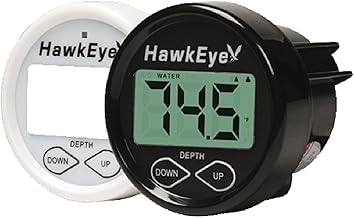
Best for boats needing temperature data alongside depth, with a transom mount transducer. The DT2BX-TM delivers instant depth updates and air/water temperature readings. The transom transducer is well-suited for boats without through-hull installations or where drilling through the hull is undesirable. Caution: performance can depend on hull material and the water conditions; ensure proper mounting to avoid signal loss.
Who it’s best for: Operators requiring depth plus temperature readings on a flexible transom-mount system. Why chosen: temperature data complements depth for fishing and navigation, and the large dash display aids quick interpretation.
HawkEye DT2BX-TH In-Dash Depth Sounder (Thru Hull)
Best for deep-water operations where through-hull installation is preferred and temperature data is valued. This model includes a thru-hull transducer and provides instant depth updates along with air and water temperature readings. The thru-hull setup can deliver robust performance in deeper waters, but requires drilling and proper sealing to prevent leaks. Caution: installation should be performed with hull-thickness and sealing in mind to ensure long-term reliability.
Who it’s best for: Boats that prioritize robust depth data with temperature readings and can accommodate a thru-hull installation. Why chosen: reliable through-hull sensing with integrated environmental data for fishing and navigation in variable conditions.
Buying Guide: Key Purchase Considerations
- Installation type: Thru-hull versus in-hull versus transom transducer. Thru-hull typically offers stable readings in deeper waters but requires drilling; transom or glue-in options provide flexibility on smaller or shallow-water boats.
- Display visibility: Look for oversized displays and back-lighting for easy reading in bright sun or low-light conditions. A large dashboard display reduces eye strain during long trips.
- Depth range and alarms: Choose models with depth ranges that fit your typical waters and ensure alarms are clear enough to act quickly when depth changes unexpectedly.
- Temperature data: If you navigate variable conditions, a model that provides air and water temperature can enhance situational awareness for fishing or weather planning.
- Hull compatibility: Ensure the transducer type matches your hull material (fiberglass, aluminum, wood) and thickness. Check for any required hole size and sealing procedures.
- Installation skill level: Some units are user-installable with basic tools, while others may benefit from professional marine installation to guarantee watertight seals and accurate readings.
Frequently Asked Questions
- What is a thru-hull depth sounder?
A thru-hull depth sounder uses a transducer mounted through the hull to send and receive sonar signals, delivering depth information from beneath the boat.
- Do I need temperature data with depth readings?
Temperature data helps monitor current water conditions and can aid in predicting fish presence and weather changes, though it isn’t required for depth measurement alone.
- Which installation is easier: thru-hull or transom transducer?
Transom transducers are typically easier to install, especially on smaller boats, while thru-hull installations may require professional sealing and hull penetration.
- What depth range is typical for coastal boating?
Coastal boating often uses devices that read from a few feet to several hundred feet, depending on water depth and local conditions. Choose a unit with more headroom than your deepest anticipated depth.
- Why are large, bright displays recommended?
Bright, large displays improve readability under sun glare and during quick navigational decisions, reducing the need to stare at the screen for long periods.
- Can these sounders warn about hazards automatically?
Yes, many models feature multi-stage warning systems with audible alarms and LED indicators to alert crews to depth changes or other critical conditions.