Answering the common buyer question: these aluminum boat sealers provide reliable leaks fixes, hull protection, and long-lasting seals. Ideal for boat owners seeking simple, repair-friendly products that work on aluminum rivets, seams, and small holes. The top five selections below cover quick repairs, barrier protection, and corrosion prevention for riveted or welded aluminum hulls. Use the quick comparison table to identify which product best fits your boat type, climate, and maintenance schedule.
| Product | Best For | Key Benefit |
|---|---|---|
| TotalBoat Aluminum Boat Leak Sealer | Riveted aluminum boats | Two-part epoxy with long working time |
| Travaco RM330K Gluvit | Sealing leaky seams and rivets | Barrier coat suitable for multiple hull materials |
| Amazing GOOP Coat-It Epoxy Sealer Kit | Easy, ready-to-use sealant | Kevlar-reinforced epoxy for strength |
| Woody Wax Marine Metal Sealer | Multi-metal finishes | Dual-action barrier with long-lasting shine |
| TotalBoat Aluminum Boat Barrier Coat | Corrosion protection for aluminum hulls | High-build epoxy barrier coat, fast-drying |
TotalBoat Aluminum Boat Leak Sealer

Two-part epoxy sealer designed for aluminum boats. It repairs leaking rivets and seams and patches small holes quickly and effectively. Long working time (about 75 minutes at 72°F) improves penetration and sealing. The formula absorbs stresses from contraction, vibration, shock, and expansion, helping the seal hold firm. It can be applied to properly prepared aluminum surfaces when air and substrate temperatures are as low as 40°F.
Best for: boat owners dealing with rivet and seam leaks who need a durable, flexible seal. Choose this if you want a long-working-time epoxy that cures into a watertight barrier. Caution: ensure surface preparation and temperature conditions meet the product’s guidelines to maximize adhesion.
Travaco RM330K Gluvit Waterproof Epoxy Sealer
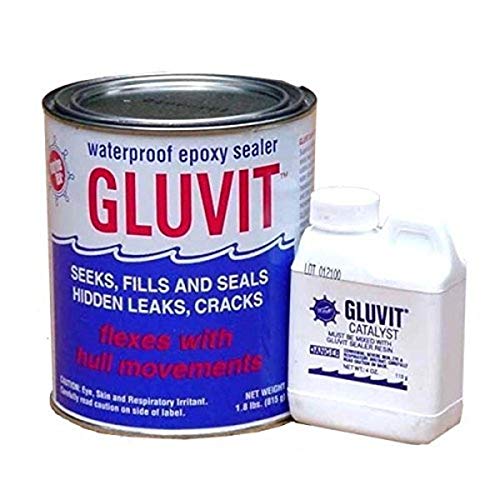
Gluvit barrier coat designed to seal and protect hulls and decks. It provides superior protection for fiberglass, wood, aluminum, and steel. It seals leaky seams and rivets in aluminum hulls and around fiberglass cabins or decks. This barrier coat is a practical choice when a versatile, multi-material sealant is needed for repairs across different areas of the boat.
Best for: owners seeking a universal barrier coat that works on multiple materials, including aluminum. Better for: situations requiring an added protective layer beyond simple leak sealing. Limitation: may require proper mixing and curing conditions per product guidelines.
Amazing GOOP Coat-It Epoxy Sealer Kit

Easy-to-use epoxy sealer kit that requires simple pouring, stirring, and applying. It’s reinforced with Kevlar fibers for added strength. The kit is practical for boats to glide smoothly over debris and rocks, making it suitable for protective sealing where abrasion resistance matters.
Best for: DIY repairs where simple operation and strong epoxy performance are priorities. Choose this if you want a ready-to-use kit with notable tear and impact resistance. Caution: as with any epoxy, follow mixing ratios and curing times for best results.
Woody Wax Marine Metal Sealer

Dual-action barrier technology coats anodized aluminum, stainless steel, and chrome with a protective seal. The formula creates a hard wax shell over a base that adheres to metal surfaces, protecting against saltwater damage and corrosion while restoring shine. The product is designed to keep hardware looking new with less frequent maintenance.
Best for: owners who want a long-lasting multi-metal sealant that also enhances appearance. Better for: maintaining high-gloss finishes on exterior fittings. Limitation: the two-part system may require careful application to achieve an even layer.
TotalBoat Aluminum Boat Barrier Coat

High-build, two-component epoxy primer and barrier coat for aluminum hulls and pontoons. It provides excellent corrosion prevention and can be overcoated with bottom paints or other 1- and 2-part paints. The product dries quickly and requires no sanding between coats, enabling faster hull protection against underwater corrosion.
Best for: protecting aluminum hulls from corrosion with a robust barrier coat system. Choose this if you want a dedicated primer/barrier coat that integrates with standard boat bottom coatings. Caution: proper surface preparation is essential for adhesion and performance.
Buying Guide: Key Purchase Considerations
- Material compatibility: Prioritize products explicitly formulated for aluminum hulls, rivets, or seams to ensure adhesion and flexibility in a marine environment.
- Seal type: Epoxy-based sealers offer strong, long-lasting bonds but require mixing and precise application; pre-mixed sealants are easier for beginners.
- Temperature and curing: Some products perform better at lower temperatures; check air/substrate temperature guidelines to avoid improper curing.
- Flexibility vs. rigidity: Flexible sealers handle hull movement; rigid primers/barrier coats provide strong corrosion protection but may require surface preparation.
- Layering and overcoating: If you plan to apply paint or bottom coatings, ensure the sealer or barrier coat is compatible with subsequent coatings.
- Maintenance interval: Consider how long the sealant lasts in your climate and water conditions to plan ongoing maintenance.
FAQ
- What should I seal first on an aluminum boat rivet seam?
Answer: Seal or barrier coat the rivet seams first to stop leak paths before applying a finish coat. - Can I use a marine wax on aluminum and expect lasting protection?
Answer: Wax provides shine and protection but is not a substitute for a proper barrier or epoxy sealant on leaks. - Which product is best for a quick repair?
Answer: Epoxy sealers with longer work times are best for thorough fixes; ready-to-use kits are better for fast, simple repairs. - Are these products safe for aluminum ponds or other water vessels?
Answer: These products are designed for marine aluminum hulls; always follow label directions for applicable substrates. - Do I need to remove old coatings before applying a new sealer?
Answer: Surface preparation improves adhesion; remove loose coatings and clean the surface per product guidelines. - How long does curing take before launch?
Answer: Curing times vary by product; refer to the label and ensure the coating has fully cured before exposure to water.