Answering your search for a reliable power buffer for boat detailing, this guide highlights five top buffers that deliver swirl-free finishes on fiberglass, gel coat, and painted surfaces. The right buffer speeds up wax removal, scratch reduction, and gloss restoration, while matching your boat maintenance style—whether you prefer cordless freedom or ongoing power with a stable cord. The selections emphasize suitability for boat owners and detail enthusiasts who want efficient results, durable motors, and clear operation. Below you’ll find concise product summaries, a quick comparison table, and practical buying guidance to help you pick the best buffer for your boat.
Quick comparison table of selected products
| Product | Motor Power | Best For | Notes |
|---|---|---|---|
| Avhrit Cordless Car Buffer Polisher Kit | 300W (up to 6000 RPM raw, 2500-6000 RPM adjustable) | Boat detailing with cordless flexibility | Includes 2 batteries, 6″ pad, multiple attachments |
| ZOTA Buffer Polisher (1600W) | 1600W | Deep polishing and long sessions | Long 13.1 ft power cord |
| AVID POWER Car Buffer Polisher | 1200W | Professional-grade polishing on boats | Rotary, 6″ and 7″ backing plates |
| AVID POWER Dual Action Car Buffer Polisher | Not specified (DA model) | Beginner-friendly swirl removal on boats | 6″ orbital, includes 3 pads |
| LDHTHOPI Buffer Polisher | 1800W | Versatile, multi-surface polishing | 6″/7″ options, 750-3100 RPM |
Avhrit Cordless Buffer Polisher Kit

Best for boat owners who want mobility without cords. This cordless polisher features a built-in 300W motor with anti-interference design for lower noise and safer operation. It offers six adjustable speeds across a 2500-6000 RPM range and a 8 mm random orbit to reduce swirls. The kit includes two 2000mAh batteries, helping you work on multiple boat panels without interrupting polish cycles. Caution: battery life may limit extended sessions on large hull surfaces.
ZOTA Buffer Polisher (1600W)

Best for boat owners seeking strong, long-duration polishing with a high-power motor. The 1600W full copper motor delivers solid performance across oxidation removal and deep paint correction tasks. It features seven variable speeds (1000-3500 RPM) for precise control and a 13.1-foot upgraded power cord to reach larger boats without frequent cord changes. Limitations: higher power requires mindful handling to avoid accidental damage on delicate gel coat surfaces.
AVID POWER Car Buffer Polisher

Best for professional-grade boat detailing with reliable power. This rotary polisher uses a 1200W motor and provides six speeds (1000-3500 RPM), enabling effective waxing, polishing, and light paint correction. It includes both 6-inch and 7-inch backing plates for versatility on hull panels and deck areas. Caution: rotary action can burn more easily on soft gel coat if used at high speeds on curved surfaces. Choose this if your boat has tougher oxidation or deep scratches to address with controlled passes.
AVID POWER Dual Action Buffer Polisher

Best for beginners and hobbyists detailing smaller boats or accessing tight spaces. This dual-action polisher combines rotary and orbital motions to reduce swirl risk while cleaning and polishing surfaces. It offers a 6-inch pad setup and a 6-speed range that supports gentle waxing through to light correction. Better for maritime vessels where controlled, forgiving finishes are important, and avoid this if you require aggressive defect removal on heavily oxidized gel coat.
LDHTHOPI Buffer Polisher
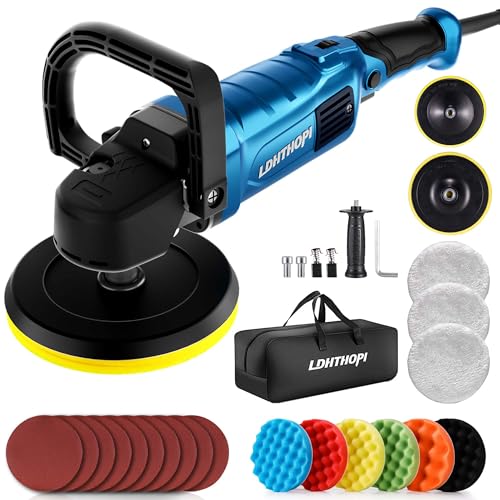
Best for versatile boat maintenance with a balance of power and control. The 1800W copper motor supports robust polishing, while 750-3100 RPM six-speed range accommodates waxing, buffing, and defect removal. It ships with seven polishing pads that cover coarse to fine work. Ideal for owners who want a single tool for multiple surfaces, including wood, metal, and fiberglass. Limitation: heavier unit may be more tiring for prolonged non-boating tasks; ensure proper handling on vertical hull sections.
Buying Guide: Key Purchase Considerations
- Motor power and duty cycle: Higher wattage generally suits larger boats and tougher finishes, but increases weight and heat. For gel coat and oxidized surfaces, aim for at least 1200-1800W, or a robust cordless setup with long battery life for on-deck use.
- Orbital vs. rotary action: Dual-action (DA) buffers are safer for beginners and reduce paint burn risk, good for beginners detailing boats. Rotary buffers offer more aggressive cutting but require careful technique.
- Speed range and control: For boats, a broad RPM range (roughly 1000-4000 or 2500-6000 for cordless) helps tailor the finish from waxing to heavy polish. Six or seven-speed options provide flexibility across coatings and conditions.
- Backing plates and pads: 5-6 inch pads cover most hull panels; 7-inch pads can be useful for larger decks. Ensure compatibility with your chosen pads and wax or compound lines.
- Corded vs. cordless: Corded machines provide consistent power for long sessions; cordless models add mobility for mast, rails, or bow areas. Consider battery life or cord length as part of your workflow.
- Ergonomics and weight: Boat detailing often involves prolonged use. Check handle options, grip comfort, and weight distribution to minimize fatigue on vertical surfaces and hard-to-reach areas.
Frequently Asked Questions
- What kind of buffer is best for a boat’s gel coat? A dual-action polisher is typically safer for gel coat as it reduces burn risk while removing swirls. For deep scratches, a rotary with controlled technique can be effective.
- How do I choose pad sizes for boat surfaces? Use 5-6 inch pads for most hull panels and 7 inch for larger decks or flat surfaces. Pad density and color help identify cut level and finishing results.
- Do I need a long power cord for boat polishing? Yes, longer cords or 12V/18V cordless options improve reach on larger boats. Plan access from shore or dock and consider extension options carefully.
- Can I use household wax with a car buffer on a boat? Yes, but ensure the product is rated for marine finishes and compatible with your buffer’s speed and pad. Avoid abrasive products that can worsen gel coat if misused.
- How should I maintain the buffer after use? Clean residue from pads, wipe the housing, and store with a dry pad. Regularly inspect brushes and cords for wear to prevent overheating and performance loss.
- Is a cordless buffer sufficient for all boat detailing tasks? For large boats or frequent heavy correction, a corded option with stable power can be more consistent. A cordless model is ideal for on-deck touch-ups and mobile work.