Find the right 12V bus bar or terminal block for marine, RV, or automotive use with durable construction and clear wiring layouts. This article highlights five top choices that balance capacity, corrosion resistance, and ease of installation. The buyer suited for each option is noted to help you compare quickly.
Summary of chosen products:
| Product | Key Capacity | Best For | Notes |
|---|---|---|---|
| RVBOATPAT Power Distribution Block 12V 150A | 150A, 48V max | Smaller 12V systems on boats or RVs | Includes positive/ground bars and copper lugs |
| WUPP 12 Volt Fuse Block (6 Circuits) | Up to 100A input, 6 circuits | Organized, neatly wired panels | LED indicators and nickel-plated copper |
| Seamaka 250A 12V Bus Bar | 250A, 48V DC | Higher current marine wiring | Brass and 304 stainless with nylon base |
| Joinfworld 12V 250A Bus Bar | 250A, 48V max | Flexible wiring with thick copper | 4 x 5/16″ studs, nylon base |
| Blue Sea Systems 2340 Battery Terminal BusBars | 100A per bus, 32V | Directly add to battery terminals | Tin-plated copper, durable screws |
RVBOATPAT Power Distribution Block 12V 150A

This 12V distribution block handles up to 150A with a maximum 48V DC rating. It uses two 12V bus bars (positive and ground) and includes 1/4″ stainless terminal screws plus a 1/4″ copper lug kit for straightforward wiring. Best for compact marine or automotive setups where space is limited and reliability matters.
- Best for: Smaller boats, RVs, or vehicles needing clean, centralized power distribution.
- Why selected: Solid 150A capacity and stainless hardware for corrosion resistance.
- Caution: The set includes standard lugs; ensure cable gauges match the 1/4″ lug terminals for a secure fit.
WUPP 12 Volt Fuse Block, 6 Circuits
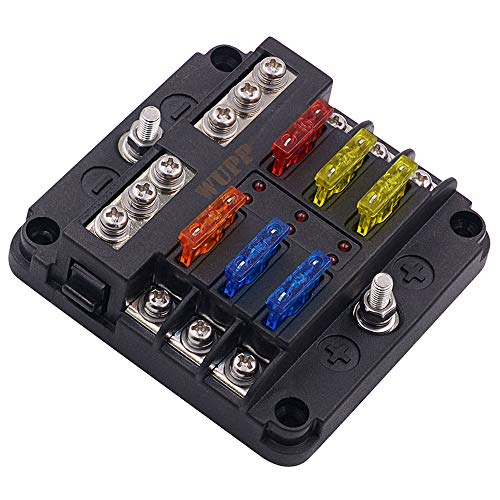
The WUPP fuse block provides six serviced circuits with LED indicators for quick fault identification. It supports up to 32V input and 100A total, with nickel-plated copper bus bars for corrosion resistance. A tidy, integrated solution reduces wiring clutter on boats or vehicles.
- Best for: Marine electronics or small boat installations needing clear fault signaling.
- Why selected: Built-in indicators simplify troubleshooting and maintenance.
- Caution: Voltage present on the circuit may persist when the fuse box is lit; plan wiring accordingly.
Seamaka 250A 12V Bus Bar with Cover

Seamaka offers a robust 250A bus bar with a 304 stainless steel screw terminal set, brass bottom plate, and a flame-retardant nylon base. It supports up to 250A and 48V DC, with strong side terminals for flexible wiring routes. A practical choice for higher-current marine or solar setups.
- Best for: High-current marine applications and solar wiring where durability matters.
- Why selected: Thick copper bus bar and corrosion-resistant materials enhance longevity.
- Caution: Installation requires proper routing to avoid exposed conductors near heat sources.
Joinfworld Power Distribution Block 250A

Joinfworld provides a 12V distribution block rated at 250A with 4 x 5/16″ (M8) studs and 3 x #8 terminals. The thicker copper bus bar supports larger cables, and a nylon bottom keeps the assembly secure and heat tolerant. Positive and negative blocks are clearly distinguished for safer connections.
- Best for: Vehicles and boats requiring heavy-duty connections and wider cable compatibility.
- Why selected: Thick copper and larger studs accommodate bigger terminal connectors.
- Caution: Ensure stud nuts are tightened properly to prevent looseness over time.
Blue Sea Systems 2340 Battery Terminal BusBars

Blue Sea’s 2340 bus bars offer easy expansion by attaching directly to threaded battery terminals, featuring tin-plated copper and #8-32 captive screws. Rated for 32V and 100A, these are compact and quick to install for adding extra positive and negative points on a battery.
- Best for: Quick upgrades to existing battery terminals without large hardware additions.
- Why selected: Direct attachment to battery posts simplifies retrofits and minimizes space use.
- Caution: Rated 100A per bus; avoid exceeding this in high-current multi-load setups.
Buying Guide: Key Considerations for Boat Battery Terminal Blocks
- Current capacity: Choose a model that matches the total expected load, with a safety margin for temperature rise.
- Voltage rating: Ensure compatibility with your system’s voltage (commonly 12V or up to 48V in marine setups).
- Corrosion resistance: Look for stainless studs, nickel plating, and nylon or nylon-based bases for boat environments.
- Number of terminals and layout: Plan how many loads you need to connect and whether you need separate positive/negative blocks.
- Ease of installation: Favor bus bars with thicker copper for higher current and robust mechanical connections.
- Safety features: Grounding provisions, safety covers, and clear polarity labeling reduce wiring errors.
- Compatibility with wire gauges: Ensure lug sizes and stud dimensions fit your cables and connectors.
- Maintenance: LED indicators (in fuse blocks) help diagnose faults quickly; consider bus bars with secure mounting options to avoid loosening.
Frequently Asked Questions
- What is a battery terminal bus bar best used for?
It centralizes connections for multiple devices, simplifying wiring and reducing clutter on boats, RVs, and vehicles.
- Can I mix positive and negative blocks?
Yes, but keep a clear separation and ensure correct polarity to avoid short circuits.
- What amperage should I choose for a marine system?
Choose a block that supports your total current with a comfortable margin for weather-related temperature increases.
- Are stainless studs necessary?
Stainless hardware resists corrosion in saltwater environments, extending the life of connections.
- Do fuse blocks require special wiring?
Fuse blocks require appropriately rated wires and secure routing to prevent accidental disconnections and ensure proper protection.
- Is it better to use a higher-current bus bar than needed?
Yes, in many cases, an over-specified bus bar reduces heat buildup and allows future expansion.