Answering your search for reliable onboard boat battery chargers, these top picks deliver steady charging, versatile modes, and marine-grade durability. This guide highlights five options that suit different needs—from small boats needing a single 5A bank to larger vessels requiring 20A or 40A total. Best for compact, space-conscious installations, mid-size boats with several battery banks, and heavy-use vessels that demand precise maintenance. The table below summarizes key specs to help you compare quickly.
| Product | |||
|---|---|---|---|
| NOCO Genius GEN5X1 | 1 | 5A | Small boats, single deep-cycle or starter battery |
| NOCO Genius GEN5X2 | 2 | 10A | Dual-battery systems, sailboats, small pontoons |
| NOCO Genius GEN5X3 | 3 | 15A | Three-bank systems, mid-size boats |
| NOCO GENPRO10X2 | 2 | 20A | Higher-demand applications, deeper banks |
| FirstPower Pro 2 Bank 5X2 | 2 | 10A | IP68-rated, rugged environments, multiple battery types |
NOCO Genius GEN5X2: 2-Bank, 10A Onboard Charger

The GEN5X2 provides two independent 5A banks for 12V batteries, with modes for lead-acid, AGM, and lithium chemistries. It is designed for harsh marine environments and includes overcharge protection plus temperature compensation. Best for boats with two battery banks that need simultaneous, balanced charging and maintenance.
Who it’s best for: boat owners with dual-battery setups, including starting and deep-cycle batteries, who want compact, reliable onboard charging. Why selected: strong power per bank across both channels, flexible battery modes, and robust marine rating. Caution: installation may require space for a two-bank unit and proper mounting hardware.
NOCO Genius GEN5X1: 1-Bank, 5A Onboard Charger
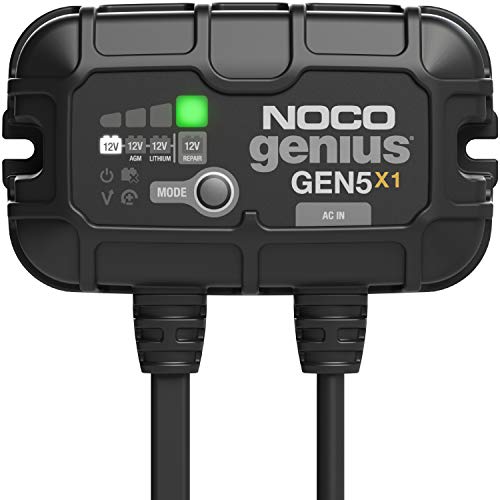
The GEN5X1 focuses on a single-bank setup with 5A of charging capability. It supports 12V lead-acid and lithium ecosystems with selectable modes and temperature compensation. Best for small boats or boats with only one critical battery that must receive consistent maintenance.
Who it’s best for: owners with a dedicated primary battery in boats where space is limited. Why selected: compact footprint and straightforward operation. Caution: limited to a single battery channel, so it won’t handle multiple banks simultaneously.
NOCO Genius GEN5X3: 3-Bank, 15A Onboard Charger
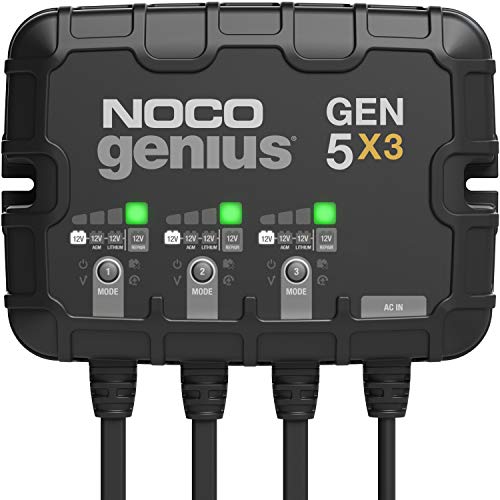
The GEN5X3 delivers three independent banks at 5A each, totaling 15A. It supports 12V lead-acid, AGM, and lithium chemistries with a dedicated repair mode. This is a solid choice for mid-sized boats with three battery positions (starter, house, and auxiliary).
Who it’s best for: boats with three battery zones needing coordinated maintenance and charging. Why selected: scalable for larger systems while maintaining compact form factor. Caution: higher bank count requires more mounting space and wiring considerations.
NOCO GENPRO10X2: 2-Bank, 20A Onboard Charger

The GENPRO10X2 supplies a total of 20A across two banks (10A per bank) with modes for 12V lead-acid and lithium batteries. It emphasizes robust performance for boats with higher energy needs and frequent, intensive charging cycles. Best for larger boats or harsh-duty usage where higher charging rates are beneficial.
Who it’s best for: vessels with significant electrical demands or multiple long-duration battery cycles. Why selected: higher total amperage per bank compared to standard GEN5X2 models. Caution: may require additional space and more complex wiring for optimum installation.
FirstPower Pro 2 Bank 5X2: 10A Onboard Charger

The 5X2 from FirstPower Pro is a two-bank, 10A system designed for 12V batteries, with IP68 waterproofing and 24/7 onboard charging capability. It covers lead-acid and lithium chemistries, including LiFePO4, and supports independent mode selection per bank. Best for rugged marine environments and boats requiring constant maintenance charging.
Who it’s best for: operators needing durable, sealed protection in active marine settings. Why selected: explicit waterproofing and dead-battery recovery features. Caution: data notes may vary on long-term reliability; ensure compatibility with your boat’s wiring and battery layout.
Buying Guide: Key Considerations For Choosing The Right Onboard Boat Charger
- Number of battery banks: Map your boat’s battery layout (starter, house, trolling, deep-cycle) to determine how many banks you need. More banks allow simultaneous maintenance and charging without switching modes.
- Total charging amperage: Higher total amps enable faster recovery for larger battery banks. Balance the charger’s output with wiring capacity, space, and onboard electrical load.
- Battery chemistry support: Ensure the charger supports lead-acid (including AGM/GEL), flooded, and lithium (LiFePO4) if you use a mixed battery system.
- Waterproofing and rugged build: Marine environments demand IP-rated housings and corrosion resistance. Consider IP68-rated units for exposed installations.
- Charging modes and flexibility: Look for selectable modes per bank (12V, AGM, Lithium, Repair/Desulfate) to accommodate different battery types and conditions.
- Installation and space: Check mounting options, wiring lengths, and available space in bilges, compartments, or near battery banks. Some units offer direct-mount solutions for easier integration.
- Maintenance features: Temperature compensation and overcharge protection help extend battery life and prevent damage in hot or cold climates.
- Future scalability: If you anticipate upgrading to more batteries, choose a charger that can scale (more banks or higher amperage) without replacing units.
FAQs
- Q: Do onboard battery chargers work with both lead-acid and lithium batteries?
A: Yes, many modern chargers support both types, but verify exact modes for each battery chemistry before installation. - Q: Can I install a 2-bank charger on a boat with 4 batteries?
A: You can if you use it in combination with other power management devices or multiple chargers; ensure proper wiring and power distribution. - Q: Is waterproofing essential for all marine installations?
A: It’s highly beneficial, especially in exposed or bilge-area placements, to resist moisture and corrosion. - Q: Should I choose more banks or higher amperage?
A: More banks improve independent charging for different battery types; higher amperage speeds up replenishment for larger systems. - Q: Do onboard chargers help extend battery life?
A: Yes, with proper maintenance modes and temperature compensation, they prevent under- and over-charging and improve longevity. - Q: Are there safety considerations during installation?
A: Yes, follow manufacturer mounting guidelines, ensure proper fuse protection, and avoid routing near heat sources or moving parts.