Looking for the ideal outboard motor for an inflatable boat? This guide highlights five reliable options, tailored to different boating needs. Whether you’re after speed, easy handling, fuel efficiency, or saltwater durability, these selections help you decide who is best for you. The top picks cover small two-stroke and four-stroke models, plus a capable electric trolling option for calm inland waters. Below, each product is evaluated for who it’s best for, plus practical trade-offs to consider before you buy.
| Product | Best For | Key Advantage |
|---|---|---|
| HinLIaDa 2-Stroke 2.3HP | Light-duty inflatables, beginners | High power for small craft; easy steering |
| CUKUSIN 4 Stroke 4 HP | Balanced performance, salt or fresh water | Durable, reliable four-stroke with good support |
| YaggeBike 4-Stroke 4HP | Versatile, portable setups | Lightweight with air cooling and simple start |
| KUSINDOG 4 Stroke 4 HP (Shade Included) | Budget-friendly, easy reverse | Shade feature adds convenience on hot days |
| COFECO 6.5 HP | Power users, faster boats | Stronger thrust with economical fuel use |
HinLIaDa 2-Stroke 2.3HP Outboard Motor
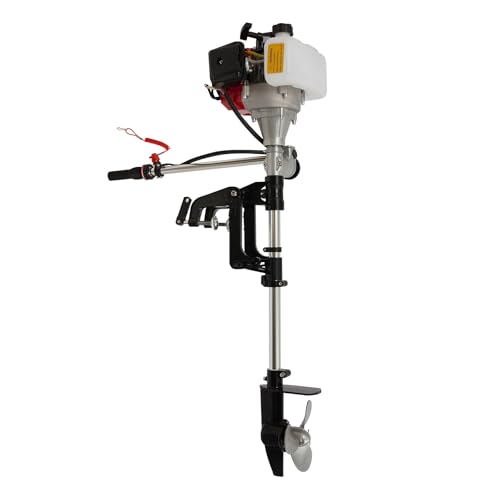
This 2.3HP, 52cc two-stroke engine is built from aluminum and PP for corrosion resistance and durability. With a stated power output of 1.7 kW and a wide 4500–8500 rpm operating range, it delivers solid thrust for small inflatable boats. The steering angle exceeds 120°, making it easier to steer tight turns or maneuver in confined waters. Best for hobbyists, light fishing, or learners who value compact size and quick response. A potential limitation is the typical two-stroke fuel mix requirement and higher fuel consumption compared with modern four-stroke designs.
CUKUSIN 4 Stroke Outboard Motor 4 HP

This is a four-stroke, 4 HP motor designed for inflatable boats, kayaks, and small dinghies. It emphasizes user-friendly operation with a twist-grip throttle and a manageable weight around 15 kg. The model includes round-the-clock online assistance and improves corrosion resistance, making it better for enthusiasts who need reliable performance in both freshwater and saltwater. Choose this for balanced power and predictable maintenance; a potential trade-off is the heavier weight compared with lighter two-stroke options.
YaggeBike 4-Stroke 4HP Outboard Motor

The 4-stroke, 4 HP engine offers solid thrust with low noise and improved fuel efficiency, ideal for fishing boats, inflatables, and small sailboats. It features air cooling for longevity and a CDI ignition system for quick starts. Best for casual boaters who want a simple, reliable engine with straightforward maintenance. A caveat is that performance will vary with water conditions and load, and the higher power requires proper handling on smaller inflatables.
Outboard 4 Stroke 4.0 HP With Shade

This 4-stroke, 4 HP motor uses air cooling and a single-cylinder layout with manual reverse. It includes shade to protect the operator on sunny days, and is designed for both freshwater and saltwater use. Best for boaters who value comfort features and easy reversing control, but the shade adds extra bulk and weight that may affect handling on very small inflatables.
YIYIBYUS 2.3HP 2 Stroke Outboard

This 2.3 HP, 52cc two-stroke motor uses a non-contact electronic ignition to simplify starting and reduce maintenance. Engine materials mirror other compact two-stroke designs: aluminum and PP for corrosion resistance. Best for budget-minded buyers who want compact power and easier cold starts. The main limitation is typical two-stroke fuel mix requirements and potentially higher fuel consumption compared with four-stroke equivalents.
Buying Guide
What should you consider when selecting an outboard motor for an inflatable boat?
- Boat size and weight: Heavier motors demand sturdier transoms and may reduce buoyancy or speed on ultra-light inflatables.
- Fuel type and efficiency: Two-stroke engines are lighter and cheaper but require fuel-oil mixing and can be less fuel-efficient. Four-stroke engines are heavier, more fuel-efficient, and often quieter.
- Power needs: For calm lakes or slow rivers, 2–4 HP is usually sufficient. For faster planing or heavier inflatables, 4–6 HP or more may be preferable.
- Maintenance and durability: Air-cooled four-strokes provide simple maintenance; water-cooled units can offer longer life under strenuous use but may need more upkeep.
- Handling and control: Longer shaft length can reduce cavitation and improve steering, while a shorter shaft can be easier to mount on small boats.
- Saltwater vs freshwater: Corrosion resistance is key in saltwater environments; many models are designed to handle both with protective coatings.
Frequently Asked Questions
- What horsepower is best for an inflatable boat?
Around 2–4 HP is typically sufficient for light inflatables and calm waters; 4–6 HP suits faster travel or heavier setups.
- Are four-stroke motors better than two-stroke for inflatables?
Four-stroke motors are generally more fuel-efficient and quieter, with easier maintenance, while two-strokes are lighter and cheaper upfront.
- Do I need a long shaft for my inflatable boat?
A longer shaft can help with deeper water and reduce propeller cavitation, especially on raised transoms; choose based on transom height.
- Can these motors operate in saltwater?
Many models claim saltwater capability; look for corrosion resistance and protective coatings, and rinse after use.
- Is electric trolling a good option for inflatables?
Electric trolling motors are ideal for quiet, shallow water fishing and precise control, but provide less thrust than gas motors for larger inflatables.
- What maintenance is required for small outboard motors?
Regularly check fuel, oil, cooling systems (for four-stroke models), air filters, and propeller condition. Store in a dry place and perform periodic inspections.