If you need reliable control over battery power on a boat or RV, a marine main power switch is essential. This guide highlights five top options, helping you pick the right switch for safety, ease of use, and durability. Each product is suitable for 12–48V systems and designed to prevent battery drain when not in use. Ideal buyers include boat owners needing quick disconnects, RV travelers seeking reliable ignition protection, and DIY installers prioritizing corrosion resistance and straightforward installation.
| Product | Best For | Key Benefit |
|---|---|---|
| Nilight 90015A | All-around marine and vehicle power management | High current ratings; sturdy ABS housing |
| Blue Sea e-Series 9001e | Compact installs and engine room safety | Ignition protected, space-saving |
| SEACHOICE Dual Switch | Two-battery setups | Parallel operation option |
| RVMARINEPAT 300A | Heavy-duty, demanding environments | High cranking protection |
| FASTSTORM 300A | All-weather reliability | IP66 waterproof and flame-retardant |
Nilight 90015A Battery Switch

Best for general marine and vehicle power isolation, this switch handles 12V DC systems with 275A continuous, 455A intermittent, and 1250A momentary ratings. It uses a heavy-duty ABS housing and a rear cover to insulate terminals from shorts. It can operate standalone or be locked with other switches. The unit helps prevent battery drain when a vehicle or boat is not in use. Choose this if you need a robust, straightforward on/off disconnect for 12V–48V systems in a tight space; avoid if you require multiple complex configurations in one unit.
Blue Sea Systems e-Series 4-Position
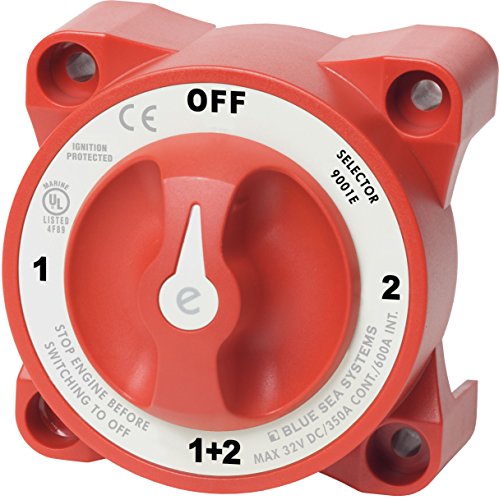
Best for compact installs with multiple mounting options, this selector is ignition protected and suitable for engine rooms in gasoline-powered boats. Its 4-position design supports safe power routing in tight spaces. It’s ideal for users who need a compact solution with flexible mounting and ignition protection; choose this if you prioritize space efficiency and engine-room safety. A limitation is that it may require careful wiring planning to fully utilize all positions.
SEACHOICE Dual Battery Select Switch

Best for boats with two or more batteries, this dual-switch unit permits selecting between batteries for starting, charging, or parallel operation. It’s UL listed, ignition protected, and CE approved, making it a solid choice for safety-conscious installations. Choose this if you need reliable battery switching between two banks; avoid if you require more than two batteries or advanced electronic control features.
RVMARINEPAT 300A Marine Switch

Best for demanding environments, this 300A switch uses tinned copper inner studs for better contact and reduced resistance. It features a flame-retardant housing and a single-circuit ON/OFF design with ignition protection rated for 900A cranking for 30 seconds. It’s ideal for heavy-duty marine or vehicle use where wiring space is available; choose this if you need high current handling and robust construction. A limitation is the mounting may require adequate space due to its larger housing.
FASTSTORM 300A Waterproof Switch

Best for all-weather reliability, this 12V–48V switch has IP66 waterproofing and flame-retardant construction. It delivers 300A continuous, with 900A cranking for 30 seconds and 500A for five minutes. It’s versatile for marine, RV, and automotive uses, making it a dependable all-terrain option. Choose this if you need a water-resistant unit with strong ignition protection; avoid if you need a compact form factor for very tight panels.
Buying Guide
What should you consider when choosing a marine main power switch?
- Voltage and current: Ensure the switch supports your system’s voltage (12–48V) and current needs (continuous and cranking ratings).
- Protection features: Look for ignition protection, waterproofing (IP rating), and flame-retardant housings to prevent shorts in harsh environments.
- Installation space: Compact designs are easier to fit in tight panels, but check mounting options (surface, rear, front).
- Electrical routing: Consider how many batteries you manage and whether you need single or multi-battery switching (two-battery vs four-position units).
- Durability: Materials like ABS housing and copper inner studs improve longevity and conductivity in marine settings.
Practical decisions:
- Choose a unit with ignition protection if you operate in engine compartments or areas with flammable vapors.
- For boats with multiple batteries, a dual or multi-position switch reduces the risk of drain and simplifies starting procedures.
- In tight spaces, prefer compact designs with flexible mounting to minimize wiring complexity.
FAQ
- What is a marine main power switch used for?
It isolates the battery or battery banks to prevent drain and to safely disconnect power for maintenance or storage.
- What does ignition protection mean?
It means the switch is designed to prevent ignition or sparking in potentially flammable environments, improving safety on boats and RVs.
- Can these switches handle 48V systems?
Many models support 12–48V, but confirm the continuous and cranking ratings for your specific application.
- Do I need a four-position switch?
If you manage more than two battery sources or require an emergency combine feature, a multi-position unit can be beneficial.
- Is waterproof rating important for marine use?
Yes, IP66 or similar ratings protect against rain, splashes, and spray in boat environments.