When selecting an automatic marine fire extinguisher, prioritize quick activation, suitability for enclosed spaces, and maintenance-free operation. This guide highlights five options that target common marine fire risks, from engine rooms to battery compartments. The best picks suit boaters who want hassle-free protection, ship crews needing simple installation, and homeowners with marine storage in mind. All choices emphasize automatic deployment, broad fire-class coverage, and reliability in compact or harsh environments.
| Product | Best For | Key Feature |
|---|---|---|
| First Alert Fire Extinguisher | Marine Fire Extinguisher, FE1A10GR | Small to mid-sized boats needing UL-rated performance | UL 1-A:10-B:C with all-metal construction |
| FEROSTICKER Small Automatic Fire Extinguisher (2 Pack) | Enclosed spaces on ships and large electric panels | Auto-activates at 170°C; no power or wiring required |
| FEROSTICKER Small Automatic Fire Extinguisher (1 Pack) | Compact spaces in vessels and equipment | Auto-activates at 170°C; stick-and-go installation |
| First Alert Fire Extinguisher | Personal Watercraft (FE5R-PWCNA) | Personal watercraft and small boats with Coast Guard relevance | UL 5-B:C rating; dry chemical for flammable liquids and electrical fires |
| Auto/Marine 10-B:C Fire Extinguisher, White (Kidde) | Refurbished option for budget-conscious buyers | Metal valve, 10-B:C rating |
First Alert Marine Fire Extinguisher FE1A10GR
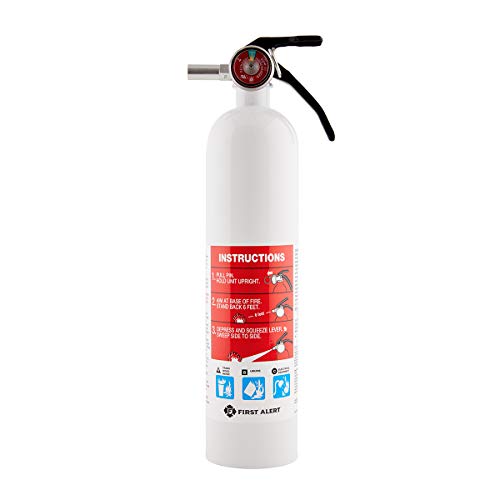
Best for medium-sized boats that require a UL-rated marine extinguisher with durable, all-metal construction. The FE1A10GR combines a commercial-grade valve and trigger with a monoammonium phosphate agent suitable for wood, paper, plastics, gasoline, oil, and electrical fires. It is rechargeable by certified professionals after use, which can suit boaters seeking long-term readiness. Caution: Recharge service is an added step after deployment.
FEROSTICKER Small Automatic Fire Extinguisher — 2 Pack
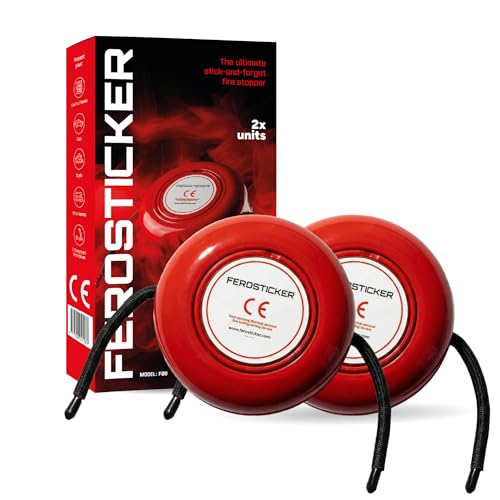
Best for ships, large electric panels, and industrial compartments where space and maintenance are concerns. Each unit auto-activates at 170°C ±10°C, releasing an aerosol to disrupt combustion. No power, pressure, or wiring is required, making it a strong choice for enclosed spaces. Caution: Installation should avoid obstructions that could impede aerosol dispersion.
FEROSTICKER Small Automatic Fire Extinguisher — 1 Pack

Best for compact spaces on ships or vehicles where a quick, automatic fire stop is needed without wiring. Activation is automatic at 170°C ±10°C, and installation requires no tools. It covers multiple fire classes (A, B, C, E, F). Caution: Suitable volume coverage is limited to small, enclosed areas.
First Alert Personal Watercraft Fire Extinguisher (FE5R-PWCNA)

Best for personal watercraft and small boats needing Coast Guard-adherent options. It meets U.S. Coast Guard Size I requirements and carries UL classifications for 5-B: C fires, using dry chemical to tackle flammable liquids and electrical fires. Caution: Not ideal for large engine compartments or high-volume kitchens; better for near-cockpit and engine bay safety.
Auto/Marine 10-B:C Fire Extinguisher, White (Kidde)

Better for refurbished-budget setups where a metal valve design and 10-B:C rating are acceptable. It targets common marine fire risks with straightforward applicability. Caution: Refurbished status may imply prior use; verify functionality and seals before deployment.
FEROSTICKER Small Automatic Fire Extinguisher – 1 Pack (F01)

Best for small confined spaces on boats, electric panels, and lithium battery storage. Activation is automatic at 170°C ±10°C, with no electricity or wiring required. Easy stick-installation makes it a practical add-on for cabins and compartments. Caution: Limited protective volume; verify space coverage for your setup.
Buying Guide
Key considerations when choosing an automatic marine fire extinguisher:
- Space and coverage: Match the unit’s protected volume to the available space. Smaller compartments need compact, auto-activated devices, while larger engine rooms may require higher-class ratings.
- Activation method: Automatic units remove the need for manual operation in emergencies but verify the activation temperature and the release method (aerosol vs. dry chemical).
- Maintenance and reusability: Some units are rechargeable or serviceable; others are maintenance-free but may require replacement after deployment or after a fixed period.
- Fire class compatibility: Ensure the extinguisher covers A (solids), B (flammable liquids), C (electrical), and any F/K class needs relevant to marine environments.
- Installation: Favor tools-free or simple stick-installation options for quick deployment, especially in tight spaces or for crew safety.
- Compliance: Marine-grade units should meet Coast Guard or UL standards where applicable to ensure acceptance on vessels.
FAQ
- Q: Do automatic extinguishers require professional recharge after use?
A: Some models are rechargeable by certified professionals, while others are designed for one-time use with replacement units after deployment. - Q: Are auto extinguishers suitable for enclosed engine rooms on small boats?
A: Yes, many models are designed for enclosed marine spaces and offer automatic activation without extending power lines or batteries. - Q: Which extinguisher class should I prioritize for a boat?
A: Look for A, B, C coverage and consider F or K classes if cooking oils or lithium battery storage is present in the space. - Q: Is a refurbished extinguisher a safe choice for marine use?
A: Refurbished units can be budget-friendly, but verify testing, packaging, and functional integrity before installation. - Q: Do these devices require maintenance once installed?
A: Maintenance-free options exist, but some units may require periodic inspection and replacement after deployment or upon expiry. - Q: Which option is easiest to install?
A: Models advertised as “stick-and-go” or those with no tools required are typically the simplest to install in tight spaces.