Looking for a reliable weather station for boating? This guide compares five top options that deliver crucial marine-ready data such as wind, rain, temperature, humidity, and barometric pressure. Each choice is evaluated for boaters who need clear, local weather insights on or near the water. Whether you’re piloting a sailboat, fishing vessel, or weekend cruiser, these stations help you plan routes, anticipate squalls, and stay safe on deck. The list highlights sensors, range, wireless options, and ease of integration with mobile devices or onboard displays.
Buying quick reference for the five selected products:
| Product | Best For | Key Strength |
|---|---|---|
| Tempest Weather Station | Extreme reliability on water and land | Hyper-local, rapid updates with wind, rain, UV, and lightning data |
| Ambient Weather WS-2902 WiFi Smart Weather Station | Smart home integration | Complete sensor array with remote access |
| Sainlogic WiFi Smart Weather Station 14-in-1 | Extensive data with AI forecasting | AI-driven forecasts, 2-year data export |
| Newentor Weather Station | Family-friendly, multi-location sensing | 3-channel system with adjustable forecast |
| AIRAIN TECH 10-in-1 Wireless Weather Station (NO WiFi) | Standalone reliability on deck | All-in-one with wind, rain, moon phase, barometer |
Tempest Weather Station With Built-in Wind Meter
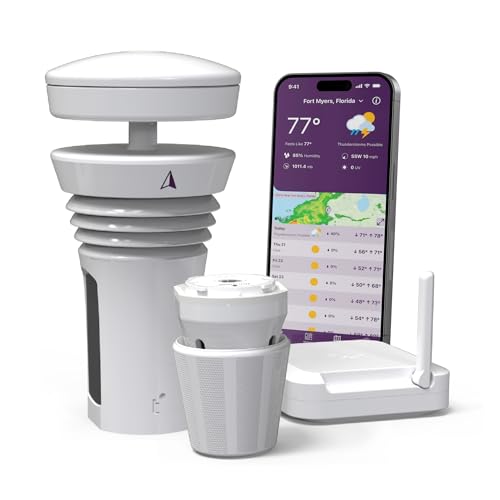
The Tempest Weather Station provides a robust, wireless outdoor sensor setup with wind speed and direction, rain gauge, barometric pressure, and a real-time forecast. Best for boaters who want precise, hyper-local data and a strong app ecosystem. The system connects via RF/wireless sensors and offers updates multiple times per minute, which is useful for approaching squalls at sea. Best for sailboats and small cruising craft that rely on timely wind and precipitation data. A potential limitation is ongoing app reliance and sensor range in obstructed marina environments.
Ambient Weather WS-2902 WiFi Smart Weather Station
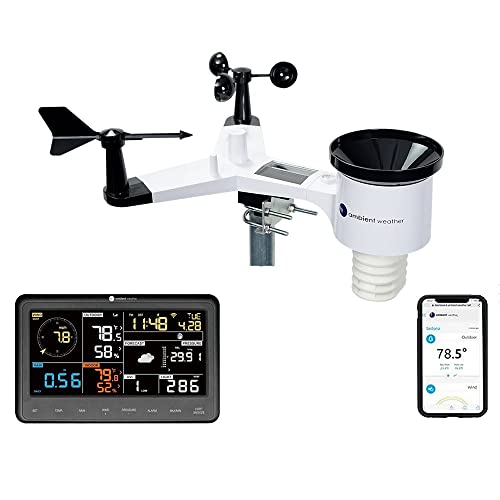
This station is a comprehensive option with a weather sensor array and an LCD display. It measures wind speed and direction, temperature, humidity, rainfall, UV, and solar radiation. Wi‑Fi connectivity enables remote monitoring and alerts, making it well-suited for boaters who want to track conditions from shore or elsewhere on the boat network. It is particularly strong for those who use smart home ecosystems (IFTTT, Alexa, Google Home). A caution: ensure stable Wi‑Fi coverage for best remote features on the water.
Sainlogic WiFi Smart Weather Station 14-in-1

The Sainlogic system offers 14-in-1 sensing and AI-driven forecasts via Weatherseed AI. It supports 2.4G WiFi and provides 24/7 forecasting, instant alerts, and 2-year data export. For boaters who want long-term trend analysis and rich data visualization, this unit delivers a strong mix of on-water accuracy and digital accessibility. The data export feature is helpful for offline planning and voyage logbooks. Limitation: requires stable WiFi and supports only 2.4G networks.
Newentor Weather Station Wireless Indoor Outdoor

Newentor combines a color 7.5″ LCD with indoor/outdoor temperature and humidity monitoring, a barometric forecast, and adjustable backlight. It supports up to three remote sensors, suitable for boats with multiple deck locations or a cabin-and-deck setup. It offers 8–24 hour weather forecast windows, providing practical, boat-specific planning data. Caution: battery life and sensor range may vary with outdoor conditions and marina obstructions.
AIRAIN TECH 10-in-1 Wireless Weather Station (No WiFi)
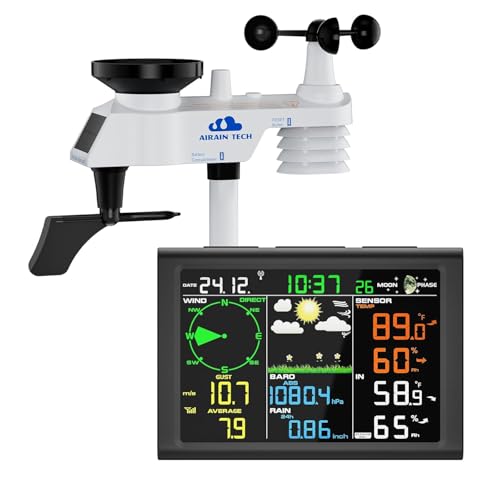
The AIRAIN TECH 10-in-1 provides a standalone weather station ideal for on-boat use without WiFi. It includes wind speed and direction, rainfall, moon phase, barometer, and indoor/outdoor temperature and humidity. It also integrates a weather forecast on a 6.5-inch color LCD. Best for boaters who want a self-contained unit with essential data when WiFi is unavailable. Limitation: no WiFi means you won’t upload live data to cloud dashboards or mobile apps.
Buying Guide: Key Considerations For Boat Weather Stations
- Sensor coverage and reliability: For boats, wind, rain, temperature, humidity, and barometric pressure are critical. Look for sensors with wide operating ranges and rugged housings suitable for marine environments.
- Power and connectivity: Decide between standalone (no WiFi) and connected (WiFi or cloud-enabled) systems. Consider solar charging for outdoor sensors and onboard power constraints.
- Display and data access: Large, readable displays are valuable on deck. Check whether you can view data locally, on a mobile app, or via a web dashboard, and how often data updates occur.
- Update frequency and range: Boating conditions change quickly. Favor units with frequent data updates (seconds to minutes) and reliable transmission between outdoor sensors and the display unit or hub.
- Forecasting capabilities: Some stations offer AI-driven forecasts and hyper-local predictions. This helps with planning routes and anticipating squalls, especially in coastal areas.
- Data storage and export: If you keep voyage logs, a system that stores data long-term and allows export to CSV or Excel is advantageous.
- Weather alerts and automation: Alerts for sudden changes in wind, precipitation, or pressure help with on-water decision making. Some systems integrate with smart home or marine automation ecosystems.
FAQ
- What is the best weather station for small boats?
Answer: A stand-alone unit with wind, rain, and barometer sensors plus a readable deck display, such as the AIRAIN TECH 10-in-1 or Tempest, is often ideal when WiFi on board is limited. - Is WiFi connectivity essential for marine weather stations?
Answer: Not always. WiFi adds remote monitoring and cloud features, but a robust off-grid unit with local display can suffice for basic needs and reliability at sea. - Can these stations alert me to approaching storms?
Answer: Yes, many offer real-time alerts for rapid weather changes, wind shifts, and rainfall, either locally on the display or via connected apps. - Do I need 2.4G or 5G WiFi for these stations?
Answer: Most consumer weather stations support 2.4G WiFi. Check compatibility with your router and marina networks; 5G is not typically required for weather data transmission. - What features matter most for boating?
Answer: Wind speed and direction, precipitation, barometric pressure, temperature, humidity, and a reliable alarm system are the core features. A bright, readable display on deck is also crucial.