Answering the common search for 1-1/8 inch thru hull fittings, this guide highlights five reliable options suited for different boat setups. These fittings fit standard 1-1/8 in hose IDs and cover straight, 90-degree, and valve-equipped designs. They’re chosen for durability in saltwater environments, ease of installation, and clear suitability for transom or through-wall mounting. Ideal buyers include DIY boat owners, marine maintenance crews, and OEMs seeking dependable, straightforward replacements or upgrades. The list below includes a quick comparison to help pick the best option for your vessel.
Summary table of selected products:
- Seachoice Extra Long Thru-Hull Fitting with Broad Flange — best for thick transoms
- SeaSense 1-1/8IN Thru-Hull Fitting — simple, versatile option
- YOQVQOY 2Pcs Thru Hull Fittings — value pack for multiple installations
- SEAFLO 1-1/8″ Thru Hull Fitting with Check Valve — built-in check valve for backflow protection
- SEAFLO 1-1/8″ 90° Angled Thru Hull — angled routing for tight spaces
Seachoice Extra Long Thru-Hull Fitting With Broad Flange

Best for boats with thick transoms, this Seachoice model is designed to accommodate up to 2-1/2 inches of thread. It’s molded from high-impact plastic to resist rust and corrosion. The broad flange aids secure mounting, reducing the risk of leaks in demanding installations. Best for durable, long-term use in harsh marine environments. Caution: ensure the threaded portion length matches your hull wall thickness to avoid over- or under-threading.
SeaSense 1-1/8IN Thru-Hull Fitting

Best for straightforward installations on standard hull spaces, SeaSense’s 1-1/8 inch thru-hull is a simple, reliable option. It’s described as a durable, easy-to-attach fitting suitable for a variety of marine drainage or venting needs. Best for owners seeking a basic, no-fruss option. Caution: product description notes may vary by region; confirm compatibility with your hose size and hull material before purchase.
YOQVQOY 2Pcs Thru Hull Fitting (1-1/8Inch)

Best value and coverage for projects needing multiple fittings, this YOQVQOY package includes two 1-1/8 inch thru-hull connectors. Suitable for multiple livewell, drain, or bilge applications. Best for budget-minded builds or replacement kits. Caution: verify that both fittings match your hose ID and hull material; some boats may require additional seals or adapters not included in the set.
SEAFLO 1-1/8″ Thru Hull With Check Valve

Best for added backflow protection, this SEAFLO model combines a 1-1/8 inch thru hull with a built-in check valve. Constructed from polypropylene and glass-filled nylon, it offers high impact resistance and a four-year warranty. Best for drainage or vent lines where backflow prevention is crucial. Caution: check valve performance can diminish with debris; ensure clean lines and proper installation.
SEAFLO 1-1/8″ 90° Angled Thru Hull With Check Valve

This angled fitting supports tight routing and space-constrained installations. It features a built-in check valve and a rugged 316 stainless-steel cap option for corrosion resistance in saltwater. Best for installations where straight routing is impractical. Caution: angled fittings require precise alignment with the hose to ensure a leak-free seal; verify clearance around the hull before drilling.
Seachoice 90-Degree Thru-Hull Connector (1-1/8 in.
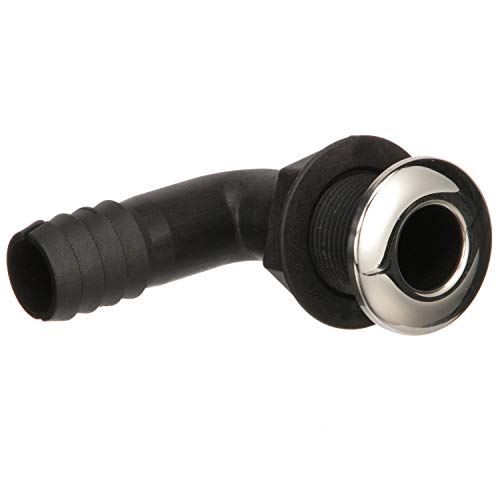
Best for easier hose routing when space is limited, this 90-degree Seachoice connector uses a polypropylene and glass fiber composition with a stainless-steel flange for resistance to corrosion. Best for tight engine rooms or cockpit spaces where straight fittings won’t fit. Caution: ensure the back-nut mounting setup matches your hull design to avoid leaks.
Buying Guide
- Material and durability: Marine environments demand corrosion resistance. Look for polypropylene, glass-filled nylon, or stainless-steel components and check for UV stabilization where sun exposure is frequent.
- Valve features: Built-in check valves prevent backflow. Consider whether a valve is required for your drainage, bilge, or livewell systems.
- Angle vs. straight: Angled fittings help with space constraints; straight fittings are simpler to install in open spaces. Choose based on hose routing and hull geometry.
- Flange and mounting: A broad or reinforced flange provides a more secure seal on thicker transoms or planked walls. Ensure compatibility with your hull thickness and mounting hardware.
- Hose compatibility: Verify the hose ID matches the fitting’s barb size and that the barb length suits your wall thickness so the clamp can secure properly.
- Warranty and warranty coverage: Some options offer multi-year warranties; this can reflect expected durability in saltwater or rough conditions.
Frequently Asked Questions
- What size is a common thru-hull fitting for 1-1/8 inch hose?
Answer: 1-1/8 inch is a standard size used for many marine drainage and vent lines; ensure the hose ID matches the fitting barb size. - Do I need a check valve on a thru-hull fitting?
Answer: A check valve is recommended for backflow protection in drainage lines and livewell systems; not all installations require one, but it adds safety against water ingress. - Is stainless steel necessary for marine thru-hull fittings?
Answer: Stainless steel (especially 316 grade) offers superior corrosion resistance in saltwater but may cost more than plastic options; choose based on exposure and budget. - Can I install a 90-degree thru-hull in a tight space?
Answer: Yes, 90-degree fittings are designed for tight routing, but ensure there is room for clamps and hoses and that the path remains free of interference. - What should I check before drilling the hull for a thru-hull fitting?
Answer: Confirm hull thickness, routing path, backing materials, and ensure you have the correct drill size and grommet or sealing ring for a watertight seal. - Are multi-pack fittings worth it for repairs?
Answer: A two-pack or multi-pack can be cost-effective for spare parts on boats with multiple lines requiring replacement or upgrades.