Looking for a high-current marine battery charger around 100 amps? This guide highlights top 100 amp-rated options and strong high-current contenders. It helps boaters who need rapid charging for large lead-acid, AGM, and LiFePO4 batteries, as well as RV and off-grid setups. Each pick targets a specific use case—professional maintenance, rapid off-grid charging, or rugged marine environments—so you can choose confidently based on your battery type and operating conditions.
| Product | Best For | Why It Stands Out |
|---|---|---|
| Victron Energy Centaur 12-Volt 100 amp 3 Bank Battery Charger | All-around marine charging with multi-bank capability | Global input range, smart temperature sensing, 3-bank versatility |
| PowerMax PMBC 100 Amp 12V Charger/Maintainer | Rugged, versatile power for RVs, boats, and off-grid uses | Thermal protection, straightforward operation, maintain/charge modes |
| Schumacher DSR Pro INC100 100A | Professional-grade marine and automotive ECU work | High constant output for ECU reprogramming and service mode |
| LiTime 80-Amp LiFePO4 Battery Charger | High-current LiFePO4 charging for off-grid and RV setups | 0V activation, 3-stage charging, robust safety features |
| SOARFLY 3 Bank Marine Battery Charger, 30A | Three-bank flexibility when 100 amps isn’t required | Independent bank modes, supports multiple chemistries, flexible charging |
Victron Energy Centaur 12-Volt 100 amp 3 Bank Battery Charger

The Victron Centaur is a high-output, multi-bank charger designed for marine use. It supports 12-volt systems with three banks and auto-ranging input (90-265VAC, 50/60Hz), enabling global installation. A built-in temperature sensor protects power components by reducing output when heat rises. It charges at bulk rate until the output falls to 70% of the rated amps and then shifts to a four-hour timer before switching to float. Best for boaters who need reliable multi-bank charging across varied electrical environments.
Who it’s best for: boaters with multiple battery strings and a need for stable, global-use charging. They value temperature-aware operation and precise bank control.
Caution: Some users may find the install and wiring more involved due to multiple banks and higher-end configuration.
LiTime 80-Amp LiFePO4 Battery Charger

The LiTime charger targets LiFePO4 battery systems with an 80-amp output, suitable for fast charging in RVs, off-grid homes, and solar storage. It includes 0V activation to wake up deeply discharged LiFePO4 cells and a 3-stage charging process with safeguards against over-temp, over-voltage, short-circuit, over-current, low-voltage, and reverse polarity. It’s a strong option when LiFePO4 batteries dominate the system and quick replenishment is key.
Who it’s best for: owners with LiFePO4 packs seeking rapid charging and robust protection features.
Caution: Performance optimization relies on compatible BMS and proper wiring; confirm battery compatibility before use.
PowerMax PMBC 100 Amp 12V Charger
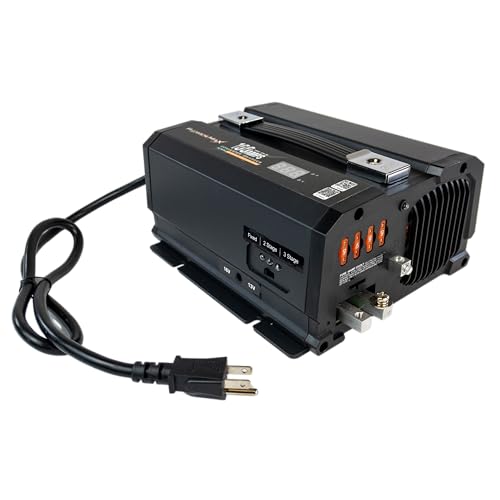
The PowerMax PMBC offers 100 amps of charging power with a straightforward setup that suits RVs, boats, and off-grid applications. It includes automatic thermal protection that reduces output to safe levels if the unit overheats, helping prevent damage during extended use. It can also function as a maintainer, supporting auxiliary loads when needed. Best for users who want a rugged, easily programmable high-current charger.
Who it’s best for: users needing robust 100A charging with simple controls and thermal protections.
Caution: The unit should not stay connected to a battery indefinitely without supervision due to heat considerations.
Schumacher DSR Pro INC100 100A
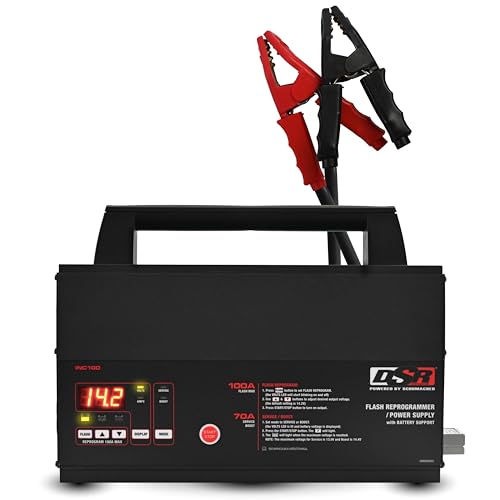
The Schumacher INC100 is positioned as a professional-grade charger with a 70-100A range, and a maximum service mode around 13.5-14.4V for boost charging or reprogramming tasks. It’s designed for heavy-duty use in marine and automotive service contexts, providing constant power for ECU work during reprogramming. This makes it a strong pick for professionals or serious hobbyists who require steady, high-output performance during critical charging sessions.
Who it’s best for: technicians or boat owners performing ECU reprogramming and high-demand charging tasks.
Caution: For everyday cruising or maintenance charging, lighter-duty options may be more cost-effective.
SOARFLY 3 Bank Marine Battery Charger, 30A

The SOARFLY three-bank charger delivers 30 amps total (10A per bank) and supports 12V lead-acid and lithium types, including AGM and LiFePO4. Each bank operates independently with selectable modes for 12V SLA/AGM, 12V Lithium, and 12V Calcium. It also includes a Force Mode to attempt revival of dead batteries. This unit suits boaters who need flexible three-bank charging without committing to 100A across the board.
Who it’s best for: boat owners who want multi-bank charging with independent control and broad battery compatibility.
Caution: Lower total amperage means slower recovery for large banks; suitable when 100A isn’t necessary.
Buying Guide: Key Considerations for High-Current Marine Chargers
- Battery chemistry – Confirm compatibility with lead-acid, AGM, gel, or LiFePO4 batteries. LiFePO4 systems often benefit from chargers with 0V wake-up and precise CC/CV stages.
- Bank configuration – Decide between single-family high-current units and multi-bank chargers. Multi-bank models simplify managing several batteries on boats and RVs.
- Input range and location – Global-use models support 90-265VAC, simplifying installation aboard international vessels and varying marinas.
- Thermal management – Look for automatic temperature sensing and protection to prevent overheating during long charging sessions.
- Charging stages – A 3-stage (pre-charge, CC, CV) strategy improves efficiency and extends battery life, especially for LiFePO4 and AGM.
- Float/maintenance mode – Essential for steady readiness when a vessel remains idle for long periods to avoid deep discharge.
- Mounting and wiring – Ensure compatible mounting brackets and appropriate cable sizing to handle 100A or more without voltage drop.
- Safety and standards – Check for built-in protections (over-voltage, reverse polarity, short circuit) and compliance markers when applicable.
Frequently Asked Questions
- What is the benefit of a 100A marine charger versus a lower-current model?
Higher amperage charges batteries faster, reducing down time for boats with large banks or deep-cycle packs. However, ensure wiring, fuses, and battery capacity can safely handle the current. - Can I use a 100A charger with LiFePO4 batteries?
Yes, if the charger supports LiFePO4 charging profiles and proper BMS coordination to prevent overcharging. - Should I prefer a single 100A unit or multiple banks totaling 100A?
Multiple banks offer better battery isolation and independent charging; a single high-current unit may be simpler for a smaller system with one bank. Choose based on battery layout and service needs. - What maintenance features should I look for?
Automatic temperature sensing, float mode, and a robust thermal protection system help keep batteries healthy in marine environments. - Is a 3-bank charger always better than a 2-bank one?
Three banks provide more flexibility for multi-battery setups, but cost and space may favor two banks if you only need to maintain two large batteries. - Do these chargers require professional installation?
installation complexity varies. Global-input models and multi-bank configurations often benefit from professional routing of power cables and proper fusing.