For boaters and mobile power users, a reliable 12V marine battery monitor keeps an eye on voltage, capacity, and health. The right monitor helps prevent unexpected outages, extends battery life, and simplifies multi-battery setups on boats, RVs, and marine equipment. The top models below are suited for boaters, RV owners, and off-grid enthusiasts who want clear, actionable readings.
Summary table of selected products:
| Product | Brand | Best For | Key Benefit |
|---|---|---|---|
| IPX7 Waterproof Battery Monitor | SUPNOVA | Single-battery marine or 12V systems | IPX7 waterproof shell with broad voltage range |
| DROK Waterproof Monitor (8-100V) | DROK | Multiple voltages, rugged outdoor use | Big LCD, reverse polarity protection, low power |
| ANCEL BM300 Pro | ANCEL | Complex setups with multiple batteries | Auto-detects voltages, Bluetooth, 4-battery monitoring |
| DROK Blue-Backlit Monitor | DROK | Dark cabins or night operation | Blue backlight, same broad voltage support |
| BINTA Monitor with Shunt | BINTA | Multiple battery banks, solar setups | Real-time SOC, up to 999Ah remaining, 8-120V |
IPX7 Waterproof Battery Monitor with Bracket

Best for: Boat owners and RV users who need a rugged, single-system monitor. This unit supports 7-100V systems, including 12V and 24V configurations, and provides remaining capacity readings with a buzzer alarm and temperature input. It’s ideal when you want straightforward capacity awareness without extra bells and whistles.
Why chosen: It combines a fully enclosed shell with IPX7 waterproofing and input reverse-connection protection. This makes it suitable for exposed locations on deck or in engine bays. The large range covers lead-acid and many lithium chemistries, offering a broad compatibility profile.
Caution: Confirm compatibility with your battery chemistry and ensure you mount in a location with adequate airflow to avoid trapped heat around the display.
DROK Waterproof Monitor 12V-100V

Best for: Users needing a flexible 8-100V battery monitor for mixed-fleet vessels or off-grid setups. It displays voltage, capacity, and remaining percentage on an upgraded large screen.
Why chosen: It includes reverse polarity protection, automatic power-saving on outages, and a low power alarm. The broad voltage range accommodates 12V, 24V, 36V, 48V, and 72V systems, simplifying monitoring across different boats and trailers.
Caution: While feature-rich, ensure the monitor’s mounting area has protection against direct spray or splashes if used in very damp locations.
ANCEL BM300 Pro Battery Monitor
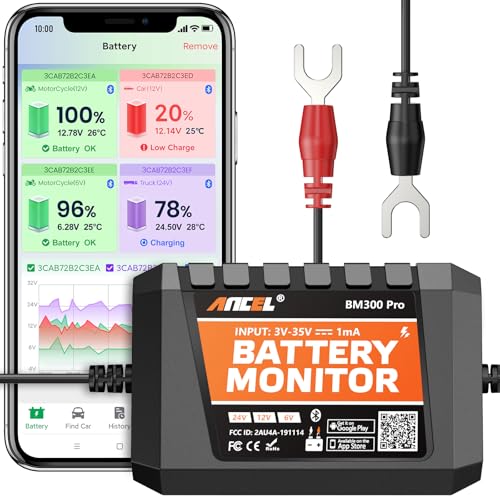
Best for: Enthusiasts with diverse vehicle needs and evolving power systems, including RVs, boats, and large trailers. It auto-detects 6V, 12V, and 24V systems and supports most common battery chemistries, including lead-acid and lithium.
Why chosen: It can monitor up to four batteries simultaneously and delivers instant alerts for voltage drops and charging issues. Bluetooth 5.3 provides extended-range connectivity for remote monitoring, which is helpful for installations away from the driver’s reach.
Caution: The BM300 Pro’s advanced features are most beneficial if you actively use the app for alerts; basic screens still work without Bluetooth.
DROK Waterproof Battery Monitor with Blue Backlight

Best for: Users who operate in low-light or night-time environments inside boats, RVs, or garages. This model mirrors the wide voltage support of 8-100V with a blue-backlit display for easy reading in dark spaces.
Why chosen: The display is easy to read at a glance, and the unit continues to offer reverse polarity protection and low-power features. It suits crews who want visibility without sacrificing accuracy.
Caution: As with other compact meters, avoid blocking the display with dashboard accessories or glove compartments where glare or reflections could hinder readability.
BINTA Battery Monitor With Shunt

Best for: Users managing multiple battery banks or solar charging setups in RVs, boats, or power rigs. It provides real-time state of charge, remaining capacity (up to 999Ah), voltage, and current, across 8-120V systems.
Why chosen: The shunt-based monitor delivers a holistic view of power flow, ideal for systems with solar panels or dual-battery configurations. It also features a backlit display and two-way current detection with auto-sleep to save energy.
Caution: A shunt installation is more complex; ensure proper wiring and secure mounting to avoid loose connections under vibration or movement.
Buying Guide: Key Considerations for a 12V Marine Battery Monitor
- System voltage and battery chemistry: Confirm whether you need 7-100V coverage or a narrower 12V-24V range, and whether lead-acid, AGM, gel, or LiFePO4 batteries are supported.
- Monitoring scope: Do you want single-battery monitoring or multi-battery monitoring with alerts and data logging? Bluetooth or app-based alerts can be valuable for remote monitoring.
- Display and visibility: Consider backlighting, display size, and viewing angle for low-light or bright outdoor conditions on a boat or RV dashboard.
- Protection and durability: IP ratings (IPX7 or higher) indicate water resistance. Reverse polarity protection helps prevent wiring errors from damaging the monitor.
- Power consumption and sleep mode: Low power consumption preserves battery life when the monitor is idle. Auto-sleep can be beneficial for remote boats.
- Installation complexity: Some units with shunts or multiple channels require more complex wiring. Balance the need for accuracy with installation effort.
Frequently Asked Questions
- What voltage range do I need for a marine battery monitor?
Look for a model supporting at least 12V systems, with broad range options such as 8-100V to cover common marine and RV configurations.
- Is Bluetooth monitoring important for marine use?
Bluetooth (or app-based monitoring) is helpful for remote checks, but not essential if you only need onboard readings. Choose based on your maintenance routine.
- Do I need a shunt-based monitor?
Shunt-based monitors provide precise state of charge and current flow, which is valuable for multi-battery or solar setups. For simple single-battery needs, a basic monitor can suffice.
- Can these monitors work with lithium batteries?
Yes, many models support LiFePO4 and other lithium chemistries. Verify compatibility with your specific lithium chemistry before installation.
- What is the advantage of IP-rated waterproof monitors?
Waterproof enclosures protect electronics in harsh marine environments, reducing corrosion and failure risks from splashes or spray.
- How hard is installation for dual-battery setups?
Dual or multi-battery installations are more complex. Look for models designed to monitor multiple banks simultaneously and provide clear wiring diagrams.