Finding the right 2 inch bilge blower means balancing airflow, noise, build quality, and where you’ll use it—engine bays, heads, bilges, or small grow tents. The following five options are selected for compact size, 12V operation, and suitability across marine, automotive, and small-ventilation tasks. Each choice targets a different buyer need, from ultra-quiet operation to higher airflow in tight spaces. Read on to compare features, best fits, and limitations before buying.
Buyer summary table:
| Product | Best For | Key Benefit | Notable Limitation |
|---|---|---|---|
| 2 Inch Inline Duct Fan (Generic) | Small offices, bathrooms, hydroponics | Low power, compact | Basic features |
| SEAFLO 3″ In-Line Marine Bilge | Boat bilges and galleys | High airflow for 12V marine use | 3″ inlet; larger than 2″ in some spaces |
| 2″ 50Mm In-line Duct Fan (MODBE) | Grow tents, greenhouses | Lightweight, good copper motor | Smaller form factor may limit airflow |
| Attwood 1733-4 Blower Bilge 3″ | Engine compartments | Patented inline design, 5-blade high lift | 3″ size, not 2″ |
| SEAFLO 4” In-Line Marine Bilge | High airflow needs on boats | Strong 4″ airflow with quiet operation | 4″ size is larger than 2″ |
2 Inch Inline Duct Fan, 12V DC Bathroom Exhaust Fan

Best for compact spaces where low power consumption is crucial. The 2 inch inline duct fan operates at 6W with a noise level around 38 dB and delivers about 22 CFM (36 m3/h). Its lightweight ABS housing is corrosion and heat resistant, making it suitable for small bathrooms, hydroponic setups, and office stalls. The compact 50 mm takeover caliber helps it fit tight ducting. Choose this for discreet ventilation in tight spots or where electricity supply is limited.
small bathroom remodelers, hobbyist hydroponics operators, and compact offices.
Why selected: minimal footprint, low power, and decent airflow for 2″ ducts.
Caution: airflow is modest; not ideal for high-demand spaces or long duct runs.
SEAFLO 3″ In-Line Marine Bilge Air Blower

Best for marine applications where higher airflow is needed from a 3″ intake. This blower provides up to 130 CFM while drawing about 2.5A, making it efficient yet powerful for bilges, heads, and galleys. It carries ISO 8846, CE, and RoHS certifications and is backed by a four-year warranty. The integrated feet mounting helps secure it in place. Choose this if you require reliable airflow in a compact boat space without sacrificing energy efficiency.
Who it’s best for: boat owners needing robust bilge ventilation.
Why selected: strong airflow for a 12V marine environment with long-term support.
Caution: larger than a 2″ duct may not fit every confined space.
2″ 50Mm In-line Duct Fan (MODBE)
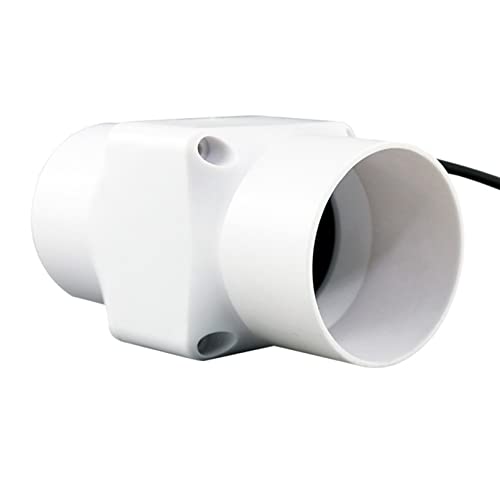
Best for greenhouse vents, grow tents, and small basements where a 2″ duct is required but airflow needs are moderate. The MODBE unit lists 36 m³/h (22 CFM) with a 38 dB noise level and a 14700 rpm pure copper motor. The lightweight ABS shell is non-toxic and corrosion resistant. This is a practical option when you need a compact blower that offers better motor efficiency and stable operation in warm environments.
Who it’s best for: urban growers and compact ventilation projects.
Why selected: balance of airflow, low noise, and reliable motor.
Caution: airflow may be less for larger enclosures or longer ducts.
Attwood 1733-4 Blower Bilge 3″ White

Best for engine compartments and bilge spaces where a higher lift is needed. The Attwood 1733-4 uses a patented inline design and a 5-blade fan to maximize airflow and efficiency. The blade sweep and pitch are engineered for high lift, delivering increased airflow velocity for improved ventilation. It is a 3″ model, so consider space constraints. This blower suits environments requiring steady ventilation with a compact form factor for marine installations.
Who it’s best for: boat operators needing reliable airflow in engine bays.
Why selected: efficient 5-blade design for higher lift in tight areas.
Caution: not a 2″ option, so fitment may be limited in very small ducts.
SEAFLO 4” In-Line Marine Bilge Blower

Best for high airflow needs in larger bilge spaces or engine rooms where a 4″ duct is feasible. The SEAFLO 4” blower delivers up to 270 CFM and draws about 6A. It is ISO 8846, CE, and RoHS certified and backed by a four-year warranty. It remains ultra-quiet for its class, with noise under 45 dB. This option suits larger yachts or installations where substantial ventilation is required without excessive noise for the size.
Who it’s best for: larger boats or spaces needing high-volume airflow.
Why selected: best-in-class airflow for a 4″ system with solid warranty.
Caution: larger footprint and ducting; review space before selecting.
Buying Guide
What to consider when choosing a 2 inch bilge blower:
- Airflow needs: measure the space and required air changes per hour. Higher CFM is better for larger bilges; smaller spaces can suffice with 22–36 CFM.
- Power and electrical load: 12V DC is standard. Check amperage to avoid overloading circuits on boats or garages.
- Duct size: ensure the 2″ or 3″ intake/duct matches your ducting. In tight spots, a 2″ unit may be essential.
- Noise profile: for overnight spaces or cabins, prefer under 40 dB; for mechanical rooms, higher noise tolerance may apply.
- Materials and durability: look for ABS plastic housings and corrosion resistance for marine or humid environments.
- Warranty and support: a 3–4 year warranty provides more long-term assurance for frequent use.
- Installation orientation: some units offer vertical or horizontal mounting; verify mounting feet or brackets fit your layout.
FAQ
- What is a suitable airflow rating for a small bilge?
Answer: Typically 20–40 CFM is adequate for compact bilges, engines spaces, or closets; choose higher if the space is larger or has multiple vents. - Do 2″ blowers work in grow tents?
Answer: Yes, for small tents and light airflow, but ensure duct length and obstacles don’t significantly reduce performance. - Can these blowers run continuously?
Answer: Many are designed for continuous operation within electrical and thermal limits; check motor specs and ambient temperature. - Is a 3″ unit ever better than a 2″ unit?
Answer: Yes, when space allows, a 3″ unit can move more air with similar power, which is useful for larger spaces or faster ventilation. - Are there maintenance needs?
Answer: Regular cleaning of dust buildup is recommended; inspect wiring and seals for wear, especially in marine conditions.