Answer: This guide reviews the top 2-part boat foams designed for non-structural flotation, insulation, and void filling. It highlights foams with closed-cell formulas, fast cure times, and compatibility with marine resins. Best for boat builders, DIY boat repairs, and dock projects requiring reliable buoyancy.
The top picks cover a range of densities and kit sizes to fit different needs. Use the buyer table to compare density, kit size, and primary use. Each product is best for specific scenarios, from lightweight flotation to rigid structural reinforcement or artistic casting.
| Product | Density | Kit Size | Best For |
|---|---|---|---|
| TotalBoat 2 Lb Density Expanding Foam Kit | 2 lb | 2 Gallon Kit | Lightweight flotation and multi-layer void filling |
| Fiberglass Supply Depot 2 Lb Density Expanding Pour Foam | 2 lb | 1 Gallon Kit | Nonstructural buoyancy and insulation in tight cavities |
| Fiberglass Supply Depot 6 Lb Density Expanding Pour Foam | 6 lb | 1 Gallon Kit | Higher rigidity and stronger flotation for larger gaps |
| TotalBoat 6 Lb Density Expanding Foam Kit | 6 lb | 2 Gallon Kit | Rigid casting, carving, and substantial flotation |
| Fiberglass Supply Depot 2 Lb Density Expanding Pour Foam (2 Gallon Kit) | 2 lb | 2 Gallon Kit | Low-profile void filling and buoyancy across larger areas |
TotalBoat 2 Lb Density Expanding Foam Kit

Product highlights: A lightweight, 1:1 mix, closed-cell foam that expands for buoyancy, insulation, and void filling. Cure time is about 5 minutes at 70-80°F. Best for nonstructural flotation and filler work on boats. 94% closed-cell structure resists water absorption and solvent damage. After cure, it can be coated with common resins and easily carved or cut to fit irregular spaces.
Who it’s best for: Small boat projects, under-deck fills, and hobbyists seeking quick, easy pours. Choose this if you need a balance of buoyancy and workability in tight spots. Caution: not intended for structural reinforcement; ensure proper ventilation during mixing.
Fiberglass Supply Depot 4 Lb. Density Expanding Pour Foam

Product highlights: 4 lb density, 1 gallon kit; designed for flotation, soundproofing, and void filling. Produces bulkier foam that can be laminated over with resins without melting. Mixed in equal parts, it expands to fill cavities and provide buoyancy. Best for larger pockets where more rigidity is desired.
Who it’s best for: Projects needing stronger buoyancy and a firmer end-result. Better for larger voids or when the foam will be left largely untrimmed. Limitation: higher density reduces expandability in tight spaces.
Fiberglass Supply Depot 6 Lb Density Expanding Foam

Product highlights: 6 lb density, 1 gallon kit; extremely rigid foam suitable for casting, carving, and substantial flotation supports. It cures into a hard, dense structure compatible with epoxy, polyester, or vinyl ester resins. Fast-setting and highly compressive strength make this a strong choice for decorative or structural-looking flotation applications.
Who it’s best for: Projects requiring durable, rigid foam to form castings or structural-looking flotation. Choose this if you need high-density foam that can take shaping and final finishing. Caution: stiffness can complicate trimming in very tight spaces.
TotalBoat 6 Lb Density Expanding Foam Kit
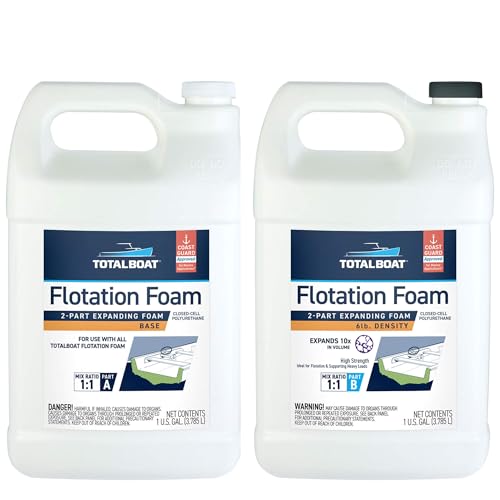
Product highlights: A marine-grade, two-part foam that cures hard and rigid with high compressive strength. Its 6 pounds per cubic foot density supports heavy flotation, architectural casting, and art applications. Cures to 94% closed-cell foam, resisting water, gas, and oil penetration. Compatible with common resins and paintable after curing.
Who it’s best for: Use when you need significant buoyancy and a strong, carvers-friendly material. Choose this for larger flotations, decorative blocks, or structural-like fills. Limitation: higher density may reduce expansion capacity in narrower spaces.
Fiberglass Supply Depot 2 Lb Density Expanding Pour Foam (2 Gallon Kit)

Product highlights: 2 lb density foam designed for boat and dock flotation with 2 gallon kit size. Provides buoyancy, soundproofing, and insulation in voids or under decks. Suitable for nonstructural applications and easy to laminate with resins after curing. Produces about 10 cubic feet per gallon kit.
Who it’s best for: Medium-scale applications needing good buoyancy with manageable expansion. Choose this for larger voids where a balance of float and workability is desired. Caution: ensure adequate ventilation during mixing and curing.
Buying Guide
What density should you choose? Lower densities like 2 lb are easier to pour and carve, ideal for lighter flotation and filling tight spaces. Higher densities (6 lb) provide rigidity and stronger buoyancy for larger voids and decorative casting. Consider kit size: 1 gallon vs 2 gallon kits affect total buoyancy and project scope.
Is it marine-grade? Look for foam labeled as “marine grade” or suitable for boat flotation, with a closed-cell structure to resist water absorption. Can it be laminated with resins? Most marine foams accept epoxy, polyester, or vinyl ester resins for added protection or shaping.
Drying and curing: curing times vary with temperature and humidity. Warmer environments speed up cure; cool or damp conditions slow it. Plan multiple pours when building up layers under decks or in large voids.
Safety and handling: wear gloves, eye protection, and work in a well-ventilated area. Follow the manufacturer’s mix ratio precisely (typically 1:1), and mix only as much as you can pour before it begins to gel.
FAQ
- Q: Can I use these foams for structural repairs? A: These are intended for nonstructural flotation, insulation, and void filling. For structural repairs, consult a marine engineer or use purpose-built structural foams.
- Q: Will cured foam bond with resin coatings? A: Yes, most 2-part marine foams are compatible with polyester, epoxy, or vinyl ester resins.
- Q: How much buoyancy does a kit provide? A: Buoyancy depends on density and volume; check the product’s published cubic-foot output per kit.
- Q: Are there hazards during mixing? A: Handle in a ventilated area; avoid skin contact, and follow the safety data sheet provided by the manufacturer.
- Q: Can I carve or cut cured foam? A: Yes, especially lower-density foams, which can be trimmed or shaped after curing.
- Q: How long does curing take? A: Typical cure is minutes to a few hours depending on temperature and humidity; follow product instructions for best results.