If you’re searching for budget-friendly, reliable propulsion for small to mid-sized boats, a used or refurbished outboard motor can be a smart choice. This guide highlights five solid options suited for different boat types and cruising needs. Whether you’re into casual coastal cruising, fishing from a dinghy, or day trips on a small inflatable, these motors offer practical power, durability, and easy maintenance. Below, you’ll find a quick buyer’s table and detailed product sections to help you compare at a glance.
| Product | Why It Stands Out | Best For |
|---|---|---|
| 4 Stroke 7.5HP Outboard | Strong power with air cooling and smooth shifting | Small to mid-size boats needing steady, reliable power |
| NAZEAOB 18HP 2-Stroke | High power with long shaft and robust construction | Faster cruising and heavier loads on larger dinghies |
| YIYIBYUS 2.3HP 2-Stroke | Lightweight, efficient for tiny to medium inflatables | Backup or auxiliary motor for small boats |
| RYIRSHOH 18HP 2-Stroke | Three-gear control with reliable fuel efficiency | Versatile cruising on small to mid-sized boats |
| DUIBAII 18HP HangKai | Strong speed with large fuel capacity and efficient carburetor | Long-range trips on boats that can carry extra fuel |
4 Stroke 7.5HP Outboard Motor 200CC
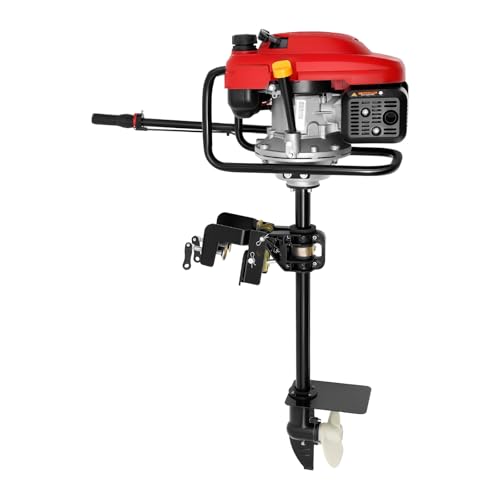
Best for budget-minded boaters seeking a balance of power and ease of maintenance. This unit delivers a maximum power around 3.5 kW at 3600 rpm, making it suitable for 13–19.69 ft boats. The design emphasizes heat dissipation and air cooling, helping reduce failures during extended runs. The CVT-like shift provides smoother gear transitions for smoother handling on small craft. Best for casual weekday and weekend cruising, or as a dependable auxiliary engine.
- Best for small to mid-sized boats that require steady, predictable power.
- Better for users prioritizing heat management and simple maintenance.
- Avoid if you need very high-end performance from a larger craft or require modern digital ignition features.
Best for: casual cruisers and anglers who want a straightforward, durable 4-stroke option.
NAZEAOB 2 Stroke 18HP Outboard

Selected for power and durability in heavier-use setups. This 18HP two-stroke engine offers a robust 4,500–5,500 RPM range, long shaft design, and a corrosion-resistant aluminium alloy build. It’s well-suited for faster cruising and carrying heavier gear on larger dinghies or inflatable boats. It provides strong propulsion while maintaining reliability in saltwater or freshwater use. A caution: heavier motors can strain smaller transoms and affect maneuverability at slow speeds.
- Best for faster cruising with heavier loads on mid-sized boats.
- Better for users who want a robust, rugged motor with good heat and corrosion resistance.
- Avoid if you need a compact, ultra-lightweight option for very small craft.
Best for: boaters needing high power on medium-draft vessels and longer trips between refuels.
YIYIBYUS 2.3HP 2-Stroke

Best as a lightweight option for tiny boats or as a reliable auxiliary engine. This 1.7 kW/2.3HP motor, with a 52cc displacement and 70 cm shaft, delivers adequate thrust for small fishing boats, dinghies, or inflatable craft. It’s made from corrosion-resistant aluminum and PP materials, striking a balance between durability and portability. A note: this motor is best for modest propulsion needs rather than frequent high-speed cruising.
- Best for ultra-lightweight setups and emergency backups.
- Better for very small boats needing a compact engine with efficient performance.
- Avoid for larger vessels requiring substantial pulling power.
Best for: owners of inflatables and tiny boats seeking a nimble, easy-to-maneuver auxiliary motor.
RYIRSHOH 18HP 2-Stroke
Best for versatile cruising on small to mid-sized boats with a focus on forward/neutral/reverse control. This 18HP motor operates at 4,500–5,500 RPM and uses a three-gear setup to optimize maneuvering in varying water conditions. The aluminum alloy construction offers corrosion resistance, and a water-cooling system supports reliable operation. Limitations include the inherent higher maintenance needs typical of two-stroke designs and potential fuel consumption compared to modern four-stroke options.
- Best for versatile control and efficient cruising in mixed water conditions.
- Better for users who value precise throttle response and gear selection.
- Avoid if you prefer a quiet, low-maintenance four-stroke motor.
Best for: boaters who want flexible propulsion with straightforward, reliable three-gear control.
DUIBAII 18HP HangKai

Best for longer runs on vessels capable of carrying extra fuel and desiring strong top-end speed. The 18HP 2-stroke HangKai motor offers up to 5500 RPM and a large 6.34-gallon external fuel tank. Its lightweight aluminum alloy construction and efficient carburetor design help balance power and fuel economy. A potential drawback is higher exhaust and noise typical of two-stroke engines, especially at higher RPMs.
- Best for long-range use where fuel capacity and speed are priorities.
- Better for boats with adequate transoms and storage for the fuel tank.
- Avoid if you require a quieter operation or reduced emissions.
Best for: cruisers focused on speed and endurance with a practical fuel plan for day trips.
Buying Guide: Quick, Practical Considerations For Secondhand Outboard Engines
- What size motor do I need? Consider your boat length, weight, and typical load. Smaller boats benefit from 2- to 6 HP motors, while mid-sized craft may handle 8–20 HP more comfortably for cruising.
- Two-stroke vs four-stroke. Two-stroke motors often provide higher power-to-weight and simpler maintenance, but may require more frequent fuel/oil mixing and can be louder. Four-stroke options run cleaner and are typically more fuel-efficient but can be heavier.
- Condition and service history. Look for a clear maintenance history, check compression if possible, and confirm cooling system integrity. Air-cooled designs reduce cooling system complexity, but ensure heat dissipation is adequate for your usage pattern.
- Fuel system and carburetion. Ensure fuel lines, carburetors, and tanks are in good condition. A worn carburetor or clogged fuel lines can cause starting and idle issues.
- Control and mounting compatibility. Verify shaft length matches transom height, and check that throttle and shift controls are functional. Short shafts suit smaller dinghies; long shafts fit larger boats.
- Reliability and availability of parts. Consider brands with readily available replacement parts and support, particularly for older or less common models.
- Noise, emissions, and environmental considerations. If you boat in noise-sensitive areas or need low emissions, prioritize four-stroke models or well-maintained two-stroke options with clean operation.
FAQ
What is a good budget for a secondhand outboard engine?
A practical budget depends on power needs, boat size, and condition. Focus on engines within your size range that show a clear maintenance history and reasonable compression readings if testable.
How do I ensure a used outboard is reliable?
Ask for service records, confirm cooling system function, inspect the propeller and cavitation plate, and verify fuel system integrity. If possible, perform a test run to listen for unusual noises and observe smooth shifting.
Which engine type lasts longer—two-stroke or four-stroke?
Four-stroke engines typically offer longer service life with steadier fuel usage. Two-stroke engines are lighter and can provide more power per weight, but may require more maintenance.
What should I check about shaft length?
Ensure the shaft length matches your boat’s transom height. A mismatch can reduce efficiency and cause cavitation or steering issues.
Are maintenance costs higher for older engines?
Older engines may require more frequent servicing or parts replacement. Regular maintenance, proper storage, and choosing models with widely available parts help control costs.