Answer: These three-bank onboard boat battery chargers are designed to independently manage multiple 12V batteries on a single vessel, keeping lead-acid, AGM, and lithium packs charged and maintained. They’re best for boat owners who need simultaneous, reliable charging for multiple batteries, such as deep-cycle, starting, and auxiliary packs. The top picks below are selected for different use cases, from compact efficiency to higher current capability and rugged marine build.
Summary of selected products:
| Product | Bank Count | Total Amps | ||
|---|---|---|---|---|
| NOCO Genius GEN5X3 | 3 | 15A | Compact, versatile boats | Per-bank 5A with temperature compensation |
| SOARFLY 3 Bank Marine Charger | 3 | 30A | Flexible modes for SLA/AGM/Lithium | Independent banks with 3 intelligent modes |
| FirstPower Pro Upgraded 3 Bank 10X3 | 3 | 30A | IP68 seawater-proof, 24/7 charging | Independent mode selection per bank |
| ProMariner 44021 ProSport HD | 3 | 20A | Reliable, heavy-duty charging | Microprocessor-based with distributed on-demand |
| Minn Kota MK 315D Digital 3 Bank | 3 | 15A | Accurate charging in variable conditions | Automatic temperature compensation and LED status |
NOCO Genius GEN5X3: 3-Bank, 15A Onboard Battery Charger
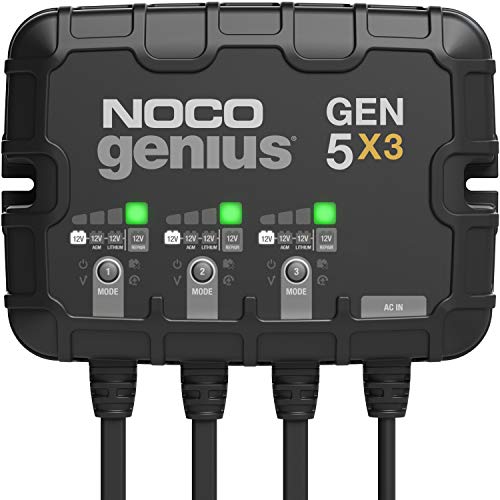
- 3-bank, 15A total (5A per bank) ideal for mid-size boats with multiple 12V batteries.
- Selectable modes per bank: 12V, 12V AGM, 12V Lithium, Repair Mode.
- Compact design—smaller and more powerful than prior generations—built for harsh marine environments.
Best for: Boat owners needing compact, versatile charging across lead-acid and lithium packs. Limitations: Higher per-bank current options may be more than needed for very small systems.
SOARFLY 3 Bank Marine Battery Charger, 12V 30A

- Three independent banks delivering 10A per bank (30A total) for mixed 12V SLA/AGM, Li-ion, and Calcium batteries.
- Three intelligent charging modes plus a Force mode to revive dead batteries.
- Independent bank control provides flexible charging setups for 3 batteries or all together.
Best for: Boats with diverse battery chemistries needing dedicated control per bank. Limitations: 10A per bank may not fully fast-charge larger 12V lithium packs simultaneously.
FirstPower Pro Upgraded 3 Bank Marine Charger 10X3, 30A

- 3-Bank, 10A per bank for 30A total, with IP68 waterproof rating for continuous onboard use.
- Modes for 12V SLA/AGM, 12V Lithium, and 12V Calcium; each bank independently selectable.
- Force mode to charge deeply discharged batteries when needed.
Best for: Users seeking extreme marine durability and continuous 24/7 charging capability. Limitations: May be larger and heavier than ultra-compact models.
ProMariner ProSport HD 44021, 3 Bank, 20A

- Three-bank charger with 20A total capacity, designed for fast, precise charging.
- Microprocessor and software-controlled charging with Distributed-On-Demand technology.
- Designed to maximize available amps across batteries as needed.
Best for: Boats needing efficient distribution of charging power across multiple batteries. Limitations: Fewer per-bank amperage options if maxing out multiple 12V lithium packs is a priority.
Minn Kota 1823155 MK 315D 3 Bank Charger

- 3 Bank x 5 Amps per bank, with automatic temperature compensation for efficient charging.
- Digital control provides faster, more precise charging; LED indicators show status.
- Suitable for a range of 12V batteries including deep-cycle packs.
Best for: Boats with temperature-variable charging needs and a preference for clear LED status indicators. Limitations: 5A per bank may be slower for high-capacity LiFePO4 packs compared to higher-per-bank models.
Buying Guide
What to consider when choosing a three-bank onboard charger for your boat:
- Battery types and chemistry: Ensure the charger supports lead-acid, AGM, and lithium (LiFePO4, Li-ion) if you use mixed packs.
- Per-bank amperage: Higher per-bank amps charge faster but require larger banks and power supply; choose based on your battery sizes and how quickly you want full charges.
- Independence of banks: Independent control allows different charging profiles for each battery, improving overall health and efficiency.
- Waterproofing and durability: IP68 ratings and rugged housings suit saltwater environments and prolonged operation aboard.
- Modes and recovery features: Repair/Force modes help recover deeply discharged batteries; review mode options per bank.
- Installation footprint: Consider space on your boat’s electrical panel and ease of wiring three banks with appropriate gauge conductors.
- Temperature management: Temperature compensation helps prevent overcharging in heat and undercharging in cold conditions.
FAQ
- Q: Do I need a three-bank charger if I only have two batteries? A: A three-bank charger can still be beneficial if you want future expansion or independent control for each battery, but you could also use two banks only if supported by the model.
- Q: Can these chargers charge lithium batteries as well as lead-acid? A: Yes, most listed models support multiple chemistries including LiFePO4 and other lithium variants, alongside lead-acid and AGM.
- Q: What is “Force/Repair” mode? A: Force or Repair mode helps revive deeply discharged batteries by initiating charging when the voltage is near 0–1V, reducing the risk of stranded electronics.
- Q: How important is IP68 waterproofing for a marine charger? A: IP68 provides protection against immersion and dust, which is valuable for offshore or saltwater environments where moisture exposure is frequent.
- Q: Should I choose more amps per bank or more banks? A: If you have large batteries and want rapid charging, higher amps per bank help; more banks give independent control for multiple batteries without cross-interference.
- Q: How do I know if a charger is compatible with my boat’s electrical system? A: Check your battery types, total amperage requirements, and whether your boat’s electrical system can safely supply the charger’s peak current.