Answering the search intent: a four-bank marine battery charger is ideal for users with multiple 12V batteries on boats, RVs, and off-grid setups who need simultaneous, safe charging. The top picks below are best for those managing lead-acid, AGM, LiFePO4, and mixed battery systems. They balance fast multi-battery charging with safeguards like temperature compensation and overcharge protection. The buyers most likely to benefit are boaters with four or more batteries, fleet operators, and outdoor enthusiasts running several power-hungry devices.
| Product | Best For | Key Benefit | Limitations |
|---|---|---|---|
| NOCO Genius GENPRO10X4 | Marine boats with four batteries | 10A per bank, flexible modes | Higher price |
| Minn Kota Precision MK-440PCL | Boats needing labeled bank-by-bank types | Independent battery type selection | Basic display, no Lithium-specific fanfare |
| LiTime 4-Bank 10A | RVs and boats with mixed chemistries | Wide battery compatibility | Newer brand, limited listing data |
| sdanbom Marine 4-Bank | Budget-friendly four-bank marine charging | IP68 waterproofing emphasis | Brand reliability varies |
| NOCO GENIUS2X4 | Four common lead-acid and LiFePO4 batteries | 4-bank, includes trickle and desulfator | Lower per-bank amperage |
The following sections compare five 4-bank options to help buyers pick the best fit for their setup, environment, and battery types.
NOCO Genius GENPRO10X4: 4-Bank, 40A Onboard Charger
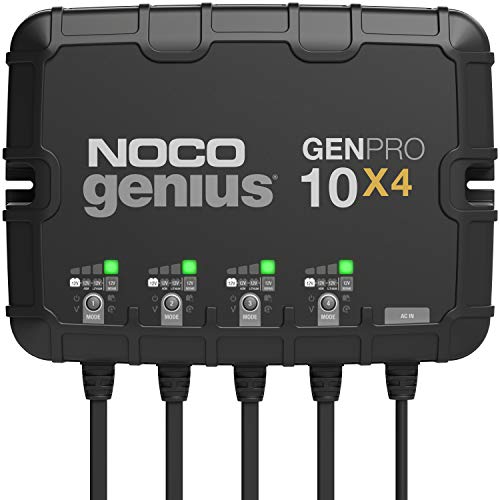
The GENPRO10X4 is a four-bank onboard charger delivering 40 amps total with 10 amps per bank. It supports 12V lead-acid and lithium systems and offers selectable modes for 12V, 12V AGM, 12V Lithium, and a Repair Mode. Best for boaters with four or more batteries who need fast, independent charging for each bank. It’s designed for harsh marine environments and includes temperature compensation. A potential limitation is its higher price relative to simpler four-bank models.
Minn Kota Precision MK-440PCL On-Board Charger

The MK-440PCL provides four independently selected banks with 10 A each, supporting 12V AGM, Flooded Lead Acid, Gel, or Lithium LiFePO4 batteries. It uses a microprocessor-based control for automatic multi-stage charging and includes temperature compensation for stable charging across varying conditions. Best for boaters who need precise bank-by-bank battery type control. A limitation is the absence of explicit advanced lithium-specific features beyond standard LiFePO4 support in a four-bank setup.
LiTime 4-Bank 10A Smart Battery Charger

The LiTime charger supplies 10A per bank across four banks, enabling simultaneous charging for RVs, boats, and off-grid setups. It supports LiFePO4, NCM, and Lead-Acid chemistries, consolidating charging needs into one unit. Smart safety features include protections against over-current, over-temperature, reverse polarity, over-voltage, under-voltage, and short circuits. Choose this for mixed battery systems; avoid if you need a brand with long-standing marine market presence and widely documented support.
sdanbom 4-Bank Marine Battery Charger

This IP68-rated charger is designed for robust marine use and supports AGM, LiFePO4, and Deep-Cycle batteries. It features multiple charging modes (12V, 12V AGM, 12V Lithium, and a Repair Mode) to accommodate different battery setups. Best for boats exposed to water and salt air; a potential limitation is less detailed performance data compared to premium brands, which buyers may weigh against its waterproof emphasis.
NOCO Genius GEN2X4: 8A 4-Bank Smart Charger

The GEN2X4 offers four banks at 2A per bank for a total of 8A, acting as a smart charger, maintainer, trickle charger, and desulfator. It supports 6V and 12V lead-acid and LiFePO4 batteries, with temperature compensation to prevent overcharging. Best for users who need a compact, low-amp multi-bank solution or as a trickle-maintainer for a smaller boat or RV battery setup. Limitation: lower total current per bank compared with higher-amperage four-bank models.
Buying Guide
- Battery types: Confirm compatibility with Lead-Acid, AGM, Gel, LiFePO4, or NCM batteries. If you mix chemistries, choose a model that explicitly supports multiple types per bank.
- Per-bank current: For four banks, 10A per bank is common and suitable for mid-size boats; consider higher per-bank amperage if you have large deep-cycle batteries or high power loads.
- Temperature compensation: This feature protects against overcharge in hot environments and undercharge in cold conditions, preserving battery life.
- Protection features: Look for over-current, over-voltage, under-voltage, reverse polarity, short-circuit, and IP waterproof ratings if your charger sits near splashing water or rain.
- Maintenance mode: Some models auto-switch to trickle/float charging when batteries are topped off. This is valuable for boats left docked for extended periods.
- Ease of installation: Consider enclosure requirements, mounting options, and required AC input ranges (typically 100-240V AC).
- Brand support and documentation: Robust manuals and customer support are helpful for complex marine electrical systems.
FAQ
- What is a 4-bank marine battery charger best for? It allows independent charging of up to four batteries, enabling faster overall charging and better battery management on boats, RVs, and off-grid setups.
- Are LiFePO4 batteries compatible with these chargers? Yes, many listed models support LiFePO4, along with other chemistries, but verify per-bank compatibility in the product specs.
- Do these chargers require special installation? They typically require a fixed 120V-240V AC input and secure mounting in a dry, ventilated area; follow the manufacturer’s installation instructions.
- What maintenance features should I look for? Maintenance/float mode, temperature compensation, and automatic detection of battery status help extend battery life and reduce manual checks.
- Can I use these on both boats and RVs? Yes, most 4-bank chargers are designed for marine and recreational vehicle applications with compatible 12V systems.
- Should I choose higher per-bank amperage? If you have large or multiple deep-cycle batteries, higher per-bank current can shorten charging time; otherwise, 10A per bank is a common balance of speed and safety.