Answering the demand for high-performance boat propulsion, this guide teams up to five practical motors and related components that align with the 400 hp mindset—whether you’re upgrading a large sport boat, heavy-duty fishing craft, or a powered inflatable. Each pick targets a different need—from high-thrust 18 hp workhorses and marine-grade reliability to accessories that support high-horsepower systems. The buyer profiles below show who benefits most from each option.
| Product | Best For | Key Benefit |
|---|---|---|
| XRmarine Water Pump Impeller Kit | Owners upgrading gear on larger outboards | Compatible with 135-400 HP Verado V4/V6 systems |
| NAZEAOB 18HP Outboard | Moderate-horsepower migrators | Low weight aluminum alloy, water-cooled CDI ignition |
| DUIBAII 18 HP HangKai Outboard | Rugged mid-power setups | 6.34 gallon fuel capacity, efficient carburetor |
| FXEIPOL 9 HP Outboard | Inflatables, kayaks, and small craft | 4-stroke, 224cc, 360° rotation, CDI |
| YIYIBYUS 2.3HP Outboard | Auxiliary propulsion and small craft | Lightweight, high-efficiency performance |
XRmarine Water Pump Impeller Kit

The XRmarine kit targets boat owners running Mercury or Mariner 4-stroke Verado systems in the 135-400 HP range. Best for owners seeking a reliable service kit to refresh an aging water pump, especially on larger outboards. The kit includes the impeller, gaskets, seals, and other components necessary for maintaining cooling performance under heavy use. This option is better for high-horsepower engines where cooling reliability is critical. A potential limitation is that this kit is designed for specific engine families; verify compatibility with your model before purchase.
NAZEAOB 18HP Outboard Motor

Best for buyers needing a compact, robust mid-power engine for fishing skiffs, small runabouts, or inflatable boats. NAZEAOB’s 18 hp engine uses a lightweight aluminium alloy build with water cooling and CDI ignition, delivering reliable starts and steady power in calm to moderate waters. It supports a 2,204-pound load capacity, making it suitable for small to mid-sized craft carrying gear or passengers. The main caution is that heavier loads will reduce top speed, so match your boat weight and mission to the motor’s power band.
DUIBAII 18 HP HangKai Outboard

Best for users needing a rugged 18 hp engine with longer fuel autonomy and all-weather versatility. DUIBAII employs a lightweight aluminum alloy frame with a water-cooled system and a CDI ignition setup. Notable is its 6.34-gallon external fuel tank and a maximum speed potential around 5500 rpm, making it a good choice for longer day trips where efficiency matters. A potential limitation is fuel consumption depending on load and operation; plan fuel needs accordingly.
FXEIPOL 9 HP Outboard
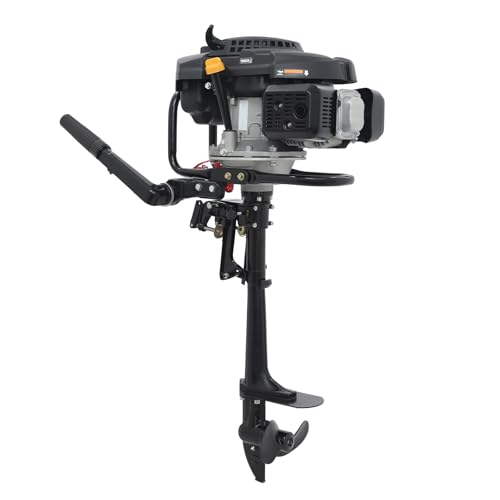
Best for small craft like inflatables, canoes, and dinghies needing robust, compact propulsion. FXEIPOL’s 9 hp, 224cc four-stroke engine offers solid power with air cooling and a CDI ignition system. Its design includes tilt and 360° rotation, plus a forward/reverse mechanism to simplify handling in tight spaces. A potential drawback is that 9 hp is modest in comparison to larger recreational boats; ensure your vessel and battery system can exploit its efficiency fully.
YIYIBYUS 2.3HP Outboard

Best for auxiliary propulsion, dinghies, and very small watercraft where lightweight operation matters. The YIYIBYUS outboard offers 1.7 kW (2.3 hp) with 52cc displacement and high efficiency at operating speeds from 4500 to 8500 rpm. Constructed with durable aluminum and PP, it resists corrosion and deformation. The main limitation is its modest power output, which is not suitable as primary propulsion for larger boats or heavy loads.
Buying Guide
- Horsepower versus boat size: Match engine power to boat weight, desired speed, and load. Higher hp isn’t always better for smaller craft.
- Engine type and maintenance needs: Two-stroke engines are light and powerful but may require more frequent fuel/oil mixing; four-stroke engines tend to run cleaner and quieter with different maintenance needs.
- Fuel system and efficiency: Consider fuel tank capacity, consumption rates at typical cruising RPM, and the availability of spare parts.
- Cooling method: Water-cooled systems are common for performance engines; air-cooled units are typically lighter but may heat faster under heavy use.
- Mounting and shaft length: Confirm shaft length, mounting compatibility, and whether a short or long shaft suits your boat transom.
- Reliability and parts availability: Prefer engines and kits with clearly documented parts, service coverage, and compatibility with common replacements.
FAQ
- What does 400 hp mean for a boat motor? It indicates the engine’s maximum output in horsepower, typically used to gauge performance for larger boats or high-demand applications.
- Can I upgrade from a small 9 hp to a 18 hp outboard? Yes, if your boat’s transom and weight support the larger engine and the mount, shaft length, and fuel system are compatible.
- Is a water-cooled system better than air-cooled? Water cooling generally provides better thermal management for higher output and longer operation in saltwater environments.
- What maintenance should I budget for these engines? Regular carburetor cleaning, fuel line inspection, propeller checks, and oil or fuel mix as required by the model.
- Which engine is best for a heavy inflatable? A lightweight, fuel-efficient four-stroke like FXEIPOL or a compact two-stroke like NAZEAOB can be suitable, depending on load and operation time.
- Do I need a professional install for these motors? Installation varies by model; consult the product’s mounting guidelines and consider a mechanic if transom reinforcement or electrical wiring is involved.