Answering the question “which 6 HP outboard motor suits my boat best?” this guide highlights dependable 6 HP options for inflatable boats, dinghies, kayaks, and small fishing boats. Each model favors a different user need—ease of starting, maneuverability, or steady cruising. The list below selects five well-rounded choices and explains who they’re best for, plus practical trade-offs to consider before buying.
Summary of selected products:
| Product | Best For | Key Benefit | Limitations |
|---|---|---|---|
| BJTDLLX 6HP Outboard Motor | Inflatable boats and dinghies needing strong water cooling | 360° steering; corrosion protection | 2-stroke design requires fuel mix and regular maintenance |
| GRFceVue 4-stroke 6HP | Longer trips with more stable torque | Air cooling with safety features, adjustable steering | Short shaft option may limit some transoms |
| LIWBYYG 4 Stroke 6.5HP | Compact, lightweight setups with good thrust | Water cooling, reverse gear, sturdy build | 5.5% higher horsepower; note small package difference |
| PERFERATE 6HP 2 Stroke | Quick acceleration on inflatable boats | Fast and powerful with low-noise muffler | 2-stroke fuel management and emissions considerations |
| Gosh et 2-Stroke 6HP | Compact, fuel-efficient setups for remote use | High-speed capability with 3-blade prop | Short formal product data; verify compatibility |
Best Overall: BJTDLLX 6HP Outboard Motor

The BJTDLLX 6HP Outboard Motor is a 2-stroke model designed for small boats demanding strong cooling and reliable ignition. It features a water-cooled engine, 360° steering for easy docking, and a corrosion-resistant cast aluminum build. This option is best for inflatable or dinghy users who prioritize quick, responsive handling and robust protection against the elements. A built-in fuel system and external tank compatibility offer flexible fueling setups. Caution: 2-stroke operation requires correct fuel-oil mix and routine maintenance.
GrfceVue 4-Stroke 6HP Outboard

The GrfceVue 4-stroke 6HP model emphasizes smoother operation and safety. It provides a two-gear forward/neutral setup, with air cooling and a safety shutdown on overheating. Its streamlined design and three-blade propeller reduce drag while delivering stable propulsion. Best for users who value steadier cruising for longer outings and easier engine management. Limitation to note: some transom configurations may require a longer shaft for optimal mounting.
LIWBYYG 4 Stroke 6.5HP

LIWBYYG’s 4-stroke 6.5HP engine blends power with reliability. Its 661-1653 lb load capacity and water cooling system help maintain performance across varied water conditions. The design supports flexible steering and tilting, with a reverse gear for controlled maneuvering. Best for anglers seeking punchy performance with straightforward operation. Caution: ensure your transom and mounting setup match to support the motor’s weight and torque.
PERFERATE 6HP 2 Stroke Outboard

PERFERATE offers a 6HP 2-stroke option with strong acceleration and a CDI ignition system. It emphasizes easy throttle control and a continuously variable transmission for manual speed management. A larger muffler helps keep noise down to moderate levels during operation. Choose this if you want rapid response and simple manual control, but be mindful of 2-stroke fuel needs and maintenance.
KTYHNPM 4-Stroke 7.5HP (Close 6HP Class)
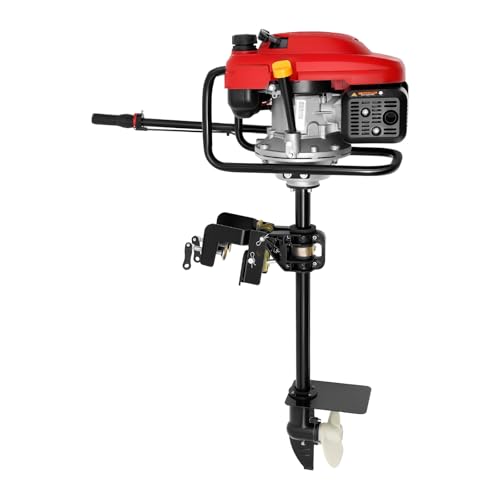
While labeled at 7.5HP, this model’s 3.5 kW output sits in the same operational neighborhood as a higher-end 6 HP class, offering strong power with a CVT-like feel for smooth shifting. It emphasizes heat dissipation and an air-cooling system for durability. Best for operators who want a robust, quieter ride with consistent torque, but verify shaft length and transom compatibility for your boat.
GOSHET 2-Stroke 6HP

The GOSHET 2-Stroke 6HP model focuses on a compact, lightweight approach with a 7” three-blade propeller to reduce water resistance and boost thrust. It uses a CDI ignition system and tilting controls via tiller for simple handling. Best for portable setups where weight and maneuverability are critical. Limitation: ensure it matches your mounting transom thickness and mounting hardware before purchase.
Buying Guide: Key Considerations for 6HP Outboard Motors
- Engine Type: Decide between two-stroke and four-stroke. Two-stroke engines tend to be lighter and deliver quick throttle response but require oil mixing and can be noisier. Four-stroke engines are heavier but typically cleaner and more fuel-efficient, with smoother operation.
- Power and Weight: Confirm the motor’s horsepower matches boat size and load. Exceeding transom capacity or boat weight can affect handling and safety.
- Cooling System: Water cooling helps prevent overheating on longer outings. Air cooling can be lighter but may run hotter in high-demand conditions.
- Gear System and Steering: Look for forward/neutral/reverse options and 360° steering if tight maneuvering is common. A CVT-like feel can provide smoother acceleration.
- Mounting and Shaft Length: Verify shaft length (short vs. long) suits your transom height and boat type. Short shafts are common on smaller inflatables; long shafts may be needed for deeper transoms.
- Starting Method: CDI ignition offers reliable spark without excessive effort. Manual starts require more physical effort but can be advantageous in remote locations without battery dependence.
- Maintenance Needs: Two-stroke engines generally require more frequent fuel/oil mixing and maintenance. Four-stroke models may need less frequent oil changes but have more complex internals.
- Noise Levels: Mufflers and engine design influence noise. If you boat in quiet or residential areas, lower noise is beneficial.
Frequently Asked Questions
- What is a typical 6HP outboard suitable for inflatable boats? – Most 6HP options are suitable for small inflatables, dinghies, and kayaks, providing adequate thrust for calm waters and shallow conditions.
- Do two-stroke 6HP motors require oil mixing? – Yes, most two-stroke models require a pre-mixed fuel-oil blend to operate properly.
- Is a 6HP motor enough for a small dinghy with passengers? – For light loads and calm water, 6HP can be sufficient; heavier loads or rough conditions may benefit from more horsepower or careful weight distribution.
- Should I prefer a short shaft or a long shaft motor? – Short shafts fit smaller transoms and inflatable boats; long shafts suit higher transoms or deeper mounting requirements.
- What maintenance is common for 6HP outboards? – Regular fuel quality checks, oil changes for four-stroke models, spark plug inspection for CDI systems, and propeller maintenance are standard.
- Can I use a 7.5HP motor for a 6HP need? – A 7.5HP model may offer extra power but ensure it is compatible with your boat’s transom, weight limit, and local regulations.