Welcome to a concise guide on the best aluminum boat primer paints for protecting hulls, pontoons, and trailers. This selection targets boaters who want durable rust prevention, easy application, and reliable adhesion on aluminum or galvanized surfaces. Ideal buyers include DIY hull touch-up hands, canoe and jon boat owners, and anglers seeking long-lasting finishes. Below, you’ll find five well-suited primers and barrier coats with clear benefits, best-use notes, and practical cautions.
| Product | Best For | Key Benefit |
|---|---|---|
| Rust-Oleum Stops Rust Flat Aluminum Primer (Quart) | General aluminum surfaces | Weather and corrosion resistance with water-based acrylic |
| Rust-Oleum Marine Metal Primer (Quart, White) | Underwater-ready or above-waterline surfaces | Base coat for better adhesion of topcoats |
| TotalBoat Aluminum Boat Paint (Quart, Light Gray) | Aluminum canoes, dinghies, trailers | No priming needed; fast-drying with strong adhesion |
| Rust-Oleum Professional Aluminum Primer Spray (15 oz, Flat White) | Bare aluminum priming | Oil-based protection with durable, weather-resistant color |
| TotalBoat Aluminum Boat Barrier Coat (Quart, Gray) | Two-part epoxy protection | High-build barrier coat for excellent corrosion prevention |
Rust-Oleum Stops Rust Flat Aluminum Primer

Best for general aluminum surfaces and exterior/interior metals, this water-based acrylic primer bonds tightly to aluminum and galvanized metal. It provides a durable protective layer with strong rust prevention. Dries to touch in 1-2 hours and covers up to 55-90 sq ft, making it a practical mid-range option for small to medium projects. Choose this if you want a low-odor, easy-to-clean primer that still offers robust corrosion resistance. Caution: not a topcoat; must be sealed with an appropriate paint for long-term exposure in harsh marine environments.
Rust-Oleum Marine Metal Primer

This quart-sized white primer is designed to prime metal surfaces above the waterline, acting as a base coat to improve adhesion of topcoats for longer-lasting finishes. It dries to the touch in 1–2 hours and covers about 100 sq ft. Best for boats that operate mostly above water or in calm water conditions, where initial adhesion is crucial. Limitation: it is a primer, so a compatible topcoat is required for full marine protection.
TotalBoat Aluminum Boat Paint (Quart, Light Gray)
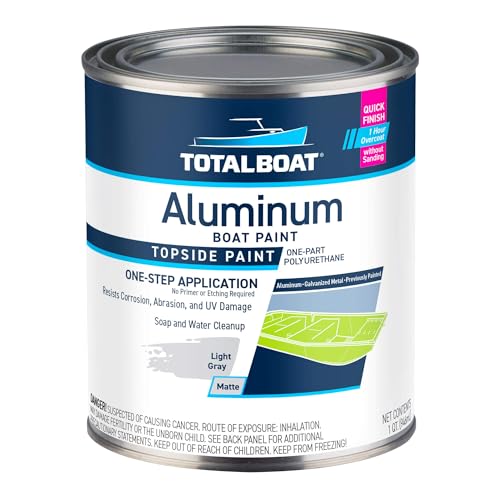
This one-part polyurethane paint is formulated for aluminum and galvanized metal, offering good resistance to chips, scratches, lifting, peeling, fading, and chemical damage. It provides an attractive, low-sheen finish and is suitable for a wide range of boats and outdoor applications. No priming is necessary, with 2–3 coats recommended and a 1-hour overcoat time at 72 F. Choose this for faster, simpler completion and consistent adhesion when applying directly over prepared aluminum surfaces. Caution: while no primer is required, surface prep with the TotalBoat Etch Wash enhances adhesion.
Rust-Oleum Professional Aluminum Primer Spray

Designed specifically for bare aluminum to prepare the surface for painting, this oil-based primer delivers rust protection and a durable finish that withstands weathering. It provides twice the protection of paint alone and covers up to 14 sq ft, with a touch-dry time of 15 minutes. Best for small, high-precision priming tasks where a spray format offers tight control. Best avoided for large hulls due to lower coverage and the need for topcoat compatibility in marine settings.
TotalBoat Aluminum Boat Barrier Coat (Quart, Gray)

This high-build, two-component epoxy primer and barrier coat delivers excellent corrosion prevention on aluminum hulls and pontoons. It can be overcoated with bottom paints or other 1- and 2-part paints, offering durable underwater protection. It dries fast with no sanding required between coats, making it a strong choice for boats that spend substantial time submerged or in saltwater. Caution: two-part systems require careful mixing and proper surface prep for best results.
Buying Guide: Key Considerations For Aluminum Boat Primers
- Surface compatibility: Is your project above or below waterline, and is the surface aluminum or galvanized? Some primers are formulated for above-waterline metal, while others provide underwater protection.
- Primer vs. topcoat: Do you need a standalone primer or a complete paint system? Some products are specific primers; others are one-part paints that include priming properties.
- Drying and overcoat windows: How quickly can you handle and apply topcoats? Faster-drying formulas enable quicker project completion but may require precise environmental control.
- Coverage and reach: Consider the square footage per can/jar to estimate how many coats you need for your hull area. Higher coverage minimizes cost and labor.
- Finish and appearance: Are you seeking a low-sheen finish or a specific color to match hull aesthetics? Some products are better suited for camouflage patterns or bright, clean white looks.
- Two-part vs. single-part: Two-component epoxy barrier coats provide durable corrosion protection but require careful mixing and safety practices. Single-part paints and primers offer easier application.
- Prep requirements: Some primers require etching, sanding, or wash steps for maximum adhesion. Prepping surfaces leads to longer-lasting results.
Frequently Asked Questions
- What primer is best for aluminum boats?
– For general purpose, Rust-Oleum Stops Rust Aluminum Primer provides good corrosion resistance with water-based ease. For underwater-duty protection, TotalBoat Barrier Coats offer superior barrier performance though require two-part mixing. - Do I need to prime aluminum before painting?
– In many cases, yes. Primers improve adhesion and corrosion resistance. Some TotalBoat paints are designed to be applied without priming, but prep steps like etching often enhance performance. - Can I use any topcoat over these primers?
– Use a compatible topcoat designed for marine use. Some primers are designed to match specific topcoats from the same brand; otherwise verify chemical compatibility before coating. - How long should I wait between coats?
– Drying times vary by product. Common windows range from 15 minutes to 1–2 hours before applying a second coat or topcoat, depending on temperature and humidity. - Is a spray primer better for aluminum than a brush-on?
– Spray primers offer precise application and faster coverage on complex hulls, but brushes or rollers can be effective for small areas. Choose based on project size and comfort level. - Are two-component barrier coats necessary for aluminum hulls?
– They provide superior corrosion resistance, especially for boats exposed to saltwater or submerged conditions. For less demanding environments, a high-quality single-part system may suffice.