Choosing the right amp for boat speakers depends on waterproofing, power handling, and compatibility with your head unit. This guide highlights five marine-grade amplifiers that balance reliability with performance for boat audio systems. The top picks cover both 4-channel and mono options, helping you decide who benefits most from each model. Suitable buyers range from casual cruisers wanting simple Bluetooth-ready amplification to anglers and weekend boaters needing stronger, weatherproof power. Below, compare each product and see which fits your setup best.
| Product | Best For | Why It Stands Out |
|---|---|---|
| Pyle PLMRA400 | 4-channel stereo on a budget | Compact, marine-rated, RCA inputs, solid protection features |
| Skar Audio RP-800.1DM | Single-channel bass authority | High power, fully marinized, strong subwoofer performance |
| Pyle PLMRMP3B | MP3-friendly, compact systems | 4-channel, 3.5mm input, simple remote volume control |
| Pyle PLMTR4A | 4-channel all-around | IP65-rated and weatherproof with wired inputs |
| Pyle PLMRA420 | Bridgeable four-channel power | Bridgeable, crossover options, robust protection |
The following sections present five Amazon-listed options with quick-reference notes to help you pick quickly. Each entry includes who it’s best for, why it’s chosen, and a practical caveat to consider during decision making.
Pyle Hydra Marine 400W 4-Channel Amplifier

Best for: Budget-friendly four-channel marine power. This amplifier delivers a compact, marine-rated option with RCA inputs for easier integration with head units lacking RCA outputs. It targets small to mid-sized boat setups where space and cost matter most. Why selected: It provides essential protection features, including a heatsink and short protection, while offering LED indicators to simplify troubleshooting. Caution: Limited high-end head-unit compatibility may require alternative input methods if RCA outputs are unavailable on your source.
BOSS Audio Systems ASK904B.64 Marine Boat Amplifier Package

Best for: Small to mid-size boats seeking integrated Bluetooth and USB options without a separate head unit. Why selected: The amplifier supports 4-channel output with Bluetooth connectivity and a weather-resistant build, making it easier to add wireless playback on a boat. Caution: Bluetooth performance can vary with interference on open water; a dedicated wired source may be more reliable in some setups.
Skar Audio RP-800.1DM Monoblock Marine Amplifier
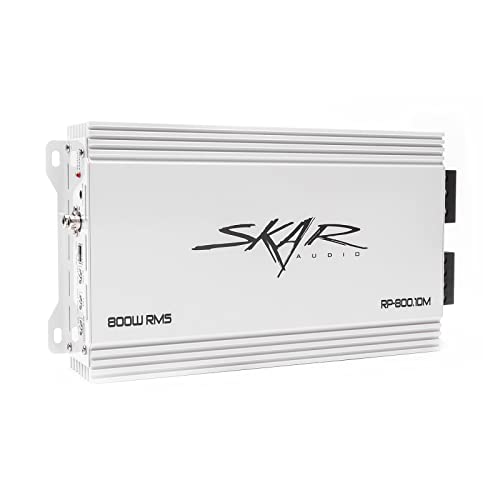
Best for: Bass-heavy boat systems needing a dedicated monoblock for a single subwoofer. Why selected: It’s a marine-class D monoblock with 1,200 Watts peak and 800 Watts RMS at 1 Ohm, plus corrosion protection on the PCB and chassis. Caution: Subwoofer-specific performance depends on proper impedance matching and enclosure design.
Pyle PLMRMP3B 800W 4-Channel Hydra Marine
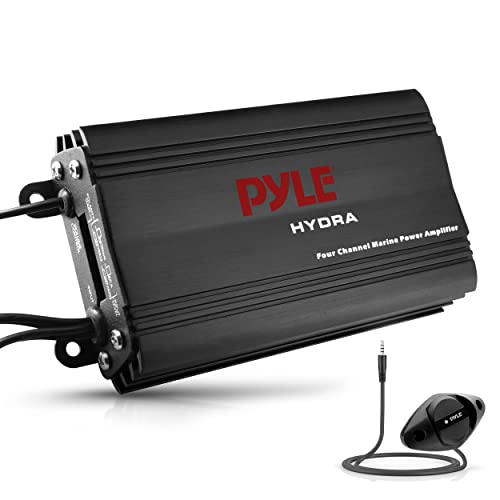
Best for: Compact four-channel systems needing MP3 compatibility and remote volume. Why selected: It adds a 3.5mm input adapter and RCA inputs for flexible connections, plus a remote for convenient volume control. Caution: Some users may prefer dedicated high-level inputs if RCA is not available from the head unit.
Pyle PLMTR4A 1500W Marine 4-Channel Amplifier

Best for: Boats needing four-channel power with weatherproofing and multiple inputs. Why selected: It’s rated IP-65 for marine environments, supports wired RCA, AUX, and MP3 inputs, and offers robust four-channel amplification for multi-speaker setups. Caution: Higher power output requires careful wiring and battery management to avoid electrical issues.
Buying Guide: Key Purchase Considerations
- Power needs: Assess speaker wattage, impedance, and the number of channels you require. A four-channel amp works well for full-range speakers, while a monoblock suits a dedicated subwoofer.
- Marine suitability: Look for IP ratings, waterproof enclosures, corrosion resistance, and protective heatsinks to ensure longevity in saltwater environments.
- Input options: Determine if you need RCA, high-level inputs, Bluetooth, or MP3/AUX compatibility. Some boats lack RCA outputs from head units, so adapters may be necessary.
- Installation space: Consider the physical size of the amplifier and its mounting orientation to maximize cooling and minimize exposure to water spray.
- Protection features: Short protection, thermal protection, and soft turn-on are important to safeguard electrical systems on a boat.
Frequently Asked Questions
- What amp is best for boat speakers?
- Do I need a dedicated marine amplifier for a boat?
- Can I use Bluetooth amplifiers on boats?
- How important is input type for boat audio?
- What maintenance helps marine amps last longer?
- Can I bridge a four-channel marine amp?
There is no single best amp; it depends on your speaker count, impedance, and whether you need a four-channel setup or a subwoofer amplifier. Look for marine-rated builds with appropriate power output and input options.
While not strictly required, a marine amplifier offers weatherproofing and corrosion resistance that standard car amps lack, improving reliability in saltwater conditions.
Yes, some models include Bluetooth for wireless audio. However, ensure Bluetooth performance is stable in the boat’s environment and pair with a reliable source device.
Very important. RCA inputs are common on marine amps, but high-level inputs or adapters may be necessary if your head unit lacks RCA outputs.
Regularly check wiring for corrosion, ensure proper ventilation, and inspect protective covers. Avoid exposing amps to direct water spray and keep connections clean and dry.
Many four-channel amps are bridgeable to provide extra power to a sub or a subset of channels. Check the specific model’s bridgeable capabilities and impedance requirements.