If you need a reliable battery maintainer for your boat, these onboard chargers are designed to keep 12V lead-acid and lithium batteries healthy in marine environments. They’re ideal for boat owners who store or idle vessels for extended periods, frequent weekend cruisers, and serious sailors who require steady maintenance without overcharging. The selections below emphasize 12V systems, thermal compensation, and multi-bank options for different battery types. Use this guide to compare models, pick the right bank count, and protect your marine power setup.
- Best for multi-battery boats needing robust 10A total power with per-bank control
- Best for tight spaces requiring compact, marine-grade reliability
- Best for simple, reliable maintenance on 6V/12V batteries
- Best for single-bank, compact onboard charging with built-in thermal management
- Best for modular, flexible charging across up to three banks
Product Comparison at a Glance
The following table highlights key features to help you decide quickly which charger fits your boat’s battery setup. Each option supports lead-acid and lithium batteries with overcharge protection and temperature compensation where applicable.
| Product | Bank Count | Total Amps | Best For |
|---|---|---|---|
| NOCO Genius GEN5X2 | 2 | 10A | Boats with multiple batteries needing independent monitoring |
| NOCO GEN5X3 | 3 | 15A | Three-battery boats or complex deep-cycle setups |
| NOCO GENIUS1 | 1 | 5A | Small boats or single-battery installs |
| NOCO GEN2D | 1 | 2A | Under-hood mount, direct-mount applications |
| NOCO Genius 2X2 | 2 | 4A | Two batteries, compact space, versatile maintenance |
NOCO Genius GEN5X2: 2-Bank, 10A Marine Charger
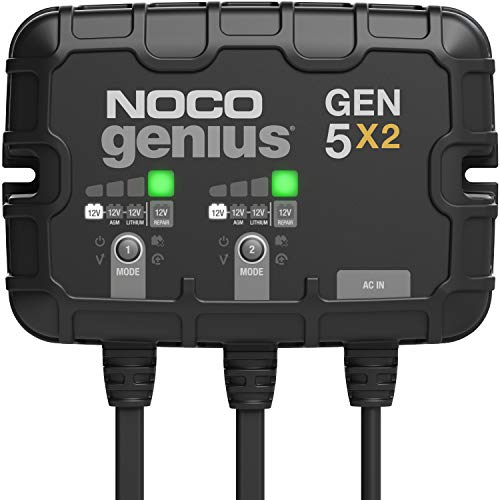
The GEN5X2 provides two independent charging banks at 5A each, totaling 10A. It supports 12V lead-acid and lithium batteries, with selectable modes for 12V, 12V AGM, 12V Lithium, and a repair mode. Best for boats with multiple batteries requiring separate maintenance cycles and robust protection in marine environments. A key advantage is independent charging per bank, allowing tailored maintenance for starter and deep-cycle batteries. A potential limitation is space: ensure installation room on your vessel is sufficient for the unit.
NOCO GENIUS2D: 2A 12V Onboard Charger
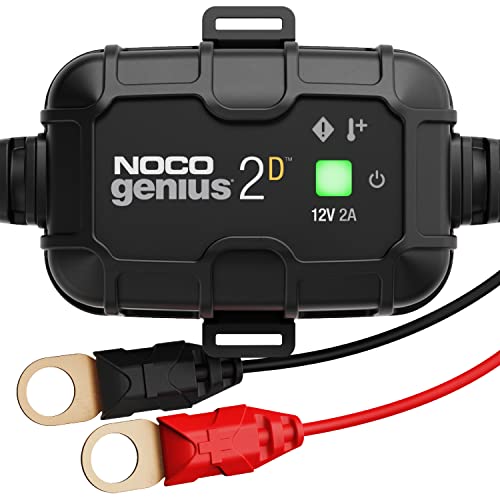
The GENIUS2D is a direct-mount charger designed for a single 12V battery. It acts as a charger, maintainer, trickle charger, and desulfator, with temperature compensation and overcharge protection. It’s best for small boats or spaces where a compact, under-the-hood installation is ideal. It’s less ideal for boats with multiple large batteries since it covers only one bank at 2A, which means longer maintenance times for larger systems.
NOCO GENIUS1: 1A 6V/12V Smart Charger

The GENIUS1 targets smaller boats with 6V or 12V batteries. It combines a charger, maintainer, trickle charger, and desulfator, plus temperature compensation. Best for owners who require a compact, all-in-one solution for a single battery. It’s less suitable for larger boats with more than one battery bank due to its single-bank design and lower overall amperage.
NOCO GEN5X1: 1-Bank, 5A Marine Charger
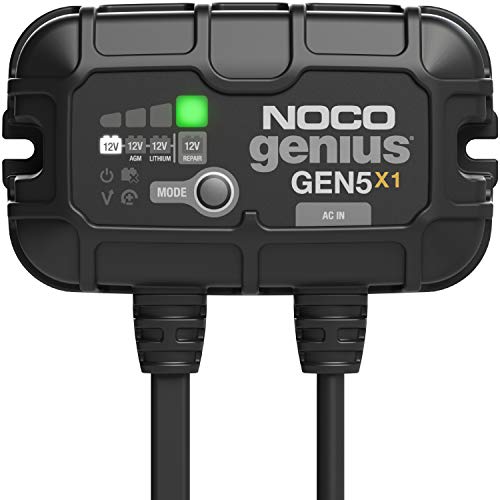
The GEN5X1 offers a single 5A bank for straightforward maintenance on 12V batteries. It supports selectable modes for 12V, 12V AGM, and 12V Lithium, with an emphasis on preventing overcharging. Best for boats with a single battery or for retrofit installations where only one bank is needed. A limitation is the lack of multi-bank flexibility if you later add more batteries on board.
NOCO GEN5X3: 3-Bank, 15A Marine Charger
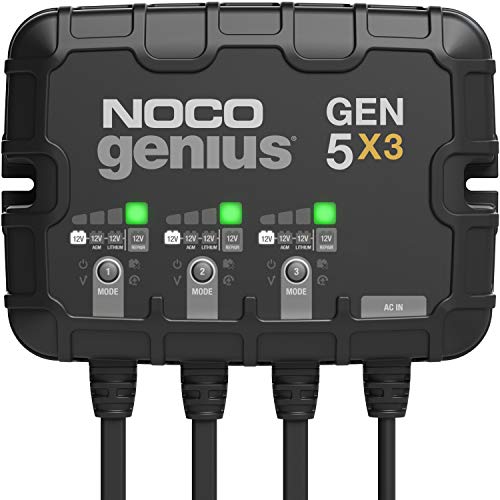
The GEN5X3 packs three independent 5A banks for boats with multiple batteries, totaling 15A. Each bank supports 12V, 12V AGM, and 12V Lithium modes, plus a repair mode. Best for boats with starter, deep-cycle, and auxiliary batteries requiring separate maintenance. It’s a strong choice when you need balanced charging across three banks. Limitation: higher upfront cost and installation footprint compared with single-bank models.
Buying Guide: How to Choose the Right Boat Battery Maintainer
- Bank count matters: Choose 1, 2, or 3 banks based on how many separate batteries you maintain. More banks offer independent control but require more space and wiring.
- Amperage per bank: For boats with large deep-cycle batteries, higher total amps (like 10A per two-bank or 5A per bank) reduce charging time and improve maintenance speed.
- Battery types supported: Ensure compatibility with lead-acid, AGM, Gel, VRLA, and lithium (LiFePO4) if you use multiple chemistries on board.
- Temperature compensation: Devices with thermal sensors adjust charging to ambient temperature, reducing the risk of overcharging in heat or undercharging in cold conditions.
- Installation considerations: Look for direct-mount or compact designs if you have limited engine-bay space. Verify mounting hardware compatibility and heat dissipation.
FAQ
- What is a boat battery maintainer?
A device that keeps 12V boat batteries at optimal charge, monitors temperature, and prevents overcharging during storage or idle periods.
- Do I need multiple banks for my boat?
Only if you have more than one battery that requires separate maintenance. A multi-bank charger can charge and maintain several batteries independently.
- Can these chargers charge lithium batteries?
Yes, most modern NOCO models support lithium (LiFePO4) along with lead-acid variants, with mode options for each battery type.
- Is temperature compensation important?
Yes. It helps prevent overcharge in hot weather and undercharge in cold weather, preserving battery life and performance.
- What installation precautions are needed?
Follow the manufacturer’s mounting guidance, ensure watertight connections for marine use, and verify compatibility with your boat’s electrical system.