Answering buyers who need reliable bilge thru hull fittings, this guide highlights durable, corrosion-resistant options and helps you pick the right size and material. The top picks cover common 3/4″ and 1″ hose sizes, with emphasis on built-in check valves and solid construction for marine environments. Best for DIY bilge drainage updates, scupper installations, or replacing aging fittings. Below, find concise product comparisons, then a practical buying guide and FAQs to finalize your decision.
| Product | Size | Material | Best For |
|---|---|---|---|
| SEAFLO Thru Hull Fittings (3/4″) | 3/4″ | Polypropylene | General bilge drainage with good impact resistance |
| SEAFLO 1-1/8″ 90° Angled Fitting | 1-1/8″ | PP+GF/Nylon+GF | Tight spaces, durable marine routing |
| EEYAD 316 Stainless Thru-Hull | 3/4″ | 316 Stainless Steel | Seawater exposure, heavy-duty applications |
| SEAFLO 3/4” White 2-Pack Thru Hulls | 3/4″ | PP + Glass-Filled Nylon | Two-fittings kit with check valve for backflow prevention |
| SEACHOICE 90-Degree Angled | ¾” | Plastic | Reliable 90-degree connection for standard hoses |
SEAFLO Thru Hull Fittings 3/4″

Best for: general bilge drainage on smaller vessels or DIY projects where 3/4″ hose is standard. The item is white and designed for a 3/4″ hose, offering a solid warranty and straightforward installation. The primary advantage is durability with a four-year warranty, suitable for non-extreme marine environments. A potential limitation is that color and material are fixed to white polypropylene options, which may not match all vessel interiors.
3/4 Inch Thru Hull Scupper Flapper Valve, 90 Degree Elbow

Best for: installations requiring backflow prevention with a 3/4″ hose. This scupper flapper valve provides an elbow design that fits hulls up to about 1-1/4″ thick and is suitable where scupper drainage must be controlled. Caution: the product is a flapper valve, so ensure compatibility with your vessel’s drainage routing; improper angles may affect performance in tight spaces.
SEAFLO 1-1/8″ 90° Angled Thru Hull Fitting

Best for: tight engine spaces or hull sections where a larger 1-1/8″ hose must pass through at a 90-degree angle. This fitting uses a high-strength polypropylene and glass-filled nylon blend, with a built-in check valve and corrosion resistance. Limitation: higher price point and more complex installation than smaller 3/4″ fittings.
EEYAD 316 Stainless Thru-Hull Fitting

Best for: seawater-rich environments or vessels where stainless durability is prioritized. The stainless steel construction provides excellent corrosion resistance for bilge drains, scuppers, and overboard drains. Caution: stainless models require careful mounting to avoid galvanic corrosion when paired with dissimilar metals.
SEAFLO 3/4” White 2-Pack Thru Hulls with Check Valve

Best for: owners seeking a value-packed option with two fittings and built-in check valves for backflow prevention. The polypropylene and glass-filled nylon composition offers high impact resistance. Consideration: ensure your hose ID matches 3/4″ sizing and that the check valve orientation aligns with the drainage flow path.
SEACHOICE 90-Degree Angled Thru-Hull
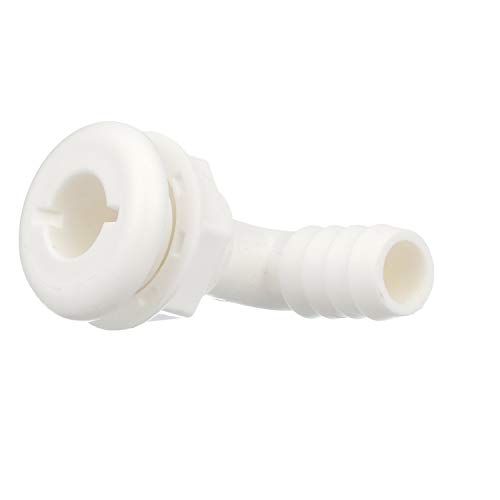
Best for: reliable 90-degree drainage connections with a 3/4″ hose. White finish and simple design make it a straightforward replacement. Limitation: made from plastic, which may show wear over time in heavy-use scenarios or exposed to harsh UV light.
Buying Guide: Key Considerations For Bilge Through Hull Fittings
- Size compatibility: Match the hose inside diameter (ID) to the fitting size (commonly 3/4″ or 1″).
- Material selection: Polypropylene and glass-filled nylon offer high impact resistance; stainless steel provides superior corrosion resistance for saltwater; consider a check valve to prevent backflow.
- Angle and orientation: 90° vs straight fittings affect routing in tight bilges or crowded engine compartments.
- Durability: Look for UV resistance, chemical resistance, and robust mounting to avoid cracks and leaks.
- Maintenance: Fittings with a built-in check valve reduce backflow risk but ensure accessibility for inspection and cleaning.
- Installation context: Some fittings are better for scuppers, others for bilge drains or overboard discharge—choose according to the drainage path.
FAQ
- What size bilge through hull should I buy for a 3/4″ hose?
– Choose fittings labeled for 3/4″ hose ID to ensure a proper fit and seal. - Are stainless steel thru-hulls better than plastic for saltwater boats?
– Stainless steel offers superior corrosion resistance in harsh marine environments, but may require careful installation to prevent galvanic issues. - Do I need a check valve on a thru-hull fitting?
– A built-in check valve helps prevent backflow, which enhances boat drainage safety and reduces water ingress risk. - Can I install a 1-1/8″ thru-hull in a small bilge?
– Yes, if the hose and space permit, but expect a larger fitting footprint and potentially more challenging routing. - What are common materials used, and their trade-offs?
– PP+GF/Nylon+GF offer durability and weight savings; stainless steel lasts longer in saltwater but can be pricier and requires mounting care. - Which fitting is best for a tight spaces installation?
– Angled 90° fittings are typically better for tight spaces; ensure the angle accommodates your hose routing.