Direct answer: Blue Sea fuse boxes deliver organized, high‑amp DC distribution for marine and heavy equipment setups. This guide highlights five top options, ideal for boat decks, campers, and off‑grid systems. Best for: skippers needing rugged, weather‑resistant blocks (Blue Sea ST‑Blade series) and users seeking compact, dependable fuse blocks. The table below compares key specs to help you choose quickly.
| Product | Circuit Count | Max Capacity | Key Strengths |
|---|---|---|---|
| Blue Sea Systems ST Blade Fuse Block 12 Circuit with Ground and Cover, 100 Amps, 5026 | 12 | 100 A | Ground bus, integrated cover, spare fuse storage |
| Blue Sea Systems ST Blade Fuse Block 6 Way Circuits with Negative Bus and Cover, 100 Amps, 5025 | 6 | 100 A | Compact six‑circuit unit with negative bus |
| Blue Sea Systems ST Blade Fuse Block Dual 12 Circuit with Ground and Cover, 100 Amps, 5032 | 12 (dual bus) | 100 A | Two isolated bus groups for load separation |
| Blue Sea Systems 5056 ST-Blade Water-Resistant 4 Circuit Fuse Block | 4 | 80 A per block / 25 A per circuit | Water‑resistant design for harsh environments |
| Siapupy 12V/24V 6-Circuit Waterproof Marine Fuse Box with LED Indicator | 6 | 150 A total | LED fault indicator, waterproof cover, space‑saving side mount |
Blue Sea Systems ST Blade Fuse Block 12 Circuit with Ground and Cover

This block provides twelve fused outputs plus a built‑in ground bus and a clear insulating cover with a push‑button latch. It supports up to 100 A total capacity and works with standard ATO/ATC fuses up to 30 A per circuit, making it suitable for mid‑size DC systems on boats or RVs. Best for: larger power setups needing many circuits in one rugged enclosure. Caution: ensure sufficient cabinet depth for the 12‑circuit footprint.
Blue Sea Systems ST Blade Fuse Block 6 Way Circuits with Negative Bus and Cover
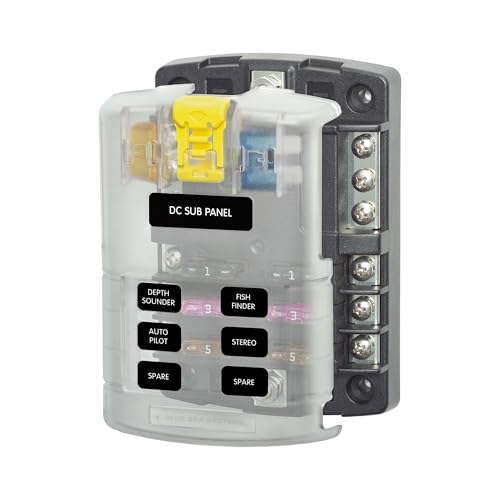
This six‑circuit version includes a negative bus and a protective cover, rated for up to 100 A total with 30 A per circuit capacity. It’s a compact choice for limited spaces while still offering organized circuit protection. Best for: smaller boats or vehicles needing a clean, single‑block solution. Limitation: fewer circuits than the 12‑circuit model, so plan layout accordingly.
Blue Sea Systems ST Blade Fuse Block Dual 12 Circuit with Ground and Cover

Featuring two electrically isolated bus groups, this block supports twelve outputs with standard ATO/ATC fuses up to 30 A per circuit and maintains a total 100 A capacity. Best for: separating critical loads from accessory circuits for easier management. Choose this if you need two distinct power domains in one housing. Caution: price and space may be higher than single‑bus units, so plan mounting.
Blue Sea Systems 5056 ST-Blade Water-Resistant 4 Circuit Fuse Block

Designed for moisture exposure, this four‑circuit block operates up to 80 A per block and 25 A per circuit with ATO/ATC fuses. It fits rugged environments where water or spray is a concern. Best for: small to mid‑sized boats in marine spray zones. Limitation: fewer circuits than larger ST‑blade models, so capacity planning is essential.
Blue Sea Systems 5502 Class T Fuse Blocks, 320A

This class T fuse block is known for rapid short‑circuit response and ABYC/USCG compliance in higher‑voltage, higher‑current applications. Best for: high‑demand DC systems like inverters or large auxiliary batteries. Limitation: not a typical blade fuse block; ensure compatibility with your fuse type and wiring scheme.
12V Fuse Box 6 Way ATO/ATC with LED Indicator
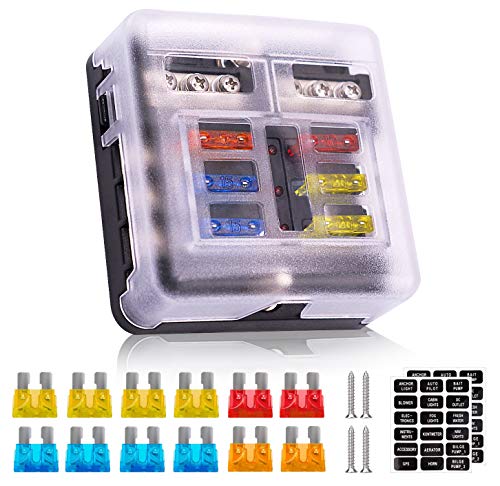
This six‑position fuse box includes a red LED indicator for blown fuses and a water‑resistant shell. It supports 12 V and 24 V systems, making it versatile for marine, automotive, and RV use. Best for: users who want quick failure visibility. Caution: LED indicators rely on electrical wiring integrity; verify correct fuse sizing to avoid false alarms.
Buying Guide: Key Considerations for Choosing a Blue Sea Fuse Box
- System voltage and total amperage: Match the block’s rating to your main battery bank and load demand to avoid overheating.
- Number of circuits: Plan future expansion; opt for blocks with spare capacity or dual‑bus designs if you anticipate additional loads.
- Bus design: Negative or ground buses simplify wiring; dual buses help separate essential and non‑essential systems.
- Environmental protection: For exposed marine or outdoor installs, choose water‑resistant or sealed enclosures to reduce corrosion risk.
- Mounting and size: Ensure there is enough space in the panel and that mounting hardware is compatible with your vessel or vehicle.
- Fuse type compatibility: Confirm whether the block supports ATO/ATC blade fuses or requires a different fuse family.
- Maintenance features: Clear covers, label recesses, and spare fuse storage simplify troubleshooting and upkeep.
Frequently Asked Questions
- What is the advantage of a dual bus fuse block?
Answer: It allows separation of different load groups, improving power management and safety by isolating critical circuits from non‑essential ones. - Can I use standard blade fuses with all Blue Sea blocks?
Answer: Most ST‑Blade blocks are designed for standard ATO/ATC blade fuses up to 30 A per circuit, but always verify the product’s data sheet. - Are water‑resistant fuse blocks necessary on boats?
Answer: They’re recommended in areas exposed to spray, rain, or splash to reduce corrosion and electrical faults. - How do I choose between a 6‑circuit and a 12‑circuit block?
Answer: Consider current needs, future expansion, and space. Larger blocks consolidate more circuits but require more panel real estate. - What maintenance helps extend fuse block life?
Answer: Keep terminals clean, label circuits clearly, and replace blown fuses promptly to prevent wiring damage.