Answering the call for a reliable, feature-rich marine head unit, this guide spotlights five Bluetooth-enabled options suited for boats. Whether you’re cruising, fishing, or relaxing on deck, these head units deliver clear audio, saltwater durability, and hands-free controls. They’re best for boaters who want wireless streaming, weather resistance, and straightforward installation. Each pick below includes why it fits specific needs, along with practical cautions to consider before buying.
Buyer’s Quick Reference Table
| Product | Best For | Key Benefit | Limitations |
|---|---|---|---|
| Pyle PLRMR23BTW | All-around in-dash marine audio | Built-in controls with 300W peak power | Requires professional installation |
| BOSS MGR350B | Weatherproof, plug-and-play on deck | IPX-6 water protection, USB | Limited display features |
| Sony DSXM55BT | High-tech multimedia on small spaces | NFC, Bluetooth, SiriusXM ready | Single DIN size limits expansion |
| KICKER 46KMC2 | Rugged, visually clear gauge-style unit | 200+ watts peak, easy Bluetooth | Compact screen may be harder to read in sun |
| Pyle PLMRB29B | Budget-friendly in-dash with built-in mic | 300W peak, Bluetooth hands-free | Simple interface, fewer advanced features |
Pyle Bluetooth Marine Receiver PLRMR23BTW (White)

Best for: boaters seeking a full-featured in-dash unit with robust audio power. This Pyle model offers 300 watts peak output (75W x 4) and onboard EQ for bass, treble, balance, and fader, helping you tailor sound to deck conditions. It supports Bluetooth streaming from A2DP devices and includes a built-in microphone for hands-free calls. The LCD display shows caller information for easier communication at sea. Professional installation is recommended to ensure proper power wiring and antenna setup. Use with XBass, and mobile apps for streamlined control.
Why chosen: The PLRMR23BTW combines strong audio output with convenient Bluetooth calling and digital display. It’s well suited for boats that need a reliable, all-in-one head unit with a recognizable brand and straightforward operation. The included wiring harness simplifies integration into 12V marine power systems.
Caution: Do not rely on the unit in exposed, high-salt environments without proper sealing and professional wiring. Miswiring can affect performance and safety at sea.
BOSS Audio Systems MGR350B Marine Boat Stereo Gauge Receiver
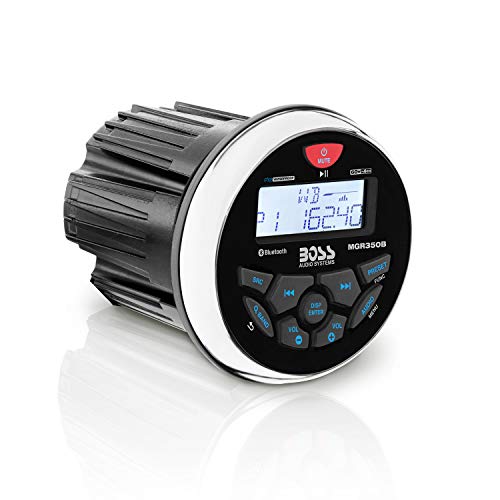
Best for: boaters who want weather resistance and USB connectivity in a gauge-style unit. The MGR350B is built with weatherproofing, including UV-coated front panels and conformal-coated PC boards, delivering protection against water exposure. It supports USB playback and charging for portable libraries and offers auxiliary input for external devices. The built-in Bluetooth keeps devices connected for hands-free calling and music control.
Why chosen: Its weatherproof design and simple USB/aux inputs make it a practical pick for deck installations where exposure to spray is common. The MGR350B is a solid choice when you want a rugged radio that emphasizes durability and straightforward Bluetooth streaming.
Caution: It does not emphasize advanced audio-tuning features. If you want extensive EQ and time alignment, this unit may feel light on those controls.
Sony DSXM55BT Bluetooth Marine Digital Media Stereo

Best for: users seeking modern multimedia features in a compact 1-DIN format. The Sony DSXM55BT includes integrated Bluetooth with NFC pairing, USB playback, and SiriusXM readiness. It supports streaming services like Pandora and offers a front USB port for iOS and other USB devices. The unit features EQ options and a bass-enhancement setting for marine acoustics, plus hands-free calling through a built-in microphone.
Why chosen: The DSXM55BT delivers a balanced feature set in a space-conscious chassis, ideal for boats with limited dash depth. The NFC pairing simplifies device connection on the fly, making it convenient for quick changes in playlists and apps.
Caution: The 1-DIN form factor may limit expandability if you plan to integrate large screens or multiple accessory inputs on deck.
Kicker 46KMC2 Weather-Resistant Gauge-Style Media Center

Best for: boaters who want a rugged, high-output audio center with a gauge-style display. The KMC2 offers over 200 watts of total peak power across four channels, Bluetooth connectivity, and multiple input options including USB and RCA. It’s designed to withstand marine conditions and still deliver strong sound with simple, intuitive controls. This unit is especially suitable for decks where a compact, easily readable interface is prized.
Why chosen: Durability and straightforward Bluetooth pairing make the KMC2 a dependable option for water use. Its gauge-style format helps mirror traditional boat dashboards while offering modern connectivity.
Caution: The display, while clear, can be challenging to read in bright direct sunlight; consider shade or a glare-reducing mounting position.
Pyle Marine Bluetooth Stereo PLMRB29B (Black)

Best for: budget-conscious boaters needing a compact marine radio with built-in microphone and Bluetooth. The PLMRB29B delivers 300 watts peak output and includes a digital LCD display for easy viewing of modes and calls. It supports Bluetooth streaming, hands-free calling, and remote control compatibility, making it a practical value option for smaller vessels or casual users.
Why chosen: For an accessible price point without sacrificing essential features like Bluetooth and USB, the PLMRB29B provides reliable performance suitable for everyday marine use. The integrated mic supports clear hands-free calls on the water.
Caution: While affordable, it offers fewer advanced audio enhancements than some higher-end models. Users should temper expectations for audiophile-grade tuning in noisy marine environments.
Buying Guide: Choosing the Right Marine Bluetooth Head Unit
- Power and sound: Look for models offering 75W x 4 peak or higher for louder deck playback. Consider total peak power versus continuous RMS when evaluating performance.
- Durability: Prioritize marine-rated builds, water resistance (IP ratings), and conformal coating if you expect spray or salt exposure. Mounting location matters for longevity.
- Bluetooth and connectivity: Ensure compatibility with your devices (iOS/Android), streaming apps, and optional USB or auxiliary inputs. Some units offer NFC for quick pairing.
- Display and controls: Choose a unit with a readable display in sunlight and simple, intuitive controls. Gauge-style units can save dash space, while larger screens offer easier navigation.
- Expansion: Consider whether you need SiriusXM, line outputs (RCA), or multi-zone audio. Some models support external amplifiers or remote controls for deck convenience.
- Installation: Check mounting depth, wiring harness availability, and whether professional installation is recommended or required for optimal performance and safety.
How to Compare Between Models
- Best for deck visibility: Gauge-style units with clear, high-contrast displays.
- Best for feature-rich audio: Units with advanced EQ, Digital Time Alignment, and hi-res audio support.
- Best for simplicity and budget: Basic Bluetooth receivers with essential inputs and durable construction.
FAQ
- What makes a marine head unit different from a car stereo?
Marine units are designed to resist salt, sun, and spray with sealed enclosures and conformal coatings for moisture protection. - Is SiriusXM compatibility common in boat stereos?
It is available on several models as an option; check the specific unit’s SiriusXM readiness and tuner requirements. - Do these units require professional installation?
Some models include wiring harnesses and straightforward wiring, but professional installation is often recommended for water-sealed mounting and 12V wiring safety. - Can I upgrade my existing boat speakers with these units?
Yes, most units support standard RCA outputs and USB connections to integrate with existing marine speaker systems. - Which model is best for a small boat with limited dash space?
Sony DSXM55BT and KICKER 46KMC2 offer compact, efficient footprints with strong Bluetooth capabilities for limited spaces. - Are there units with built-in mic for hands-free calls?
Several Pyle models include built-in mics; confirm the specific model’s microphone features in the product details.