Answering the question “which Bluetooth radio is best for a boat?” this guide highlights five marine in-dash receivers designed to withstand salt spray while delivering clear sound. Each option suits different needs—from hands-free calling and USB charging to SiriusXM readiness or high-visibility displays. This buyer’s overview targets boaters seeking reliable 12V, single-DIN or compatible installations, with features that fit small to mid-size vessels. The quick comparison below helps identify which model fits your deck layout, connectivity goals, and environment.
| Product | Best For | Key Feature |
|---|---|---|
| Pyle PLMRB29B | Budget-friendly, basic Bluetooth streaming | Built-in mic, remote, 300W peak |
| Pyle PLRMR23BTW | All-in-one with USB/SD, modern controls | XBass, app compatibility |
| Sony DSXM55BT | Pandora/SiriusXM ready, NFC convenience | Integrated Bluetooth, NFC |
| KENWOOD KMR-M332BT | Rugged, weatherproof marine audio | Conformal coating, app control |
| Dual MXD140 | Durable Bluetooth with sunlight display | Sunlight-readable LCD |
Readers should expect standard 12V marine operation, weather resistance, Bluetooth streaming, and USB or auxiliary inputs. The following sections present five top choices with concise, buyer-focused reasoning to help you decide quickly and confidently.
Pyle Marine Bluetooth Stereo PLMRB29B

- Best for budget-conscious boaters seeking solid Bluetooth performance with 300W peak power.
- Features: 12V marine radio receiver, built-in mic, digital LCD, remote control, RCA, MP3, USB, AM/FM, 75W x 4 channels.
- Best-use scenario: small to mid-size boats needing straightforward Bluetooth streaming and hands-free calling.
The PLMRB29B is chosen for its straightforward setup and reliable hands-free calling thanks to the built-in microphone. A limitation is that its feature set is more basic compared with premium units, so you may miss advanced app integrations or SiriusXM readiness.
Pyle Bluetooth Marine Receiver PLRMR23BTW

- Best for feature-rich listening on a budget, with USB, SD slots, and enhanced EQ.
- Features: 300W peak, bass/treble/balance/fader adjustments, XBass compatibility, Bluetooth streaming, built-in mic.
- Best-use scenario: boaters who want SD/USB media options and strong equalization without premium price.
Choose this if you value multiple media sources and app compatibility, but be aware installation may require expert setup for optimal Bluetooth sync.
Sony DSXM55BT Bluetooth Marine Receiver

- Best for integration with satellite radio and easy hands-free control.
- Features: Bluetooth with NFC, front USB, built-in mic, SiriusXM ready, supports Pandora and various formats, EQ5 sound controls.
- Best-use scenario: boaters who want SiriusXM or Pandora integration with quick NFC pairing.
Limitations include potential need for an external SiriusXM tuner for some features and reliance on compatible mobile apps for certain services.
KENWOOD KMR-M332BT Marine Stereo
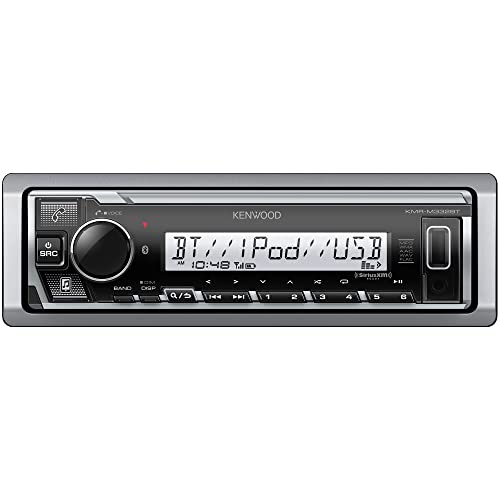
- Best for rough environments and clear app control with strong mechanical readability.
- Features: Single DIN, Bluetooth, USB MP3, AUX, AM/FM, SiriusXM-ready, weatherproof design, multi-color illumination.
- Best-use scenario: boats exposed to sun, spray, and heat; resistive design helps maintain readability in bright conditions.
Choose this for robust marine endurance and flexible smartphone connectivity, but expect slightly higher installation complexity in tight dashboards.
Pyle Marine Radio Speaker Set PLMRKT38W

- Best for upgrading onboard audio with dedicated marine speakers and an inline radio receiver.
- Features: Bluetooth streaming, built-in mic, 4 speakers, remote, wiring harness, IPX-rated water resistance.
- Best-use scenario: boats needing better overall sound distribution with durable, weatherproof speaker units.
Note this option is best used as an extension to the head unit system rather than a standalone radio alternative, and proper wiring is essential for optimal performance and safety.
Pyle PLRMR27BTB Marine Receiver

- Best for a compact, feature-packed Bluetooth unit with flexible inputs.
- Features: 300W peak, built-in mic, digital LCD, remote control, RCA outputs, USB, SD, AM/FM, Bluetooth.
- Best-use scenario: small cabin boats needing straightforward control and multiple media paths in a single DIN form factor.
Limitations: the unit may require careful mounting to access all controls in tight spaces, and advanced app features may vary by device compatibility.
Buying Guide
What to consider when choosing a Bluetooth radio for your boat:
- Power and sound: Look for a model with sufficient peak power for your boat size and speaker setup. More channels can provide better power distribution and louder output without distortion.
- Weather protection: Prefer units with marine-grade coatings, IP ratings, and corrosion resistance to endure sun, spray, and salt air.
- Connectivity: Decide between Bluetooth only or additional inputs like USB, SD, AUX, and SiriusXM readiness. NFC and app control add convenience on some models.
- Display and readability: Sunlight-readable LCDs and bright backlighting improve visibility in daylight and bright dashboards.
- Installation compatibility: Ensure the unit fits your dash size (single DIN vs. double DIN) and check wiring harness compatibility for your boat’s electrical system.
- Hands-free features: Built-in microphone and call handling are important for safe communications during operations.
Frequently Asked Questions
- What is a Bluetooth marine stereo best for?
Answer: It is best for wireless music streaming, hands-free calling, and controlling audio from smartphones while on the water. - Do marine stereos require SiriusXM to be useful?
Answer: No, but SiriusXM readiness can expand radio options if you subscribe and add a tuner. - Can these units withstand saltwater exposure?
Answer: Many are designed with weatherproof or IP-rated protection and corrosion-resistant components, but installation location matters for longevity. - Is single-DIN suitable for all boats?
Answer: It fits most smaller dashboards; larger cabins may accommodate double-DIN or stacked setups for better controls. - Is app control worth it on a boat?
Answer: App-based control can simplify operation and provide firmware updates, but ensure compatibility with your mobile device.