Answering the question of how to reliably charge multiple marine batteries at once, these 3-bank onboard chargers provide independent charging for each bank and protect against overcharge. They are best for boat owners who need dedicated charging for separate systems (starting, deep-cycle, and lithium packs) or for crews that run multiple 12V batteries aboard. The top picks below balance waterproofing, charging modes, and automatic protection features to keep batteries healthy in harsh marine environments. Use the quick-reference table to compare core specs before diving into detailed product sections.
| Product | Bank Count | Max Amps | ||
|---|---|---|---|---|
| NOCO Genius GEN5X3 | 3 | 15A total (5A/bank) | Lead-Acid & Lithium | IP-rated marine shell |
| FirstPower Pro 10X3 | 3 | 30A total (10A/bank) | Lead-Acid & Lithium | IP68 fully sealed |
| SOARFLY 3 Bank 30A | 3 | 30A total (10A/bank) | Lead-Acid & Lithium | IP68 waterproof |
| anegine 3 Bank 30A | 3 | 30A total (10A/bank) | Lead-Acid & Lithium | IP68 waterproof |
| FirstPower Pro 5X3 15A | 3 | 15A total (5A/bank) | Lead-Acid & Lithium | IP68 fully sealed |
Note: Each product section explains who benefits most, why it was selected, and any practical limitations. The aim is to help boat owners choose a 3-bank charger that matches battery types, environmental exposure, and maintenance preferences. Use the Buying Guide below to refine your selection based on mode options, dead-battery recovery, and mounting considerations.
NOCO Genius GEN5X3: A Compact 3-Bank Charger
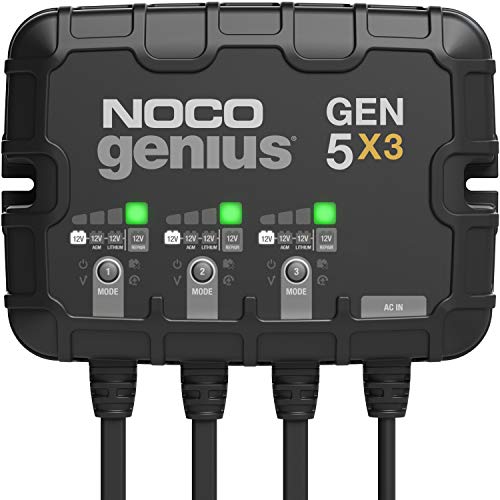
The NOCO GEN5X3 provides three independent banks with a total of 15 amps (5 amps per bank). It is designed for marine use, offering temperature compensation and overcharge protection across 12V lead-acid and lithium batteries. Best for boaters who want a compact, high-precision charger that can handle both AGM/Lithium and standard flooded batteries. A key limitation is that the unit prioritizes compact size over the buddy-lever of higher total amperage, so it may be better suited where space is at a premium and battery banks are not consistently heavily discharged simultaneously.
- Best for: Small to mid-sized vessels needing compact, multi-battery management
- Why selected: Independent banks and temperature compensation support diverse battery chemistries
- Caution: 5A per bank may be slow for large deep-cycle setups under heavy use
FirstPower Pro 10X3: High-Output 3-Bank Charger

This 3-bank charger delivers up to 30 amps total (10 amps per bank), making it well-suited for boats with heavy battery demand or many deep-cycle packs. It supports 12V SLA/AGM, 12V Lithium, and 12V Calcium with independent bank control. It is IP68 waterproof and offers a Force Mode to revive dead batteries. Choose this if you routinely run multiple systems and need faster replenishment. A potential drawback is higher power draw and price compared with lower-amperage models.
- Best for: Vessels with multiple high-current 12V batteries
- Why selected: Strong charging capacity with flexible battery-type modes
- Caution: Higher cost and power consumption
SOARFLY 3 Bank Marine Charger: 30A, IP68

SOARFLY’s 3-bank, 30A charger provides independent charging with three selectable modes for SLA/AGM, Li-ion, and calcium batteries. Its IP68 rating ensures durability in wet environments and its Force Mode helps recover deeply discharged cells. Best for boats with diverse battery chemistries and a need for reliable performance in rough seas. A limitation is that some users may need to verify compatibility with custom or rare lithium chemistries beyond LiFePO4.
- Best for: Boats with diverse battery chemistries and rugged use
- Why selected: Independent banks, robust IP68 protection, dead-battery recovery
- Caution: May require compatibility checks for some lithium chemistries
anegine 3 Bank 30A: Waterproof and Computer-Controlled
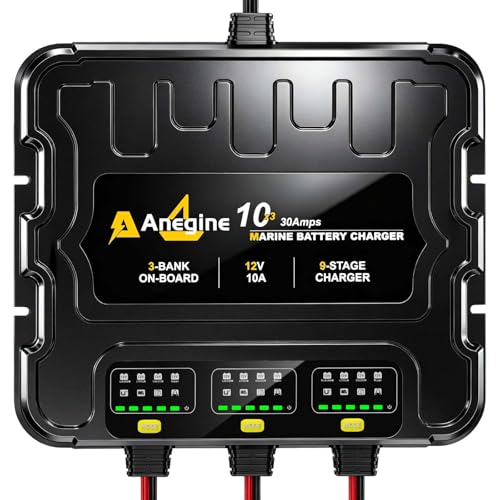
anegine’s 3-bank charger provides up to 10A per bank with IP68 waterproofing. It features Force Mode to revive dead batteries and supports lead-acid and lithium options, including LiFePO4. Best for boats needing reliable protection against overcharge while running multiple batteries in harsh marine environments. A potential limitation is the 10A per bank ceiling for deep-cycle systems that demand sustained higher current.
- Best for: Boats with multiple batteries and frequent exposure to water
- Why selected: Balanced power per bank with comprehensive protection features
- Caution: Moderate per-bank current may limit rapid charging for some setups
anegine 3 Bank 30A: IP68, 3-Bank with Overcharge Safety

This model combines IP68 waterproofing with balanced 3-bank charging at up to 10A per bank. It emphasizes overcharge protection and temperature compensation to protect battery life across SLA/AGM, LiFePO4, and other 12V chemistries. Best for users prioritizing robust protection and long-term battery health on saltwater boats. A caveat is that some installations may require additional space for wiring and mounting hardware.
- Best for: Saltwater boats needing durable, protective charging solutions
- Why selected: Strong protection, independent bank control, and temperature awareness
- Caution: Installation footprint may be larger on tight panels
FirstPower Pro 5X3: Lightly Powered Yet Versatile

The 5X3 option delivers 5A per bank across three banks, totaling 15A. It includes multiple charging modes for SLA/AGM, Li-ion, and Calcium batteries with independent bank control. Best for users needing steady, moderate charging across several batteries without high current demands. Limitation is slower replenishment for large, high-demand banks compared to 30A-per-bank models.
- Best for: Boats with several mid-sized batteries and moderate usage
- Why selected: Balanced performance, versatile mode options, solid protection
- Caution: Not ideal for heavy power draws or very large deep-cycle packs
Buying Guide: How to Choose a 3-Bank Marine Battery Charger
- What battery types will you charge? If you mix lead-acid and lithium, prioritize chargers labeled for both chemistries and with independent banks to prevent cross-charge issues.
- How many amps per bank do you need? For large deep-cycle banks, 10A–15A per bank provides faster replenishment; for modest setups, 5A per bank may suffice.
- Is IP68 waterproofing important? Boats frequently exposed to spray or immersion benefit from IP68-rated units.
- Do you need Force Mode or dead-battery recovery? If you regularly revive long-unused batteries, force/recovery features are valuable.
- Will the charger operate in Repair Mode or Temperature Compensation? These features help maximize battery longevity and performance in variable marine environments.
- How easy is installation? Consider footprint, mounting, and connector compatibility with your boat’s wiring harness.
Frequently Asked Questions
- What is a “3-bank” charger? A charger that independently charges three 12V battery banks inside the same unit, enabling separate charging profiles for different batteries.
- Can I use a 3-bank charger with LiFePO4 batteries? Yes, if the unit supports lithium modes (LiFePO4) and has proper voltage and current settings for that chemistry.
- What is Force Mode? A mode that starts charging a deeply discharged battery (down to near 0V) to attempt a revival when standard charging cannot begin.
- Is waterproofing essential for on-deck use? For exposed installations, IP68 waterproofing provides robust protection against water immersion and spray.
- Do these chargers require professional installation? Some boats may need an electrician to ensure correct wiring, fuse sizing, and safe mounting, especially in saltwater environments.
- How do I know which charger is best for me? Match the total required current, per-bank amperage, battery types, and environmental exposure to the features described in the buying guide.