Answer: If you need a reliable outboard motor bracket for small to mid-size engines, these five options cover common 7.5–20 HP outboards with solid construction, adjustable height, and easy mounting. They’re suited for small fishing boats, dinghies, and tenders that require stable engine support and simple lift mechanisms. This guide compares the top five brackets by material, height range, load capacity, and key design features to help you choose the right one.
Buyer-friendly table of selected products:
| Product | Brand | HP Range | Material | Notable Feature |
|---|---|---|---|---|
| Marinebaby Boat Outboard Motor Bracket | Marinebaby | 7.5–20 HP | Aluminum with stainless springs | 5-position height adjustment |
| 2 Stroke Outboard Motor Bracket Kicker | Haida | Up to 20 HP | 304 stainless steel | Roller system, compact base |
| FUTURUP Boat Outboard Motor Bracket | FUTURUP | 7.5–20 HP | Aluminum | Reinforced frame, 4-position height |
| Mojiate Outboard Bracket Heavy Duty | Mojiate | 7.5–20 HP | 304 stainless steel | Heavy-duty welded frame |
| YaeMarine 2 Stroke Outboard Bracket | YaeMarine | Up to 25 HP | All stainless steel | Carry up to 110 lbs |
Marinebaby Outboard Motor Bracket — Aluminum, 20 HP
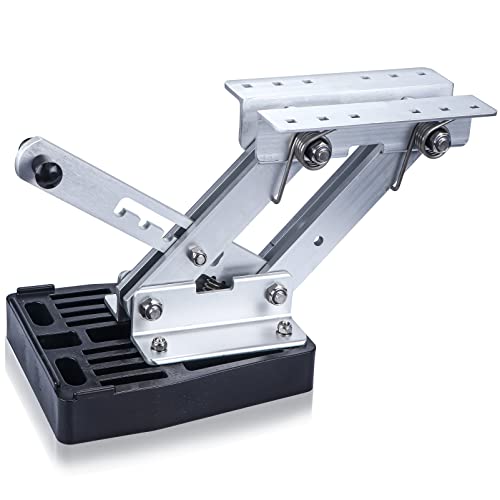
Best for: Small workboats and trollers needing a sturdy aluminum bracket with straightforward height adjustment. Reason: It uses a solid polypropylene mounting board and stainless steel springs to counter-balance motor weight, supporting 7.5–20 HP engines with a 5-position height range (195mm–320mm).
Why selected: This bracket offers a reliable combination of light-but-strong aluminum construction and simple lift control, ideal for portable or seasonal boats where weight matters.
Caution: Ensure mounting holes on your transom align with the bracket’s 5-position range; verify fit for your specific transom dimensions.
Haida 2 Stroke Outboard Bracket — 20 HP

Best for: Boats that require a stainless steel framework with a plastic base for light-to-moderate loads. Reason: The 304 stainless steel construction provides corrosion resistance in saltwater environments, with a mounting size of 4-7/16″ × 5-11/16″ and a practical 8-1/4″ × 10-3/8″ roller area.
Why selected: It’s a compact, corrosion-resistant option suitable for small sailing or fishing craft that need a simple lever-style lift and secure hold.
Caution: Manual lifting is required to raise and lower the motor; not ideal if you need powered adjustment or very frequent repositioning.
FUTURUP Aluminum Outboard Bracket — 7.5–20 HP

Best for: Users wanting a wide, stable track with easy retractable capability for sailing or auxiliary use. Reason: Radiates stability with a reinforced welded frame and stamping stainless parts plus a 4-position height adjustment.
Why selected: The combination of a wide track body and stainless hardware makes it a robust choice for frequent motor changes or variable water conditions.
Caution: Maximum listed weight is 115 lbs; ensure your engine weight stays within the bracket’s supported range.
Mojiate Heavy Duty Outboard Bracket — 20 HP

Best for: Boats needing stainless steel construction with maximum corrosion resistance and heavy-duty support. Reason: The bracket uses high-quality 304 stainless steel with a reinforced welded frame and an adjustable 4-position vertical system, suitable for 7.5–20 HP engines.
Why selected: Strong, durable, and designed to withstand marine environments while offering reliable elevation control for balance and performance.
Caution: The base is plastic; verify compatibility with long-term mounting loads and ground clearance on your particular craft.
YaeMarine 2 Stroke Outboard Bracket — Up to 25 HP

Best for: 2-stroke engines requiring a full stainless steel, high-strength bracket for up to 110 lbs. Reason: The all-stainless stamped construction supports robust power transfer and longevity, with a wide mounting pad and tall vertical lift (10.5″).
Why selected: This option offers maximum corrosion resistance and a higher weight ceiling, making it suitable for boats that push the limits of 20 HP brackets.
Caution: Not recommended for most 4-stroke engines; ensure your motor matches the 2-stroke compatibility.
Buying Guide: Key Considerations
- Engine compatibility: Confirm HP range, engine type (2-stroke vs 4-stroke), and weight before choosing a bracket.
- Materials and corrosion protection: Stainless steel and aluminum with protective finishes extend life in saltwater environments.
- Mounting footprint: Check mounting dimensions, bolt patterns, and transom thickness to ensure a proper fit.
- Height adjustability: Consider how many height settings you need and whether a locking mechanism is offered.
- Base design: Plastic bases are lighter but may wear sooner; metal bases tend to be sturdier for heavier motors.
- Ease of lifting: Some brackets include springs or counterweights; others require manual lifting—factor in how often you reposition the engine.
- Storage and portability: If you transport the boat seasonally, choose brackets that are easy to mount/dismount and store.
Frequently Asked Questions
- What size outboard motor bracket do I need?
Choose a bracket that matches your engine’s HP range and weight. For most small to mid-size boats, brackets rated 7.5–20 HP are common and compatible with 2-stroke motors.
- Are stainless steel brackets better than aluminum?
Stainless steel offers superior corrosion resistance and durability in saltwater, but aluminum brackets are lighter and often sufficient for inland use.
- Do brackets require professional installation?
Most brackets use standard mounting holes and basic hardware, but verify compatibility with your transom and consider professional mounting if you’re unsure.
- Can I use a 25 HP bracket for a 20 HP motor?
Many 25 HP-rated brackets can accommodate up to 20 HP motors, but always confirm the rated load and mounting compatibility to avoid overstressing the bracket.
- What maintenance is needed for these brackets?
Regularly inspect mounting bolts, springs, and pins for wear or corrosion; lubricate moving parts if recommended by the manufacturer.