The best dual boat battery chargers deliver safe, automatic charging for two 12V batteries, letting you run electronics, trolling motors, and bilge pumps with confidence. This guide highlights top options that work with SLA/AGM, LiFePO4, calcium, and deep‑cycle batteries, with clear guidance on who should choose each. Ideal buyers include offshore cruisers needing rapid two‑bank charging, weekend boaters seeking 24/7 upkeep, and anyone reviving deeply discharged batteries without manual effort.
Summary table of selected products:
| Product | Best For | Why It Stands Out |
|---|---|---|
| Smart 2 Bank Marine Battery Charger, 10A (5A/Bank) — Zrfmib | General use on boats needing 2 banks | Independent bank modes; compact waterproof design |
| 2 Bank Marine Battery Charger 5X2 — FirstPower Pro | All battery types; 24/7 onboard charging | IP68, force mode, robust protection |
| 2 Bank Marine Battery Charger, 20A (10A/Bank) — anegine | Higher current for faster charging | High per-bank output; solid protection suite |
| LiTime 2-Bank 10A — LiTime | LiFePO4 and mixed chemistries | Smart indicators; CE/FCC/RoHS; IP65 |
| Power Queen 2 Bank 20A (10A/Bank) | Smart dual-channel with wide battery compatibility | Activation feature; comprehensive LED status |
Smart 2 Bank Marine Battery Charger, 10A

Best for: boaters needing two independent charging channels with mode selection for SLA/AGM, lithium, and calcium. This charger automatically switches from full charge to float, helping extend battery life.
Why this pick: It supports two batteries simultaneously and lets each bank choose its charging mode via a MODE button. It can recover deeply discharged batteries by manual activation when a bank drops below 1V.
Caution: No details on external connectors beyond onboard use; ensure your battery types align with the supported modes before installation.
2 Bank Marine Battery Charger 5X2 — FirstPower Pro

Best for: marine workloads that require 24/7 charging with robust weather sealing. Independent banks ensure each battery gets appropriate charge.
Why this pick: IP68 waterproofing, 2×5A per bank, and a FORCE mode to revive deeply discharged cells. Suitable for a wide range of 12V lead-acid and lithium batteries.
Caution: Some users may prefer higher total output if you regularly charge larger battery banks simultaneously.
2 Bank Marine Battery Charger, 20A — anegine
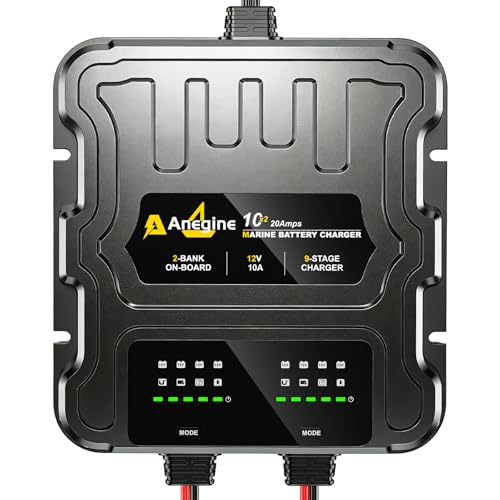
Best for: faster charging on two 12V batteries when you need quicker turnaround times on the water.
Why this pick: Delivers up to 10A per bank (20A total) with IP68 waterproofing and a force mode to wake deeply discharged batteries. Each bank operates independently for precise charging.
Caution: Higher power output may require additional space in cramped compartments and careful heat management in hot climates.
LiTime 2-Bank 10A — LiTime

Best for: LiFePO4 batteries and mixed chemistries needing smart protection and compact dual-channel charging.
Why this pick: Each bank provides 10A; has CE/FCC/RoHS certification, IP65 waterproof, and multiple protections to guard against over-temperature and short circuits.
Caution: Ensure the charger’s voltage matches your battery chemistry and that the remote environment remains within IP65 limits for best results.
Power Queen 2 Bank 20A — Power Queen
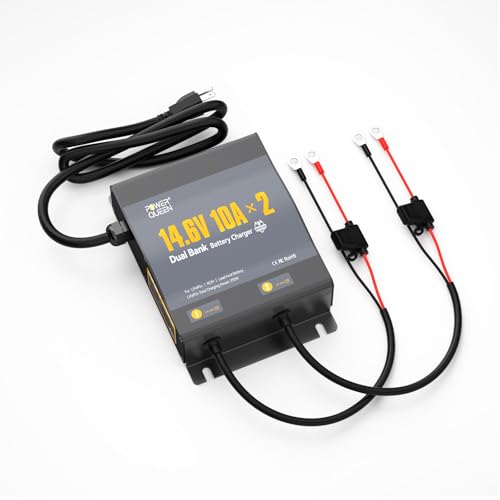
Best for: boaters seeking clear status indicators and activation features to revive BMS-protected lithium packs.
Why this pick: Dual 10A channels with independent charging, a wide battery compatibility range, and LED status for quick checks. Activation function helps extend battery life with LiFePO4 and other chemistries.
Caution: Activation features may require careful handling to avoid unintended charging on incompatible batteries.
Buying Guide: Choosing the Right Dual Battery Charger
What battery chemistries do you need to support?
Look for chargers that support SLA/AGM, Ca/Ca, LiFePO4, and general lithium. Independent bank control helps ensure the right charge profile per battery.
How important is IP rating and marine-grade durability?
In marine environments, IP68 or IP65 waterproofing minimizes water exposure risk. A rugged case and sealed connectors help prevent corrosion and salt damage.
What charging speed and current matter most?
Higher total output accelerates charging, especially when you have two large batteries. Ask for per-bank current (A) and total watts (W) to compare fairly.
Is force mode or dead-battery recovery needed?
Force mode or dead-battery recovery helps revive batteries that dip below 1V. This feature is useful for boats that sit idle for extended periods.
How easy is setup and monitoring?
Simple MODE toggles and clear LED indicators simplify usage. Some models provide LCD displays or app-like indicators for status checks without opening compartments.
What about compatibility and installation limits?
Confirm battery chemistry compatibility, voltage (12V most common), and any space, mounting, or heat constraints in your boat’s battery compartment.
FAQ
- Can I use a dual charger with different battery chemistries? Yes, if the charger supports multiple modes and independent bank control to tailor charging profiles per battery.
- What does IP68 waterproofing mean in practice? It indicates complete protection from dust and immersion in water up to a certain depth, suitable for boat installations.
- Should I choose 5A per bank or 10A per bank? Choose based on battery size and desired charging speed; larger batteries benefit from higher per-bank current.
- What is dead-battery recovery? A feature that allows manual activation to recover very discharged or unused batteries, improving usability on boats that sit idle.
- Do these chargers require professional installation? Most can be installed by a competent do-it-yourselfer, but follow the manufacturer’s mounting and wiring guidelines and consider professional help if unsure.
- Are there safety protections to prevent overcharging? Yes, most models include over-current, over-voltage, short-circuit, and temperature protections to safeguard both batteries and equipment.