Answering the question for anglers and boaters: choose a depth finder with an in-hull transducer for clean readings, reduced hull drag, and reliable depth data at speed. This guide highlights five options that pair in-hull (or thru-hull) transducers with clear displays and practical features. Best for high-speed coastal trips, saltwater or freshwater use, and boats with solid fiberglass hulls. A quick comparison table follows to help you decide at a glance.
| Product | Best For | Key Benefit |
|---|---|---|
| DepthTrax 2B Boat Mount In Dash Digital Depth Finder (Hawkeye) | Mid-to-large boats seeking integrated in-dash depth with through-hull flexibility | Supports transom or glue-in transducers and solid hulls up to 1/8″ aluminum |
| HawkEye DT2BX-TH In-Dash Depth Sounder (Thru-Hull Transducer) | Vessels needing true thru-hull depth with temperature | Includes thru-hull transducer and temperature readings |
| Garmin GT15M Transducer | Fiberglass hull boats wanting hull-inside mounting and CHIRP depth | Hull-inside installation, supports high-speed readings |
| Faria Beede 13795 Chesapeake Depth Sounder Thru-Hull | Classic, oversized display with alarms for deeper setups | Thru-hull depth sounder with clear back-lit display |
| Faria Beede Kronos 19151 Depth Sounder (in-Hull Mounted Transducer) | Compact, rugged in-hull option for tight spaces | In-hull mounted transducer with stylish dial design |
DepthTrax 2B Boat Mount In Dash Depth Finder

DepthTrax 2B provides uninterrupted depth readings from 2.5 to 600 feet on a large in-dash display. It supports a 200 kHz transducer and offers a 3-stage Advanced Warning System with audible alarm, bright LED warning light, and LCD indicators. Best for boaters who want a robust, high-contrast display and flexible mounting for fiberglass hulls or aluminum hulls up to 1/8 inch.
Who it’s best for: anglers and open-water cruisers who need dependable, high-contrast depth data at speed. Reason for selection: strong compatibility with through-hull or glue-in transducers and a comprehensive alarm system. Caution: ensure your hull compatibility since optimal transducer mounting varies by hull construction.
HawkEye DT2BX-TH In-Dash Depth Sounder (Thru-Hull Transducer)

DT2BX-TH delivers continuous depth from 2.5 to 600 feet on the largest display in its class, with a 3-stage warning system that includes audible alerts and an LCD indicator. It includes a Transom Mount Transducer with 30 feet of cable and adds air/water temperature readings. Best for boats that need a true thru-hull installation for accurate data at higher speeds.
Who it’s best for: boaters requiring integrated temperature data along with depth. Reason for selection: proven depth range and temperature readouts in a single unit. Caution: thru-hull transducers require careful installation through the hull and may require professional drilling.
HawkEye DT2BX-TH In-Dash Depth Sounder (Includes Thru Hull Transducer)
Note: This model is the same DT2BX-TH lineup, emphasizing instant depth updates and air/water temperature readings. It includes a thru-hull transducer and is suitable for boats needing precise, continuous depth data through a robust hull installation.
Who it’s best for: users who want an immediate depth read with temperature metrics. Reason for selection: integrated temperature sensors add value beyond depth alone. Caution: effective sealing around the through-hull penetration is essential to prevent leaks.
Faria Beede Chesapeake Depth Sounder Thru-Hull

The Chesapeake Depth Sounder from Faria Beede features an oversized back-lit display with audible and visual alarms for elevation. It’s designed for reliable performance in various lighting conditions. Best for anglers who want a classic, easy-to-read interface with dependable depth alarms.
Who it’s best for: traditional cockpit layouts and users who prefer a large, legible dial display. Reason for selection: strong emphasis on visibility and alarms. Caution: feature set is focused on depth and alarms; temperature readouts are not specified in this model.
Faria Kronos Depth Sounder (In-Hull Transducer)
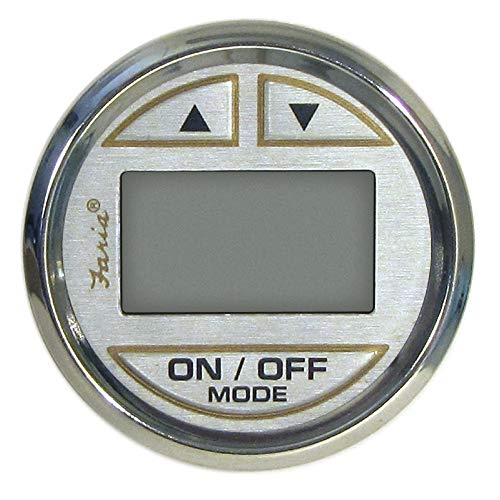
The Kronos Depth Sounder uses an in-hull mounted transducer to deliver depth readings. Its perimeter-lighted spun-aluminum dial and embossed gold graphics provide a classic, high-contrast presentation. Best for boats where a compact, traditional gauge is preferred over digital panels.
Who it’s best for: seafarers who value a stylish, durable dial with clear depth presentation. Reason for selection: combines an in-hull transducer with a reliable, easy-to-read display. Caution: may not include all advanced digital features found in newer displays.
Garmin GT15M Transducer

The GT15M transducer is designed for hull-inside installation, suitable for fiberglass hulls without transom cavitation concerns. It supports mid-band CHIRP sonar (85–165 kHz) and a 600 W power rating, combining depth accuracy with reliable performance at higher speeds. Best for boats moving quickly where hull integrity is a priority.
Who it’s best for: speed-focused boats that need consistent depth when mounted inside the hull. Reason for selection: CHIRP depth capability and hull-friendly installation. Caution: installation requires precise hull preparation and sealing to protect electronics.
Buying Guide: Key Considerations For In-Hull Depth Readouts
What should you check before buying a depth finder with an in-hull transducer?
- Hull type and mounting method: Confirm whether the transducer is designed for thru-hull, glue-in, or inside-hull mounting on your fiberglass or aluminum hull.
- Transducer frequency and beam angle: Higher frequencies offer finer detail; consider 200 kHz for standard depth; CHIRP options improve target separation at depth.
- Power rating and depth range: Look for devices rated to handle at least 2.5–600 feet if you plan deep-water use.
- Display visibility: Large, high-contrast screens help reading in bright sunlight and at angles typical during fishing or cruising.
- Alarm and alert features: A 3-stage warning system can provide audible alerts and visual cues for rapid depth changes.
- Additional sensors: Temperature data and voltage readouts add utility for all-season boating.
- Installation considerations: Thru-hull installations require precise drilling and sealing; indoor-hull options avoid penetrating the hull but may require routing.
FAQ
- What is an in-hull transducer? It is a transducer mounted inside the hull, providing depth readings without a through-hull hole.
- Can I install a depth finder with a thru-hull transducer myself? It’s possible but requires precision drilling and sealing to prevent hull leaks.
- Do depth finders with temperature readings exist? Yes, several models include air and water temperature sensors.
- Is CHIRP better than traditional sonar for depth accuracy?
- What should I prioritize for high-speed boating? Choose a depth finder with a fast update rate, a clear display, and a transducer designed to minimize cavitation issues at speed.