Answering the question “which fishing boat anchor system should I buy?” this guide highlights versatile, dependable options for different boat sizes and environments. Ideal for anglers, pontoon operators, and casual boaters, these selections balance holding power, ease of use, and durability. The top five picks below target common boating needs such as sand, mud, and shallow-water anchoring, making it easier to choose the right system for your craft.
Summary table of selected products:
| Product | Best For | Notes |
|---|---|---|
| Seachoice River Anchor | Stability on varied bottoms | Vinyl-coated cast iron with strong penetration |
| Anchor Kit Fluke Anchor Set | Complete package for multiple boats | Includes chain and rope |
| Attwood Anchor Lift System | Easy dropping and retrieving | Self-lubricating nylon wheels |
| Sand Spike Boat Anchor | Shallow water and sand bars | Slide hammer for quick set |
| Power-Pole Micro Anchor | Compact, quick-deploy anchor | Simple, lightweight design |
Seachoice River Anchor, Black Vinyl Coated Cast Iron, 12 Lbs.

Best for powering into bottoms and providing reliable hold in a variety of lake and river conditions. The 12 lb cast iron design is built for durability and penetration, with a protective black vinyl coating to resist corrosion and wear.
- Best for boaters needing strong penetration and durability in mixed bottom types.
- Better for smaller to mid-sized craft where a sturdy, penetrating anchor is preferred.
Who it’s for and why selected: Ideal for anglers and small- to mid-sized boats that require dependable holding power with minimal fuss. The anchor’s design emphasizes solid grip on soft sediments while remaining durable under regular use. A potential limitation is its heavier cast-iron build, which may be less convenient for distant or backpack-style deployments on very small craft.
Anchor Kit Fluke Anchor with Chain & Rope
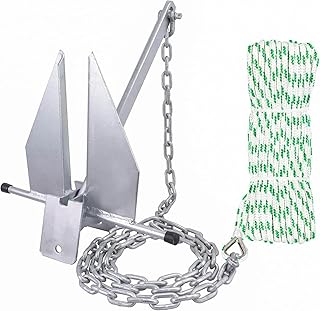
Best for boats that need a ready-to-use, all-in-one anchoring solution. This kit includes a fluke-style anchor, chain, and rope, offering a balanced combination of stability and handling for pontoons and larger small boats.
- Better for boats requiring a complete anchoring setup rather than multiple separate components.
- Choose this if you want a single purchase that covers chain and line, simplifying installation.
Who it’s for and why selected: Suited for pontoon boats and dawn-to-dusk anglers who value convenience and a bundled solution. Limitation: the exact chain and rope composition may vary, so compatibility with your cleats and windlass may need verification.
Attwood 13710-4 Anchor Lift System

Designed to simplify dropping, raising, and storing an anchor. Features a heavy-gauge steel construction with a durable powder-coated finish and self-lubricating nylon wheels for smoother operation.
- Best for boats that need frequent anchor deployment and retrieval with minimal effort.
- Better for users prioritizing mechanical ease over a purely compact anchor solution.
Who it’s for and why selected: Ideal for boaters who anchor often or in commercial contexts where quick anchor handling matters. Limitation: installation may require mounting space and compatibility with existing hardware on older boats.
Sand Spike Boat Anchor

Best for shallow-water adventures and sandy or beachy shores. The 39-inch spike provides quick set-up with a slide hammer and rubber-coated handle for comfortable operation.
- Best for shallow water and beach launches where quick, secure anchoring is needed.
- Limitations: works best in soft sand; may not perform as well on rocky bottoms.
Who it’s for and why selected: Suitable for kayaks, small pontoons, and shallow-water boats that require an easy-to-deploy anchor in soft substrates. Choose this if you frequently anchor near shorelines and sandbars. Avoid if anchoring on rocky or dense substrates.
Power-Pole Micro Anchor

Compact and lightweight, the Power-Pole Micro Anchor is designed for quick deployment with minimal bulk. Suitable for smaller boats and short-duration anchoring needs where space is at a premium.
- Best for anglers using compact boats or requiring a lightweight, simple setup.
- Better for temporary or light-duty anchoring; may not suit heavy use on larger vessels.
Who it’s for and why selected: Ideal for small boats, kayaks, and light-duty needs where portability matters. Choose this if you want a simple, quick-deploy anchor. Consider a larger anchor for heavier boats or rougher water conditions.
Buying Guide
What anchor type matches your boat and bottom conditions?
Bottom type (sand, mud, vegetation, rock) heavily influences anchor choice. Fluke and plow-style anchors excel on mud and sand, while mushroom or grapnel types offer steadier holds in rocky or weedy bottoms. Consider a kit that includes chain or rope, as chain improves holding power and gear alignment.
How important is ease of use and storage?
Boat size and typical anchoring frequency determine whether a lift system or a simple anchor with rope suffices. Lift systems reduce manual effort and improve storage, but require space and mounting. For casual anglers, a ready-to-use kit may save setup time.
Material durability and maintenance considerations
Vinyl-coated iron provides durability and corrosion resistance. Stainless steel or galvanized components resist corrosion in saltwater but may cost more. Self-lubricating wheels and powder-coated finishes reduce wear and maintenance over time.
Package contents and compatibility
Many kits include rope and chain. Confirm compatibility with your boat cleats, windlass if applicable, and available mounting space. A bundled package can simplify purchasing, but verify item specifications before buying.
Deployment conditions and vessel size
Choose a heavier anchor for larger boats or rough seas. Lighter anchors suit small craft and calm conditions. If you anchor near shore or in shallow water, a spike or sand anchor might offer faster, easier setup.
Safety and handling tips
Always check anchor line for wear, avoid overloading winches, and maintain a clear path during deployment. Use a buddy system when handling large anchors in windy conditions to prevent injuries and accidental gear loss.
FAQs
- Q: What anchor is best for muddy bottoms? A: Fluke or plow-style anchors typically perform well in mud due to their holding shape and digging capability.
- Q: Should I buy a kit with chain and rope? A: Yes, a chain enhances weight distribution and improves anchor hold; rope provides flexibility for various mooring needs.
- Q: Are lift systems worth it for small boats? A: They can be useful for frequent anchor use, reducing manual effort and storage space, but may be overkill for occasional anchoring.
- Q: Can I use any anchor on saltwater? A: Most anchors are suitable for saltwater, but verify corrosion resistance and coatings to maximize longevity.
- Q: How heavy should an anchor be for a 20-foot boat? A: Anchor weight scales with boat size and typical conditions; 8–20 pounds is common for smaller craft, while larger boats may require heavier anchors.
- Q: Do I need a windlass with a heavier anchor? A: Windlasses simplify handling heavier anchors, especially on boats where lifting manually is strenuous.