Answering the common buyer question: which flat bottom boat motors offer reliable power, easy handling, and corrosion resistance for small craft? This guide highlights five top choices across 6HP–18HP ranges, each suited to dinghies, inflatable boats, kayaks, and similar flat bottom designs. It covers who each motor is best for, why it stands out, and a clear note on limitations to help you compare quickly.
| Product | Horsepower | Best For |
|---|---|---|
| BJTDLLX 6HP Outboard | 6 HP | Small, inflatables and dinghies needing reliable water cooling |
| Gosangom 3.5HP | 3.5 HP | Lightweight, portable setups and casual paddling craft |
| COFECO Hangkai 12HP | 12 HP | Faster cruising with a robust cooling and CDI system |
| NAZEAOB 18HP | 18 HP | Heavier loads and faster travel on larger flat bottom boats |
| GrfceVue 6HP 4-Stroke | 6 HP | Quiet operation and reliable performance with air cooling |
BJTDLLX 6HP Outboard Motor

The BJTDLLX 6HP is a compact, light 2-stroke outboard with water cooling and a built-in CDI ignition. It is designed for short-shaft configurations and can push lightweight craft with solid efficiency. Best for small inflatable boats or dinghies that need dependable, quick-start power on calm waters. The 360° steering rotation supports easy reverse maneuvers, which helps when docking or navigating tight spaces. A key limitation is that 2-stroke engines typically require mixed fuel and more frequent maintenance than some four-stroke rivals.
Who this is for
- Owners of small inflatable boats or dinghies seeking simple, direct propulsion.
- Boats needing easy reverse control without complex gear shifting.
Gosangom 3.5HP Outboard Motor

This 3.5HP 2-stroke motor offers lightweight portability with a compact 36 x 14.17 x 5.9 inch footprint and a total weight around 21.6 pounds. It features water cooling, a CDI ignition system, and a three-blade propeller designed to minimize water resistance. It excels for quick trips and light-craft cruising where fuel efficiency and portability are priorities. A potential drawback is its smaller power output, which may not suit faster touring or heavier loads on windy days.
Who this is for
- Users who prioritize a super-lightweight, easy-to-move motor for small boats.
- Owners needing a simple two-stroke setup for casual, short-range trips.
COFECO Hangkai 12HP Outboard
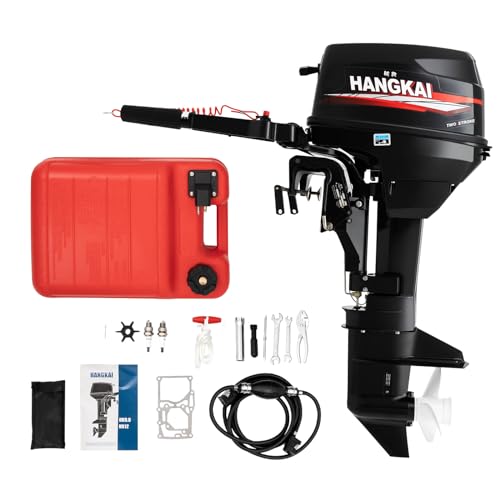
The COFECO Hangkai 12HP combines higher horsepower with a water-cooling system and a CDI ignition, enabling faster cruising and responsive control. It offers three gears for forward, neutral, and reverse, letting you adjust speed more precisely for varied water conditions. This model is well-suited for medium-sized flat bottom boats that require stronger propulsion without sacrificing control. A potential limitation is its higher power draw, which may impact fuel economy in frequent short trips.
Who this is for
- Boat owners needing more thrust for faster travel with reliable engine cooling.
- Users who value multiple speed settings for cruise control on open water.
NAZEAOB 18HP Outboard

The NAZEAOB 18HP is a robust 2-stroke engine designed for smaller boats that need higher thrust. With a three-gear transmission and CDI ignition, it supports efficient cruising at 4,500–5,500 RPM and maximum thrust suitable for heavier loads. It is best for flat bottom boats that require faster transit or carrying more gear. The device’s heavier build means it’s less ideal for very light or small inflatables where weight distribution is critical.
Who this is for
- Owners of larger flat bottom boats who require stronger propulsion and higher load capacity.
- Users who routinely travel longer distances or need quicker acceleration.
GrfceVue 4-Stroke 6HP

The GrfceVue 6HP is a four-stroke option with air cooling, a key safety feature, and a two-gear forward/neutral configuration. Its 4500–5500 RPM range balances speed and efficiency for casual cruising on flat bottom boats. The air-cooled design can offer longer engine life in hot climates, but users should monitor for overheating on long, strenuous runs. It is a solid pick for those who want a quieter, more maintenance-friendly option than some two-stroke models.
Who this is for
- Customers seeking a quieter, cooler-running motor for regular use.
- Boaters who prefer a simpler two-gear control and steady cruise performance.
Buying Guide: Flat Bottom Boat Motor Essentials
Key considerations help align choice with boat type, water conditions, and usage style. Below are practical questions and answer-style guidance to compare options.
- What power level do I need for a flat bottom boat?
Choose 3.5–6HP for small inflatables or dinghies and 12–18HP for heavier loads or larger boats requiring faster speeds. - Two-stroke vs. four-stroke: which is better?
Two-stroke engines (like the 2-stroke examples above) are typically lighter and deliver quick acceleration but require fuel mixing and more frequent maintenance. Four-stroke engines offer smoother operation and longer intervals between service but can be heavier. - Water cooling and CDI ignition: why they matter?
Water cooling helps prevent overheating on extended runs, while CDI ignition supports reliable starts in varying temperatures and conditions. - Shaft length and mounting: what to check?
Short shafts fit smaller vessels; long shafts suit deeper transoms for better prop clearance. Confirm alignment with your boat’s transom height. - Maintenance and fuel use: what to expect?
Regular inspection of seals, fuel lines, and the propeller reduces failures. Two-strokes require oil mixing; four-strokes demand standard oil changes.
Common questions buyers ask
- Can these motors be used in saltwater?
Most listed models mention corrosion resistance, but always rinse after saltwater use to extend life. - Is a built-in fuel tank common?
Some models include a tank; others require external fuel supply. Check tank compatibility with your setup. - Do these motors include reverse gear?
Several listed options offer forward, neutral, and reverse; verify the model you choose has the gear controls you want. - Are there safety features I should look for?
Look for tilt pins, anti-vortex plates, and overheating protection to improve handling and safety on the water. - Which motor is best for portability?
Lighter, smaller two-stroke models are typically easiest to carry and install on compact inflatables.
FAQ
- What is the best flat bottom motor for a dinghy?
For small dinghies, a light 3.5–6HP two-stroke or a compact four-stroke around 4–6HP balances weight and performance. - How important is a water cooling system?
Water cooling helps prevent overheating and supports longer continuous use on flat bottom boats. - Should I choose a model with a CDI ignition?
CDI ignition improves starting reliability, especially in varying weather and fuel conditions. - Is a long shaft necessary?
Long shafts are needed if your transom height is high or you plan deeper water cruising; short shafts suit low transoms. - What maintenance is essential?
Regular fuel system checks, propeller inspection, lubrication, and cooling system maintenance are essential for longevity.