Answering the common question, these flotation foams provide buoyancy, insulation, and soundproofing for nonstructural boat applications. The best choices are lightweight, closed-cell formulas that resist water absorption and tolerate exposure to fuel and solvents. This guide highlights five top options and explains who each is best for—whether you’re sealing decks, filling voids, or reinforcing flotation in small craft. All selections are suitable for nonstructural use and can be shaped or finished to fit boatyards, workshops, or home projects.
| Product | Density | Kit Size | Best For |
|---|---|---|---|
| TotalBoat 2 Lb Density Kit | 2 Lb/ft³ | 2 Gallon Kit | Lightweight buoyancy, easy layering |
| Oycevila 2 Lb Density Kit | 2 Lb/ft³ | 2 Gallon Kit | Budget-friendly flotation and insulation |
| TotalBoat 6 Lb Density Kit | 6 Lb/ft³ | 2 Gallon Kit | Stronger support and carving capabilities |
| Fiberglass Supply Depot 2 Lb Kit | 2 Lb/ft³ | 1 Gallon Kit | Compact, easy pour for small voids |
| Fiberglass Supply Depot 4 Lb Kit | 4 Lb/ft³ | 1 Gallon Kit | Higher-density filling and structural-lite support |
TotalBoat 2 Lb Density Kit

This 2 Lb density, two-part closed-cell polyurethane foam expands quickly and cures in about five minutes at typical workshop temperatures. It’s ideal for lightweight buoyancy, insulation, and gap filling under decks. Best for nonstructural jobs needing easy layering in multiple batches. The foam is 94% closed-cell, offering strong resistance to water, gas, oil, and solvents. It can be coated with epoxy, polyester, or vinyl ester resins after curing. Use this when you want a workable, easy-to-model foam for small to medium voids.
Best for: boaters performing quick buoyancy additions or deck-level insulation where lightweight, carve-friendly foam is desired. Choose this if you need rapid curing and simple layering without a lot of weight.
Caution: While strong for its density, it is not designed for structural reinforcement or high-load flotation. Avoid using for load-bearing applications beyond stated nonstructural use.
Oycevila 2 Gallon Kit

This 2 Lb density, two-part polyurethane foam is designed for flotation and void filling with a focus on marine compatibility. It expands to form a closed-cell structure that traps air while resisting saltwater exposure. The kit emphasizes strength and durability despite its light weight, making it suitable for boats, sails, kayaks, and canoes. Insulation properties also help maintain temperature in compartments like fish boxes or bait wells. Best for: customers seeking a balance of buoyancy, insulation, and resistance to marine elements on smaller vessels.
Limitation: As a lighter-density foam, it may not offer the same rigid structural support as higher-density products in heavier-duty applications.
TotalBoat 6 Lb Density Kit
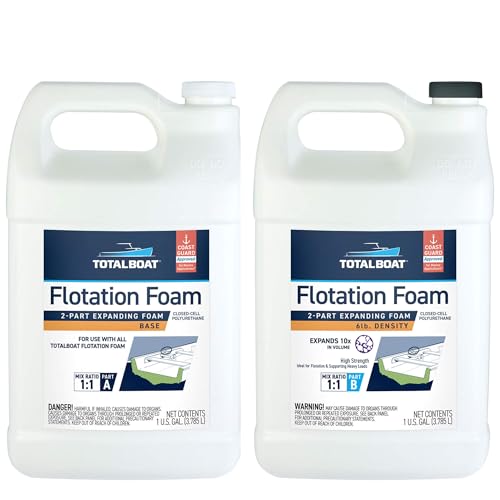
This kit uses a higher-density, 6 Lb/ft³ closed-cell polyurethane foam that cures very hard and rigid. It is suitable for more demanding flotation, casting, carving, sculpture, and light structural reinforcement tasks. The foam expands significantly and cures to a closed-cell structure that resists water, gasoline, and oil penetration. It accepts coatings of epoxy, polyester, or vinyl ester resins and can be painted. Best for: projects requiring stronger buoyancy support, durable fill for voids, or creative applications where rigidity matters. Choose this if you need a tougher foam that can be shaped and finished after curing.
Caution: Higher density means more weight; ensure weight budgets are considered for small craft or delicate installations.
Fiberglass Supply Depot 2 Lb Kit

This 2 Lb density, 1-gallon kit provides a compact, manageable option for small voids and deck-fill tasks. It produces about 5 cubic feet of foam when fully cured and can be poured in place to add buoyancy and soundproofing where needed. The product is designed for nonstructural use and is compatible with common boat resins once cured. Best for: quick, small-area buoyancy in limited spaces or for adding flotation to sections of a boat that require light, easily carved foam.
Limitation: For larger or higher-load flotation, you may need to consider higher-density foams or larger kit sizes to ensure adequate buoyancy and durability.
Fiberglass Supply Depot 4 Lb Kit

This 4 Lb density, 1-gallon kit offers a higher-density option for bulkier fills that still maintain ease of use. It produces about 2 cubic feet of foam and is designed to be laminated with epoxy, polyester, or vinyl ester resins after curing. Best for: situations where stronger buoyancy is required without moving to full structural foam. It can also provide additional rigidity for larger voids and heavier loads. Consider this when you need more buoyant mass per volume than 2 Lb foams provide.
Note: Heavier foam may demand more rigorous handling and curing considerations in tight spaces.
Buying Guide: Key Considerations For Boat Flotation Foam
- Density and buoyancy: Higher density foams offer greater rigidity and buoyancy but add weight. Choose 2 Lb or 4 Lb for lighter, easier-to-handle fills, or 6 Lb for stronger support in larger voids.
- Closed-cell structure: Look for 94% closed-cell formulations to minimize water absorption and resistance to fuels and solvents.
- Cure time and temperature: Fast-curing foams are convenient in the shop, but ensure ambient temperature supports proper cure times for your project.
- Compatibility with coatings: Verify that cured foam accepts resins (epoxy, polyester, vinyl ester) if you plan to seal or coat the surface.
- Nonstructural use only: Most marine flotation foams are intended for buoyancy and insulation, not for structural reinforcement. Review product claims before use in critical applications.
- Application and mixing: Most foams use a 1:1 mix ratio. Prepare in batches to fill large or layered sections without overheating or uneven expansion.
- Safety and handling: Use gloves and proper ventilation during mixing and curing. Some products can irritate skin or eyes; follow the manufacturer’s safety data.
Frequently Asked Questions
- What density foam is best for boat flotation?
– For lightweight buoyancy and insulation, 2 Lb density is common. For stronger buoyancy in larger voids, 4 Lb or 6 Lb densities offer more rigidity. - Can flotation foam be painted or coated?
– Yes. Most closed-cell polyurethane foams cure to a surface that can be painted with epoxy, polyester, or vinyl ester resins; some can accept standard paints after curing. - Is flotation foam suitable for structural reinforcement?
– No. These foams are designed for buoyancy, insulation, and void filling in nonstructural applications. Do not rely on them for structural support. - Will foam absorb fuel or water after curing?
– 94% closed-cell foams resist water absorption and chemicals; however, verify the specific product’s warranty and resin compatibility for your environment. - How should I apply foam under a deck or in a cavity?
– Mix in batches, pour or inject in layers, and allow each layer to cure before applying the next. Use barriers or formwork if needed to shape the foam precisely. - Can I mix different densities for a project?
– Yes, layering different densities is common to balance buoyancy with ease of shaping and finishing. Plan the layering sequence to meet buoyancy goals.