Answering the need for buoyancy, insulation, and gap filling, this guide highlights the best flotation foam sheets and kits for boats. Each product is chosen for its suitability to nonstructural buoyancy, ease of use, and compatibility with common resins. Ideal buyers include DIY boat restorers, hobby sailors, and small-boat builders seeking reliable, paint-compatible foam. The comparison table below provides quick at-a-glance details to help you decide which option fits your project and skill level.
| Product | Best For | Notes |
|---|---|---|
| TotalBoat 2 Lb Density Expanding Foam Kit | Lightweight buoyancy and insulation | 1:1 mix, fast cure, 94% closed cell |
| Seachoice Emergency Foam Flotation Cushion | Emergency flotation and throwable safety | Type IV cushion, USCG approved |
| Fiberglass Supply Depot Divinycell H-80 PVC Foam Core | High-load, flat panels | 5 lb density, closed-cell |
| TotalBoat 6 Lb Density Expanding Foam Kit | Structural reinforcement and flotation | High-density, 94% closed cell |
| 2 Gallon Kit Marine Flotation Foam (Oycevila) | Versatile marine foam with insulation | Lightweight, expanding polyurethane |
TotalBoat 2 Lb Density Expanding Foam Kit

Best for: Boat owners needing lightweight buoyancy and insulation. This two-part polyurethane foam expands to a 94% closed-cell foam, offering water resistance and structural fill for noncritical areas. The 1:1 mix and quick cure simplify application for small to medium voids under decks or around framing.
Why selected: It provides easy mixing, fast curing, and a marine-grade closed-cell structure that resists water and solvents. Coats well with typical boat resins. Caution: Avoid structural or load-bearing use beyond nonstructural filling.
Seachoice Emergency Marine Foam Flotation Cushion

Best for: Quick-response flotation in emergencies aboard small boats. This cushion is a USCG Type IV throwable device and is designed for immediate buoyancy in distress situations or as a backup safety measure.
Why selected: It provides certified flotation support and is readily deployed. Limitation: Not a bulk-fill foam for structural buoyancy; intended as a safety device rather than deck-wide insulation or reinforcement.
Fiberglass Supply Depot Divinycell H-80 PVC Foam Core

Best for: Flat panel laminations needing high stiffness and load-bearing performance. H-80 is a closed-cell PVC core with higher density, ideal for structural sandwiches and demanding composite sections.
Why selected: Higher strength-to-weight ratio supports heavier loads in panels, improving stiffness and durability. Caution: Not a spray or pour foam; suitability limited to laminate cores and rigid panels.
TotalBoat 6 Lb Density Expanding Foam Kit

Best for: Projects needing rigid, high-density foam for flotation, casting, or structural reinforcement. This kit uses a two-part system with a higher density for stronger, more durable fills and supports.
Why selected: The 6 lb density offers greater compressive strength and compatibility with epoxy, polyester, or vinyl ester resins. Caution: Heavier foam means slightly longer cure times and weight considerations in tight spaces.
2 Gallon Kit Marine Flotation Foam (Oycevila)
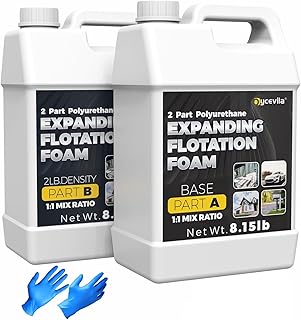
Best for: Mixed-use foam with insulating properties and good flotation for various watercraft. The kit expands to create a closed-cell structure that traps air and resists water penetration.
Why selected: It combines flotation with insulation benefits, useful for creating pockets of buoyancy while maintaining temperature stability. Caution: Check for compatibility with your chosen resin system before coating or finishing.
Buying Guide
Key purchase considerations help choose the right foam for your boat project.
- Foam type and purpose: Decide between pourable polyurethane foams for void filling, and solid core foams for panels and stiffness. Closed-cell content matters for water resistance.
- Density and strength: Lower densities suit light buoyancy and insulation; higher densities offer better structural support but add weight.
- Cure time and handling: Fast-curing foams speed up projects, but require quick working temps and careful batching. Consider your working environment.
- Resin compatibility: Ensure foam is compatible with epoxy, polyester, or vinyl ester resins if you plan to coat or integrate with existing composite parts.
- Intended use: Reserve higher-density foams for structural reinforcement; use lightweight foams for deck voids and insulation.
- Safety and certifications: For emergency flotation devices, prefer items with recognized certifications (e.g., USCG Type IV). For nonstructural fills, verify guidance for marine use.
FAQ
- What is the difference between spray and pour foams for boats?
– Pour foams cure in place and fill voids precisely, while spray foams cover larger areas quickly and may require masking and safety precautions. - Can all these foams be painted or coated?
– Most marine foams cure to a surface that can be coated with epoxy, polyester, or vinyl ester resins; check product-specific guidance. - Is higher density always better for flotation?
– Higher density provides more rigidity and load-bearing capacity, but adds weight; balance buoyancy needs with boat size and structural requirements. - Are there safety considerations when using marine flotation foams?
– Follow manufacturer mixing ratios, temperature recommendations, and ventilation guidelines. Avoid open flames and ensure proper cure before handling. - Can these foams be used in open water for emergency flotation?
– Some items are certified for emergency flotation (like Type IV cushions), but most pour foams are for noncritical buoyancy and structural fills.