When choosing foam float strips for a boat lift, you want durable, closed-cell foam that resists water absorption and provides reliable buoyancy. This guide helps buyers pick the right foam strips and related flotation foams for marine applications and deck protection. It targets boat owners, DIY marine renovators, and maintenance crews seeking dependable buoyancy and cushioning under decks, pontoons, or lift platforms. The following selections are optimized for stability, ease of installation, and long-lasting marine performance.
TotalBoat 6 Lb Density Expanding Foam Kit
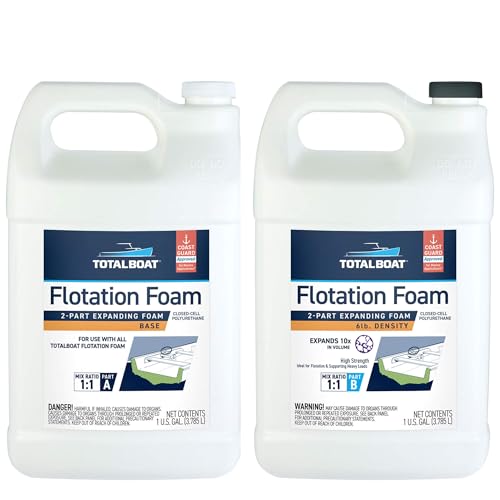
Best for: Marine hull reinforcement and buoyant void filling where a hard, rigid foam is needed. This two-part marine-grade expanding foam cures to a 94% closed-cell foam, trapping air to prevent liquids from penetrating. It’s ideal for flotation, structural reinforcement, and decorative work where high-density support is required.
Why selected: The 6 pounds per cubic foot density provides strong buoyant and structural capacity, suitable for boats, buoys, and temporary floatation structures. It cures quickly and accepts epoxy, polyester, or vinyl ester resins after curing, enabling various rebuilds or coatings.
Limitation: It is a large, multi-step kit; it requires proper mixing and curing conditions to achieve full performance. Not a drop-in solution for simple sealant tasks.
Key considerations:
– Density and buoyancy suitability for boat lift applications
– Compatibility with resins for coatings
– Cure time and environmental needs for best results
TotalBoat Flotation Foam 2 Part Kit

Best for: Non-structural flotation and ventilation-free deck fills where light weight and easy mixing matter. This 2-part polyurethane foam expands to create buoyant voids and offers good thermal insulation and sound dampening for marine installations.
Why selected: The 2-part, easy 1:1 mix and rapid expansion allow multiple layers to fill cavities under boat decks or vibration-prone areas. It resists water infiltration after curing and accepts coating with resins.
Limitation: Classified for nonstructural applications; avoid relying on it for critical structural buoyancy without further engineering evaluation.
Key considerations:
– Suitable use cases (nonstructural flotation and insulation)
– Cure speed at typical boatyard temperatures
– Post-cure coating compatibility
KXKZREN EVA Foam Border Strips

Best for: Edges and borders on marine deck flooring or anti-skid edges where cushioning and slip resistance are needed. EVA foam border strips offer durable cushioning and a non-slip surface, helpful for boat decks or ladder steps.
Why selected: Marine-grade EVA offers cushioning, heat resistance, non-skid properties, and moisture resistance. The 6mm thickness with 2.2″ width and near-78″ length provides flexible border coverage for many deck configurations.
Limitation: Not a rigid flotation material; best used for edge protection and anti-slip applications rather than floating pods.
Key considerations:
– Thickness and width compatibility with deck edges
– Adhesive needs and surface prep for secure bonding
– UV stability and moisture performance
OCEANBROAD EVA Boat Flooring Sheet

Best for: Quick-to-install, self-adhesive EVA flooring for decks, pilings, and lifted platforms where a non-slip, buoyant surface is beneficial. Excellent for boats, paddle boards, and kayaks seeking lasting traction and protection.
Why selected: Closed-cell EVA provides water resistance, UV stability, and a cushioned feel underfoot. The peel-and-stick backing helps with fast installs on flat, smooth surfaces.
Limitation: Adhesive bond may require cleaning and prep; damage to the backing can reduce stickiness. Not ideal for irregular or highly curved surfaces without cutting and re-seaming.
Key considerations:
– Surface prep and adhesion success
– Piece-by-piece cutability for custom shapes
– Maintenance and cleaning in saltwater environments
Abahub EVA Boat Decking Traction Pad

Best for: Non-slip traction on boat decks, SUP boards, and kayak surfaces. EVA traction pads deliver a cushioned, grip-friendly surface that reduces scuffing on deck materials.
Why selected: The self-adhesive backing allows straightforward placement on flat surfaces, and the 6 mm EVA foam delivers cushioning with good UV resistance for outdoor marine use.
Limitation: Not a flotation foam; primarily for traction and deck protection rather than buoyancy.
Key considerations:
– Size and shape for deck coverage
– Adhesive strength on fiberglass or metal
– UV and saltwater durability
Buying Guide: How To Choose Foam Strips And Flotation For Boat Lifts
- : Are you seeking buoyant flotation material, deck traction, or edge protection? Choose products that align with your primary goal (buoyancy vs. grip vs. protection).
- : For flotation needs, prioritize closed-cell polyurethane or EVA foams with high density. Check documented density and closed-cell percentage to gauge water resistance.
- : Two-part expanding foams require careful mixing and curing conditions. For deck sheets or border strips, ensure the thickness and dimensions fit your surface area and shape.
- : If you plan to coat cured foam with resins or paints, verify compatibility (epoxy, polyester, vinyl ester). Some foams accept coatings after curing well, others do not.
- : Self-adhesive EVA sheets simplify installation on flat decks, while bulk foams often need mixing, curing space, and protective handling. Consider your tool availability and workspace.
- : Marine environments demand UV resistance, saltwater compatibility, and abrasion resistance. Look for products with proven marine-grade formulations.
- : Weight contributes to lift efficiency and stability. Higher density foams provide more buoyancy but can be heavier to handle during installation.
- : Some EVA sheets are easy to clean; others require careful coating or sealants to maintain longevity in harsh conditions.
Frequently Asked Questions
- Can I use regular household foam for boat lift flotation? No. Marine-grade, closed-cell foams are designed to resist water absorption and chemical exposure typical of marine environments.
- Is expanding foam suitable for all flotation needs? Expanding two-part foams can be excellent for void fills and reinforcement but may not be ideal for long-term structural buoyancy without professional assessment.
- What is the difference between EVA foam sheets and neoprene foam strips? EVA sheets provide non-slip deck traction and cushioning, while neoprene strips focus on weather sealing and edge protection with less buoyancy.
- Do these foams require coatings after curing? Some do; cured foams can be coated with resins for additional protection, while others are used as finished surfaces, depending on the application.
- How do I choose the right density for boat lift flotation? Higher density foams offer greater buoyancy and strength; select based on the required buoyancy, weight constraints, and the expected loads on the lift system.
- Are these products easy for DIY installations? Many EVA border strips and deck sheets are designed for straightforward cutting and self-adhesive application, while bulk foams require mixing and curing time.
Buying foam strips and flotation foams for boat lifts involves balancing buoyancy, durability, and ease of installation. The selections above emphasize marine-grade materials and deck-friendly options to help ensure reliable performance in challenging conditions.
Summary of selected products:
| Product | Best For | Key Benefit | Limitations |
|---|---|---|---|
| TotalBoat 6 Lb Density Expanding Foam Kit | Flotation, structural reinforcement | High-density, closed-cell, fast cure | Complex mixing, larger kit |
| TotalBoat Flotation Foam 2 Part Kit | Nonstructural flotation | Easy 1:1 mix, 94% closed-cell | Nonstructural use only |
| KXKZREN EVA Foam Border Strips | Deck edges, anti-slip borders | Durable EVA, non-skid and cushion | Edge-focused, not flotation |
| OCEANBROAD EVA Boat Flooring Sheet | Deck traction and protection | Self-adhesive, water-resistant | Adhesive reliance, flat surfaces |
| Abahub EVA Boat Decking Traction Pad | Non-slip deck protection | Cushioned grip, easy cut | Not a flotation material |