Looking for a dependable fuel filter for your boat engine? This guide highlights five top choices that balance filtration efficiency, compatibility, and maintenance ease. Each product is selected for specific boaters—ranging from casual anglers to performance-minded captains—so you can pick the filter that best fits your fuel system and mounting setup. Below is a quick buyer’s table to compare the essentials at a glance.
| Product | Filtration | Best For | Key Benefit |
|---|---|---|---|
| Attwood 12562-6 Universal 40-Micron | 40 micron | General outboard use | Visual inspection with clear body |
| Quicksilver 802893Q01 Water Separating | 25 micron | Contaminant separation | Protects from water and particulates |
| CARMOCAR Fuel Filter Water Separator | 10 micron | High cleanliness demand | Low pressure drop, good for universal fuel lines |
| Quicksilver 879885Q Inline Filtration | 20 micron | Inline filter under cowl | Translucent body for quick inspection |
| T-H Marine Universal Fuel Filter | Various ports incl. 1/4″, 5/16″, 3/8″ | Versatile line sizes | Clear housing for monitoring |
Attwood 12562-6 Universal 40-Micron Outboard Fuel Filter

The Attwood 12562-6 uses a clear body for visual maintenance checks and a rugged, impact-resistant construction. This model is disposable for convenience, which suits boaters who prioritize quick, straightforward upkeep. Best for casual to moderate use on small to mid-size outboards where routine filter changes are part of regular maintenance.
- Best for: boaters who want easy visual inspection and simple disposal.
- Caution: The 40-micron rating is mid-range; higher-sensitivity filters may be preferred for premium fuel systems.
Quicksilver 802893Q01 Water Separating Fuel Filter
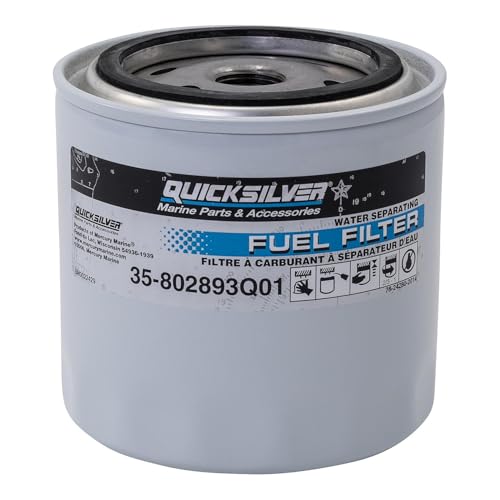
This unit is designed to remove water and debris with a 25-micron filtering element and a filtration media combination that meets Mercury Marine original equipment specifications. It is best for mid-range engines and boats where water separation is a priority and the system benefits from OEM-aligned parts.
- Best for: engines needing robust water separation and OEM-aligned parts.
- Caution: 25 microns may be coarser than some high-performance filters, so consider downstream filtration needs for ethanol blends.
CARMOCAR Fuel Filter Water Separator Replacement

The CARMOCAR model is tailored for universal marine fuel applications with 10-micron filtration and 3/8″ NPT ports. It aims to deliver lower pressure drop while trapping tiny particles and emulsified water. This makes it a strong choice for boats that experience mixed fuel quality or ethanol blends.
- Best for: boaters needing high filtration precision and a universal fit.
- Caution: Verify compatibility with your specific Mercury, Yamaha, or other engine models to avoid port mismatches.
Quicksilver 879885Q Inline Fuel Filter

This inline filter is designed for 5/16″ (8mm) fuel lines with a 20-micron filtration efficiency. It is suitable for under-cowl installation and can be replaced using existing hose clamps. Its transparent body enables quick assessment of fuel content and debris, helping prevent delayed maintenance.
- Best for: boats with 5/16″ fuel lines needing easy-to-check inline filtration.
- Caution: May require more frequent changes in dirty fuel conditions due to 20-micron rating.
T-H Marine Universal Boat Fuel Filter

The T-H Marine unit offers universal compatibility with 1/4″, 5/16″, and 3/8″ fuel lines, making it a versatile choice for many boats. Its clear housing allows for straightforward monitoring of fuel quality and filter condition, supporting proactive maintenance. Best for multi-engine or variable line setups where adaptability matters.
- Best for: boat owners who need a flexible, multi-size fuel filter solution.
- Caution: Ensure proper installation to match the correct port sizes and avoid leaks.
Buying Guide
What should I consider when choosing a boat fuel filter?
Filtration level matters. Higher microns (e.g., 40 micron) filter larger particles, while 10–20 micron filters capture finer debris but may restrict flow more. Match the filter to your engine’s fuel system and the quality of fuel you typically encounter.
What about water separation?
Boats often face emulsified water in fuel. Filters designed with water separators help keep water out of the injectors and carburetors, preserving performance and reducing corrosion risk.
Port size and mounting compatibility
Check that the filter’s ports match your fuel lines (3/8″, 1/4″, 5/16″ are common). Universal mounting options are convenient for boats with multiple engine types or refurbishments.
Maintenance considerations
Consider whether you prefer transparent housings for visual checks and whether the unit is disposable or serviceable. Some filters are easier to replace entirely, while others allow cartridge swaps.
Installation and space
Under-cowl and tight-engine compartments require compact, easy-to-replace units. Accessibility for quick maintenance is a practical benefit for most boaters.
Fuel compatibility and sources
Ensure the filter is compatible with the fuels you use, including ethanol blends. Some models advertise OEM alignment, which can simplify replacement and reliability.
Frequently Asked Questions
- What does a fuel filter do for a boat engine? It removes particulate contaminants and, in some models, separates water to protect fuel injectors and carburetors from damage and performance loss.
- How often should I replace a boat fuel filter? Replacement intervals depend on fuel quality and engine usage. Follow the manufacturer’s recommendations and inspect filters during routine maintenance.
- Can I use any fuel filter on any boat? Not exactly. Check port sizes, micron rating, and whether the filter supports water separation for your fuel system.
- Is a transparent housing important? A clear housing helps you visually monitor fuel content and sediment, enabling proactive maintenance decisions.
- Should I choose a 10 micron or 25 micron filter? A 10-micron filter offers finer filtration and is better for high-quality fuel, while 25 microns can improve flow in lower-maintenance setups but may let finer contaminants through.
- Do inline filters require special clamps? Most inline models fit standard hose clamps, making installation straightforward with common tools.