Answering the question of which fuel flow monitor is best for boats, this guide highlights five reliable options and explains who each product is best for. Whether you own a small fishing skiff or a larger vessel, these monitors help track fuel consumption, improve engine efficiency, and support better maintenance planning. The top picks are chosen for compatibility with marine systems, ease of integration, and clear data reporting. The following sections present each product with practical use cases, so you can compare at a glance and select the right monitor for your setup.
| Product | Best For | Key Benefit |
|---|---|---|
| Garmin GFS 10 Fuel Sensor | Garmin ecosystem users | Simple integration with Garmin gear |
| Fuel Flow Sensor PK (10 ft cable) | LMF/LMF-based systems | Flexible cable and connector options |
| Maretron FFM100-01 | NMEA 2000 networks | Advanced data with true temp compensation |
| 1 Inch Digital Turbine Fuel Flow Meter | General purpose flow monitoring | High-accuracy digital readings |
| Maretron Ffm100 Fuel Flow Monitor (FFM100) | Basic monitoring setups | Compact entry option |
Garmin GFS 10 Fuel Sensor

The Garmin GFS 10 Fuel Sensor is best for boaters using Garmin ecosystem components who want a straightforward add-on that integrates with existing Garmin displays and sensors. The unit is compact and designed to monitor fuel flow as part of a broader engine management setup.
Best for: Garmin fans who need a simple, plug-and-play fuel sensing option with familiar Garmin interface. This sensor pairs well with Garmin MFDs for quick visualization of flow data.
Why selected: It provides a tested, purpose-built fuel sensing option within the Garmin line, making it a natural choice for owners who already rely on Garmin products.
Caution: The listed data package is minimal beyond the item and manual; consider whether you need additional accessories for full integration with your vessel’s fuel system.
Fuel Flow Sensor PK

The Fuel Flow Sensor PK suits boaters using Lowrance LM and HDS units thanks to its 10 ft cable and T-connector. This option is well-suited for vessels with modular sensor needs or when expanding an existing fuel monitoring network.
Best for: Users already running LM/LMF‑200 or HDS systems who want flexible cable reach and a straightforward sensor pack.
Why selected: It offers an easy upgrade path for vessels needing a dedicated flow sensor with compatible connectors for common marine electronics.
Caution: The description emphasizes a 10-inch cable within the package; ensure this length matches your installation routing to avoid extra cable management work.
Maretron Fuel Flow Monitor, FFM100-01

The Maretron FFM100-01 is designed for NMEA 2000 networks, offering advanced capabilities like true temperature compensation and reverse-flow detection. It is a robust choice for vessels seeking precise fuel flow data across a distributed network of sensors.
Best for: Boat operators who run NMEA 2000 networks and want accurate, compensated fuel flow data across multiple engines or tanks.
Why selected: The monitor’s emphasis on accuracy, temperature compensation, and reverse-flow detection supports proactive fuel management and cost reduction.
Caution: This option is part of a broader Maretron ecosystem; ensure compatibility with your existing NMEA 2000 backbone and sensors.
1 Inch Digital Turbine Fuel Flow Meter
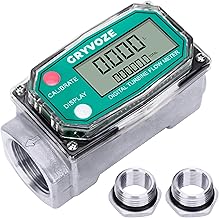
The 1 Inch Digital Turbine Fuel Flow Meter provides high-accuracy readings with an impressive ±1% accuracy for a range of liquids, including water, diesel, and various oils. It’s a flexible, general-purpose solution for owners who want precise flow data and a clear LCD readout.
Best for: General-purpose monitoring on a variety of fluids where accurate, real-time flow data is crucial and installation space is manageable.
Why selected: The digital LCD display and strong accuracy make it a dependable option for builders seeking a standalone flow meter with straightforward data output.
Caution: Not waterproof for outdoor use; designed for sheltered, dry environments. Plan placement away from rain or condensation to maintain accuracy and longevity.
Maretron Ffm100 Fuel Flow Monitor

The Maretron FFM100 fuel flow monitor offers a compact entry option for basic fuel flow monitoring within an established NMEA 2000 network. This model is suitable for straightforward monitoring tasks without requiring extensive expansion.
Best for: Boat owners seeking an uncomplicated fuel flow monitor that integrates into a Maretron or similar NMEA 2000 setup for essential data capture.
Why selected: It provides a practical, cost-conscious approach to begin fuel flow tracking while staying compatible with common marine data networks.
Caution: The product page details are relatively sparse; verify compatibility with your existing sensors and network backbone before purchase.
Buying Guide
- What system compatibility matters: If you already use Garmin, Lowrance, Maretron, or other marine electronics, choose a fuel flow monitor designed for that ecosystem to minimize integration steps.
- Network type: For multi-sensor setups, select devices that support NMEA 2000 or the same network protocol your boat uses to ensure reliable data sharing.
- Data accuracy and compensation: Look for temperature compensation and reverse-flow detection features for more precise fuel consumption readings and early issue detection.
- Installation considerations: Assess cable length, connector types, and mounting space. Some options require additional accessories for full integration with existing dashboards.
- Display and data access: Decide whether you prefer a digital LCD readout, dashboard display integration, or data-access via compatible MFDs.
- Maintenance and environment: Consider environmental exposure; some models are designed for sheltered installations, while others expect indoor or protected placements.
Frequently Asked Questions
- What is a fuel flow monitor on a boat used for?
A fuel flow monitor tracks the rate and total consumption of fuel, helping optimize engine performance and reduce operating costs.
- Do I need a specific network to use these monitors?
Many monitors work within common marine networks like NMEA 2000, while others are designed for specific ecosystems such as Garmin or Lowrance.
- Can I install a fuel flow monitor myself?
DIY installation is possible for some units, especially standalone sensors, but more complex integrations may require professional help to ensure proper wiring and network compatibility.
- What features improve data accuracy?
Temperature compensation, reverse-flow detection, and high-resolution LCD displays improve accuracy and readability of fuel flow data.
- Are fuel flow monitors suitable for all fuel types?
Most monitors support common marine fuels like diesel and gasoline, but verify compatibility for your specific fluids and sensor materials.
- What should I consider when choosing among these products?
Consider ecosystem compatibility, network requirements, accuracy features, installation space, and whether you need real-time display or dashboard access.