If you need a reliable gas caddy for boating, these options provide safe ample fuel with easy transfer near the water. This guide targets boaters who want convenient refueling onshore or on deck, while also serving rugged needs for trailers and docks. Each pick is evaluated for capacity, transfer method, durability, and portability, helping you choose the right model for your vessel and operations.
| Product | Capacity | Transfer | Best For |
|---|---|---|---|
| VEVOR Fuel Caddy | 15 gallons | Manual pump; gravity | Boats that need long-range fueling without power |
| Scepter Flo ’N Go 14 Gallon | 14 gallons | Gravity flow; manual pump | Marine workboats and lawn equipment |
| PAMBEE 15 Gallon Gas Can | 15 gallons | Siphon and gravity | Boat and ATV refueling on land |
| GAOMON 15 Gallon Fuel Caddy | 60L (~16 gallons) | Siphon pump; 10 ft hose | Versatile marine and vehicle refueling |
| Garvee 15 Gallon Gas Caddy | 15 gallons | Manual transfer pump | Durable marine and farm tasks |
Use this buying guide to compare features such as capacity, pump type, hose length, and material, so you can pick a model that reduces spill risk and simplifies on-boat refueling.
VEVOR Fuel Caddy, 15 Gallon — Best All‑Around Marine Fuel Caddy

The VEVOR model offers a 15-gallon capacity with a gravity and manual pump option. It uses a durable HDPE body designed to resist corrosion, sunlight, and rough handling—helpful for boats that travel to remote docks or require field refueling. Best for boaters who need a large on-board tank with a dependable hand pump when power is unavailable. A potential limitation is the manual pump’s efficiency on elevated fills, which can require more effort than powered options.
Scepter Duramax Flo ’N Go 14 Gallon — Best For Easy On-Deck Refueling

The Scepter Flo ’N Go caddy provides 14 gallons with a heavy-duty build and wheels for portability on deck or shore. It supports gravity-flow and manual-pump modes, making it versatile for fueling a boat, lawn equipment, or farm vehicles. Best for users who prioritize ease of movement across rough terrain and a robust, long-life tank. A drawback is that the siphon mode depends on arm effort when the caddy sits on the ground, which can slow refueling in some setups.
PAMBEE 15 Gallon Gas Can — Best Value For Versatility
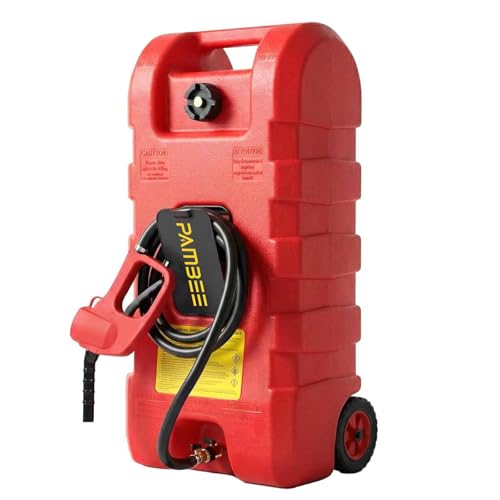
The PAMBEE unit offers 15 gallons with both siphon and gravity options and a 10-foot hose, making it flexible for boat launches, ATVs, or on-land refueling at marinas. It’s well-suited for boaters who need a portable fuel storage option that remains stable on wheels. A practical limitation is that siphon speed depends on manual pumping rate, which may vary with user effort.
Scepter Duramax Flo ’N Go 14 Gallon — Red 2026 Version

This 14-gallon option emphasizes portability and two fueling modes (gravity and manual siphon) with a 10-foot hose, ideal for marine and home use. It’s best for boat owners who want a reliable option that handles both on-deck and on-shore fueling. A caveat is that the siphon speed remains dependent on manual operation, which may not suit high-volume needs.
GAOMON 15 Gallon Fuel Caddy — Best Siphon Versatility

The GAOMON model combines a 60L capacity with a 10-foot hose and a siphon pump that reaches up to 2 GPM. It emphasizes spill prevention with dual brass shut-off valves and a design that minimizes leaks. Best for boaters who value a strong siphon mechanism and want a durable, rust-resistant tank. A limitation is that high-volume transfers can require steady pumping to maintain flow, particularly when the tank is below the fill point.
Garvee 15 Gallon Gas Caddy — Durable Marine-Grade Build

The Garvee caddy uses industrial-grade HDPE for durability, with dual shut-off valves and vapor-tight seals to reduce spills. It includes a manual transfer pump and a 10-foot hose for flexible fueling near a boat or lawn equipment. Best for users needing a rugged option for harsh environments. Limitation: as a manual system, filling speed may vary with pumping effort and terrain.
GAOMON 16 Gallon Fuel Caddy — 3.7GPM Pump Version

The 16-gallon variant provides a higher capacity with a dual-mode pump offering 3.7 GPM in some configurations. It features a long 10-foot hose and rugged construction suitable for boats, ATVs, and lawn equipment. Best for users who need faster transfer rates alongside robust materials. A potential caveat is that higher capacity models may be bulkier to handle in tight boat spaces.
Buying Guide: Key Considerations For Marine Gas Caddies
- Capacity vs. space: Larger tanks reduce refueling stops but take more storage space on deck or in a trailer. Choose 14–15 gallons for most boats with limited dock side access.
- Transfer method: Gravity flow is simple but requires elevation; siphon pumps speed up transfers but depend on user action. Decide which is more practical for your setup.
- Material and durability: HDPE is common and durable, with good chemical resistance. Look for corrosion resistance, UV stability, and secure seals to prevent spills at sea.
- Wheels and portability: 6-inch wheels and a comfortable handle help move the caddy over docks, ramps, or turfs. Check weight when full.
- Spill prevention: Dual shut-off valves and vapor-tight caps reduce leaks. Ensure hose connections are secure and fittings are brass or corrosion-resistant.
- Safety and compatibility: If you refuel indoors or in tight spaces, ensure there are child-resistant caps and grounding features to minimize static risks.
- Maintenance: Inspect hoses, valves, and seals regularly. Look for rust resistance and easy cleaning to prevent contamination of fuel.
Frequently Asked Questions
- What capacity is best for a small boat? – A 14–15 gallon caddy balances fuel needs with onboard storage space for most small boats.
- Are siphon pumps safe for marine use? – Yes, when operated with proper seals and shut-offs to prevent spills and leaks.
- Should I choose gravity-fed or pump-assisted models? – Gravity-fed is simple and reliable on a dock; pump-assisted models are faster and better on uneven terrain.
- Can these caddies handle diesel and gasoline? – Most listed models support both fuels; always verify the specific model’s compatibility with your fuel type.
- Is a longer hose better for boats? – A longer hose increases reach for deck refueling but may add weight and potential hose management challenges on small boats.
- Do these require electrical power? – Most are manual or gravity/pump-based and do not require power; some variants may offer powered options in other brands.