Short answer: choose a portable marine fuel tank that matches your boat type and engine needs. For small fishing boats and inflatable craft, compact 3–6 gallon tanks are ideal. For mid–to–large outboards, larger tanks (6–12 gallons) reduce refueling stops. This guide highlights five top options and explains who they’re best for, along with practical buying tips to help you compare at a glance.
The following selections emphasize transfer capability, built-in gauges, and compatibility with common outboard connectors. They’re suitable for American boaters seeking reliable fuel storage that minimizes spills and vapor buildup while on the water.
| Product | Capacity | Best For | Key Feature |
|---|---|---|---|
| Scepter 12 Gallon Portable Marine Gas Can | 12 gal | Boaters needing long runtimes on larger boats | Built-in fuel gauge and 2-way vented cap |
| Scepter 6 Gallon Portable Marine Gas Can | 6 gal | Mid-size boats and under-seat storage | 2-way vented cap and built-in gauge |
| VEVOR 6.34-Gallon Portable Tank | 6.34 gal | Compact boats needing easy handling | 9.8 ft hose with gauge |
| LAUCO Portable Marine Fuel Tank 6.34 Gal | 6.34 gal | Durable, spill-minimizing setups | Two-cap design (sealed or vented) for flow control |
| LizHOUMIL Portable Boat Fuel Gas Tank 3 Gal | 3 gal | Small boats, personal watercraft, inflatables | Clear gauge, built-in filter, ergonomic handle |
Scepter 6 Gallon Portable Marine Gas Can

The Scepter 6 Gallon tank delivers ample capacity for mid-size boats and under-seat storage. It features a 2-way vented cap that supports airflow during refueling and helps prevent vapor buildup. A built-in fuel gauge is integrated for quick checks, and compatibility with standard marine fittings makes it straightforward to connect.
Best for: boaters who need a balance between capacity and portability, and who value a built-in gauge for on-the-spot monitoring. Better for boats where under-seat storage is important. Caution: ensure the 2-way vented cap is fully closed during storage to minimize leaks.
Portable Boat Fuel Gas Tank, 3 Gallon/12L
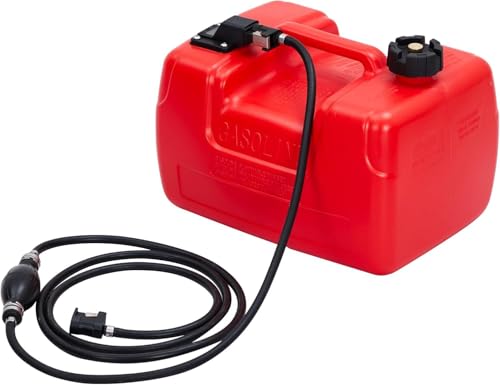
This 3-gallon tank emphasizes a durable construction with an ergonomic I-shaped handle for easy carrying and transport. A clear fuel gauge allows at-a-glance monitoring, and a built-in filter helps keep fuel cleaner for smoother engine performance.
Best for: smaller boats, dinghies, inflatables, or as a spare tank on larger vessels. Limitation: smaller capacity means more frequent refueling on longer trips.
VEVOR Marine Tank, 6.34-Gallon

The VEVOR 6.34-gallon tank is built tough from high-density polyethylene and includes a 9.8-foot hose with a ready-to-go gauge. Its design focuses on durability against aging and corrosion, with practical storage under seats on many vessels.
Best for: boaters needing a compact yet sturdy tank with a long hose for versatile refueling. Caution: avoid prolonged direct sun exposure to limit aging and expansion risks.
LAUCO Portable Marine Fuel Tank 6.34 Gal

LAUCO’s 6.34-gallon tank offers a sealed or vented cap option for controlled flow and reduced leakage. It includes a 9.8-foot hose and is designed for compatibility with common marine tank interfaces. The design emphasizes solid construction and spill avoidance.
Best for: boaters who want flexible venting options and reliable spill prevention. Limitation: ensure proper cap selection for your fueling situation to maintain optimal flow control.
LizHOUMIL 3 Gallon Portable Tank
LizHOUMIL’s 3-gallon tank packs essential features into a compact form: a clear gauge, built-in filter, and an ergonomic handle for easy transport. It is a practical spare or primary tank for small craft and light-duty trips.
Best for: small boats, personal watercraft, and as a spare or start-of-season fuel source. Caution: smaller capacity means more frequent refueling on longer outings.
Buying Guide
What capacity should you choose?
- Light use or small boats: 3–6 gallons is usually sufficient.
- Mid-size boats: 6–12 gallons balances refueling intervals with handling convenience.
- Large engines or long trips: consider 12 gallons or more if storage space allows.
What features matter most?
- Built-in gauge: simplifies fuel monitoring on the water.
- Vented vs sealed caps: vented caps prevent vapor buildup during refueling; sealed caps reduce leaks when stored.
- Hose length and connector compatibility: ensure the hose fits your boat’s fuel fittings and reach from the tank to the engine.
- Material durability: high-density polyethylene (HDPE) resists impact, aging, and corrosion in saltwater environments.
- Weight and maneuverability: lighter tanks are easier to handle, especially in tight spaces.
How to compare models quickly?
- Capacity vs. space: measure your storage area to ensure the tank fits.
- Fitting compatibility: verify standard marine fittings and connector types used on your engine.
- Safety considerations: look for leak-prevention designs and vapor management features.
What are potential drawbacks to watch for?
- Smaller tanks require more frequent refueling on longer trips.
- Some models rely on specific caps for venting; ensure you use the correct cap to avoid performance issues.
- Exposure to direct sunlight can affect aging in some plastics; store out of direct sun when possible.
FAQ
- Q: Do these tanks work with diesel or ethanol blends?
- A: Many models are designed to handle diesel and ethanol-blended fuels; check the product features for each specific model.
- Q: Can I use these tanks under-seat on my boat?
- A: Tanks with slim profiles and molded feet are often designed for under-seat storage, but verify dimensions and fit for your boat.
- Q: Is a built-in gauge accurate for fuel planning?
- A: Built-in gauges provide quick checks; for precise planning, cross-check with an external gauge if needed.
- Q: How do vented caps prevent vapor buildup?
- A: Vented caps allow air to escape during refueling, reducing pressure and minimizing vapor accumulation.
- Q: What maintenance is required?
- A: Keep the interior clean with the built-in filter, inspect hoses for cracks, and store away from heat sources when not in use.
- Q: Are these tanks compliant with regulations?
- A: Several models reference EPA/CARB compliance and standard fittings; review the product description for each model.