Gas trolling motors for kayaks offer strong thrust, quick planing, and extended run times for anglers and explorers who want more reach on the water. This guide highlights five reliable gas-powered kayak motors, explains who they’re best for, and compares key factors like power, heat management, and ease of use. It’s designed for kayak enthusiasts, small-boat anglers, and outdoor adventurers seeking dependable propulsion without relying on electric options.
Buyer snapshot (quick table):
- Tiozuiu 52cc 2-Stroke Outboard — Best for: serious day trips with quick starts and solid runtime.
- YIYIBYUS 2.3HP 52cc — Best for: compact, durable builds with reliable ignition.
- HinLIaDa 52CC 2-Stroke — Best for: easy steering and stout speed for inflatable boats.
- JooWing 2.3HP 52CC — Best for: lightweight, fuel-efficient powering with quick refuelability.
- Gosangom 3.5HP 52CC — Best for: heavier loads or rougher water where more thrust helps.
Best Overall Gas Trolling Motor for Kayak: Tiozuiu 52cc 2 Stroke Outboard

The Tiozuiu 2-stroke engine delivers 2.3 horsepower and reaches up to 8500 rpm, enabling rapid water launches for kayaks and small craft. A full tank provides about 40 to 70 minutes of continuous operation, useful for standard day trips and focused fishing sessions. This motor’s heat-dissipation design helps protect the unit during extended use, while a CDI ignition and a hand-pull start simplify ignition. Best for: kayakers who want strong, immediate thrust and straightforward starts.
Caution: The 2-stroke fuel mix and higher rpm require attention to maintenance and fueling practices, especially on longer outings.
Best Compact Gas Power: YIYIBYUS 2.3HP 52CC Outboard

Powered by a 1.7 kW (2.3 HP) 52cc 2-stroke engine, this model offers an idle speed around 2800-3200 rpm and operating range up to 8500 rpm. It uses non-contact electronic ignition for dependable starts. Aluminum and PP construction provide corrosion resistance and durability. Best for: kayak anglers who want a balanced mix of weight, ease of maintenance, and steady acceleration. Limitation: higher RPM range requires careful handling and fuel management on longer trips.
Best Steering and Reach: HinLIaDa 2-Stroke 2.3HP Outboard
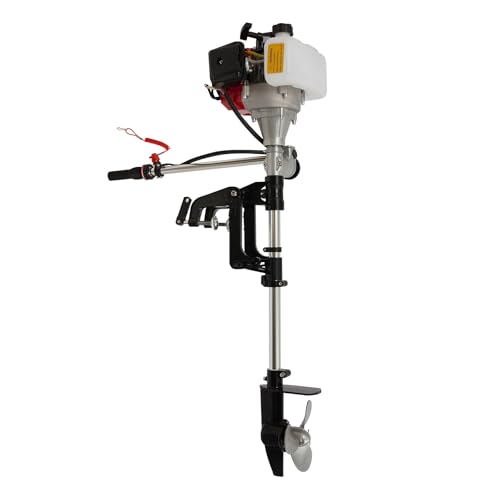
HinLIaDa offers a 2.3 HP, 52cc gas-powered unit with high-efficiency operation at 4500-8500 rpm and easy steering characteristics. The aluminum-PP build emphasizes durability and corrosion resistance. Best for: inflatable and small-rig kayaks where precise steering and quick response matter. Caution: Steering performance may vary with boat size and mounting configuration.
Best Fuel-Efficient Power: JooWing 2.3HP 52CC
The JooWing model uses a 0.22 gallon fuel tank to provide 40-70 minutes of continuous run time, with a 2.3 HP output at speeds up to 8500 rpm. It features fast heat dissipation through cooling holes and an ergonomic handle for stable operation. Best for: kayaks and inflatable boats that require a compact, efficient motor with quick refueling capabilities. Limitation: run time can vary with throttle position and water conditions.
Best Heavy-Thrust Option: Gosangom 3.5HP 52CC

Gosangom delivers a higher 3.5 HP output from a 52cc 2-stroke engine, designed for better top-end performance and stronger thusthrough a 6.7″ three-blade propeller. It is built with an aluminum alloy housing and aims for reliability in both freshwater and saltwater setups. Best for: kayaks that need extra power to move through choppy water or carry gear. Caution: Higher power often means greater fuel use and weight.
Buying Guide
What matters most when choosing a gas trolling motor for a kayak? Focus on power, weight, fuel economy, and maintenance needs. Consider the following questions:
- What boat size and weight will the motor move? Choose higher HP for heavier loads or rough water, and lower HP for small, light kayaks.
- How long will you be on the water? If long trips are common, prioritize efficiency, fuel tank size, and heat management.
- Is ease of starting important? Look for CDI ignition and simple pull-start systems for quick deployments.
- Where will you use it most—freshwater, saltwater, or both? Corrosion resistance and robust housings matter in saltwater.
- What are your mounting and storage constraints? Lighter, compact designs fit tighter spaces; ensure compatibility with your kayak’s transom or mounting area.
Feature-Comparison Quick Reference
| Product | Horsepower | Displacement | Run Time | Best For |
|---|---|---|---|---|
| Tiozuiu 52cc 2-Stroke | 2.3 HP | 52cc | 40-70 min | Rapid takeoff, active anglers |
| YIYIBYUS 2.3HP | 2.3 HP | 52cc | 40-70 min | Durable, reliable ignition |
| HinLIaDa 2.3HP | 2.3 HP | 52cc | 40-70 min | Easy steering, inflatables |
| JooWing 2.3HP | 2.3 HP | 52cc | 40-70 min | Fuel efficiency, quick refuel |
| Gosangom 3.5HP | 3.5 HP | 52cc | 40-70 min | Heavy loads, rough water |
Installation and Safety Notes
Gas outboard motors require careful mounting, fuel handling, and safe storage. Always follow manufacturer mounting recommendations, use appropriate fuel-oil mixtures, and store away from heat sources. Regularly inspect cooling holes and propellers for debris, and perform routine maintenance to reduce the risk of overheating or mechanical failure during trips.
FAQ
- Are gas trolling motors suitable for kayaks? Yes, they provide strong thrust for faster travel and quick repositioning, especially on medium to larger kayaks.
- What fuel type is needed? Most listed models use a gasoline and oil mix appropriate for 2-stroke engines; always follow the manufacturer’s fuel ratio guidelines.
- How long can I run these motors? Run times vary by model and throttle, typically around 40–70 minutes per tank in standard configurations.
- Do these motors require special maintenance? Yes, periodic cleaning, cooling system checks, and spark/ignition inspections help maintain performance and durability.
- Which motor is best for inflatable kayaks? Lighter, easily steered models like HinLIaDa and JooWing are often preferred for inflatables and smaller boats.
- Are there safety considerations for saltwater use? Yes, choose corrosion-resistant housings and ensure proper rinsing after saltwater use to extend life.