Answering the question “What livewell thru-hull fitting should I choose?” this guide highlights five reliable options for keeping your livewell plumbing leak-free and efficient. The best picks are suited for different hose sizes, materials, and mounting needs, from compact 3/4″ fittings to larger 1″ configurations. Ideal buyers include anglers upgrading a livewell, skippers maintaining a small vessel, and DIY boat owners seeking corrosion-resistant connections. Below is a quick summary table to compare the top picks at a glance.
| Product | Best For | Key Feature |
|---|---|---|
| SEAFLO Thru Hull Fittings (3/4″) | Compact livewells, small hoses | 4-year warranty, white finish |
| Seachoice Thru-Hull Strainer Mount with Aerator Screen (3/4″ Hose) | Leak-free aerator mounting | Flush mount without extra nut |
| Seachoice Polypropylene Extra Long Thru-Hull Connector (3/4″ ID) | Extended reach, reliable seal | 1 3/4″ flange |
| YOQVQOY Thru Hull Fitting (1″) | Secure 1″ hose connections | Corrosion-resistant, multiple dimensions |
| SEAFLO Thru Hull Fittings (1″) | Standard 1″ livewell piping | 4-year warranty, white finish |
SEAFLO Thru Hull Fittings (3/4″)

Best for compact livewells serving 3/4″ hoses. Material and finish support corrosion resistance in typical marine environments. The 4-year warranty offers long-term confidence for small-bore plumbing. Suitable for anglers upgrading a compact livewell or bilge circuit that uses 3/4″ hose. Caution: verify the hose ID compatibility with 3/4″ fittings to avoid leaks or loose connections.
Seachoice Thru-Hull Strainer Mount (3/4″ Hose)

Best for mounting a strainer flush with the livewell wall. This part accommodates a 3/4″ hose and integrates an aerator screen flush without an extra nut. It’s a practical option when a clean, low-profile thru-hull is desired and remote pumps are in use. Limitation: designed for 3/4″ systems; larger hoses need different fittings.
Seachoice Polypropylene Extra Long Thru-Hull Connector (3/4 in. ID)

Best for reliable thru-hull connections with a longer reach. This polypropylene connector fits 3/4″ inside diameter hoses and features a 1-3/4″ flange for a solid seal. Choose this if your livewell plumbing requires a longer, corrosion-resistant connection. Caution: ensure flange mounting area provides enough space for the extended profile.
YOQVQOY Thru Hull Fitting (1″)
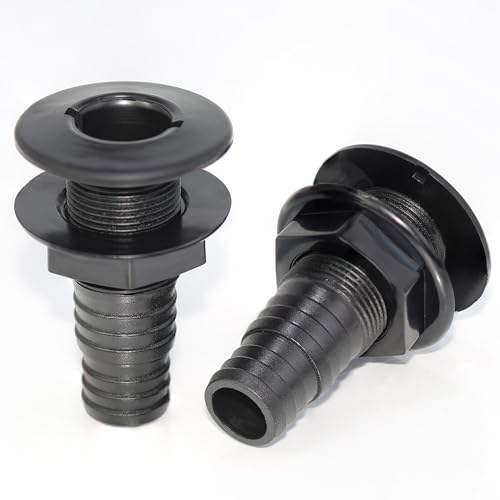
Best for standard 1″ hose systems with corrosion-resistant construction. The kit provides a universal fit for multiple marine configurations and lists several precise dimensions to help ensure a secure connection. Limitation: larger fittings require adequate hull space; verify hole size and hull thickness before installation.
SEAFLO Thru Hull Fittings (1″)

Best for standard 1″ livewell plumbing. The white finish and 4-year warranty provide long-term protection against marine exposure. Suitable for mid-sized livewells or bilge applications that require a robust 1″ connection. Limitation: ensure compatibility with existing 1″ hoses and space around the hull cutout.
Buying Guide
What size hose does your livewell use? Matching the hose ID to the thru-hull fitting is essential for a secure seal. For compact systems, 3/4″ fittings are usually sufficient, while larger livewells may require 1″ fittings. Consider material choice: polypropylene and ABS offer corrosion resistance and UV stability, but verify saltwater exposure and maintenance needs. Do you need a strain relief or an aerator integration? Some models are designed to mount aerator screens flush to the hull for a clean look and reduced snag risk. Always confirm flange size and hull thickness to ensure a leak-free installation.
What mounting approach works best? Flush-mount designs minimize drag and snag potential, while longer connectors provide flexibility in hose routing. If your setup uses a remote pump, ensure the thru-hull fitting accommodates the pump’s intake location and required flow path. For boats with limited space behind the livewell wall, consider a 3/4″ option first, then upgrade to 1″ if the system demands higher flow. When in doubt, opt for fittings with corrosion-resistant materials and a warranty that covers marine service life.
FAQ
- What size of thru-hull fitting is most common for livewells?
Answer: 3/4″ and 1″ are the typical sizes, with 1″ used for larger livewells and higher flow requirements. - Is a strainer essential for livewell installations?
Answer: A strainer helps prevent debris from entering the pump and can be mounted flush for a cleaner installation. - Can I mix fittings from different brands?
Answer: Mixing is possible if the hose IDs and flange dimensions match exactly; otherwise leaks may occur. - Do through-hull fittings require maintenance?
Answer: Periodic inspection for corrosion, leaks, and hose wear is recommended in marine environments. - What material provides best durability in saltwater?
Answer: Polypropylene and ABS variants are commonly chosen for their resistance to salt, UV, and impact. - How do I verify correct installation?
Answer: Check for a tight seal at the flange, test with water pressure, and inspect for any signs of seepage around the hull.