Answering the demand for reliable boat cooling, this guide highlights five marine air conditioners that balance quiet operation, durability, and energy efficiency. Best for cruisers, live-aboards, and anglers, these units cover a range of voltages and BTU capacities. Each option is evaluated for suitability, ease of installation, and long-term performance in harsh marine environments.
Quick product overview: the selected models vary from compact 6,000 BTU units ideal for small cabins to 16,000 BTU systems designed for larger saloons. Many feature corrosion-resistant titanium coils and sound-dampening covers. For boaters seeking off-grid capability or specific power options, several models support different electrical configurations. The summary table below helps compare key specs at a glance.
| Product | BTU | Voltage / Hz | Best For | Notes |
|---|---|---|---|---|
| MarinAire 16,000 BTU Self Contained | 16,000 | 110-120V / 60Hz | Mid-to-large boats; daytime cooling | Quiet operation; titanium coil; energy-efficient refrigerant |
| MarinAire 6,000 BTU Self Contained | 6,000 | 110-120V / 60Hz | Smaller cabins; boats with limited space | Rotatable blower; compact design |
| MarinAire 11,000 BTU Self Contained | 11,000 | 110-120V / 60Hz | Moderate cabins; versatile install | Peaceful quiet option; titanium coil |
| Dometic ECD Self-Contained 16k | 16,000 | 230V | RV/Boat dual use; easy install | Environmentally friendly refrigerant; compact control |
| MarinAire 16,000 BTU 208-230V | 16,000 | 208-230V / 60Hz | Large boats; high cooling demand | Quiet, corrosion resistance; efficient refrigerant |
Below are five detailed product sections to help you compare features, installation needs, and suitability for different boaters. Each entry notes who the product is best for, along with a practical caveat based on listed features.
MarinAire 16,000 BTU Self Contained – 110-120V

The 16,000 BTU unit is designed for larger cabins and saloons. It focuses on quiet operation with a sound cover that reduces noise significantly, helping maintain a peaceful interior. The titanium coil offers strong corrosion resistance, suitable for saltwater environments, provided the unit is bonded to a sacrificial anode.
Best for: boats with mid-to-large living spaces that require substantial cooling with reduced noise. The unit’s energy efficiency helps manage ongoing electrical costs on longer voyages.
Caution: Requires proper bonding to a sacrificial anode for corrosion protection; improper bonding may negate the coil’s corrosion resistance.
MarinAire 6,000 BTU Self Contained – 110-120V

A compact option ideal for smaller cabins or boats with limited interior space. It emphasizes efficiency and a smaller footprint while offering the essential cooling function for hot days aboard.
Best for: boats with tight interior layouts or where a lighter unit is preferred. The compact design may limit cooling capacity in exceptionally warm conditions.
Caution: Lower BTU capacity means it may not reach comfortable temperatures in very hot climates or very large cabins.
MarinAire 11,000 BTU Self Contained – 110-120V

At 11,000 BTU, this model sits between the small and large capacity options. It features a quiet operation profile and the brand’s titanium coil for corrosion resistance, beneficial in saline environments.
Best for: mid-sized boats with moderate cooling needs and a preference for a quieter, more durable coil. The unit balances performance with a modest power draw.
Caution: While efficient, its cooling capacity may still be challenged in extremely hot, sun-drenched days on very large vessels.
Dometic ECD Self-Contained 16,000 BTU – 230V
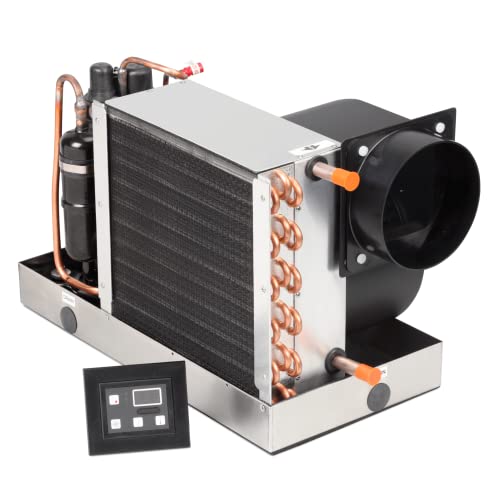
This 16,000 BTU model uses R410A refrigerant and offers energy efficiency with a compact digital control and display. The unit is designed for space-saving installation and ease of use in boats and RVs alike.
Best for: boaters needing a robust, environmentally friendlier system with straightforward operation and a compact control package. Suitable for mid-to-large cabins on boats or RVs.
Caution: Requires 230V supply, which may necessitate electrical planning for smaller vessels or limited shore power access.
MarinAire 16,000 BTU 208-230V – 60Hz

This variant provides 16,000 BTU cooling at a higher voltage range, ideal for boats with 208–230V power supplies. It maintains quieter operation and corrosion resistance through a titanium coil and careful design.
Best for: larger vessels with the right high-voltage supply and a need for substantial cooling capacity. The higher voltage supports sustained cooling in demanding conditions.
Caution: Requires compatible electrical infrastructure to support 208–230V operation, which may not be available on all boats.
Buying Guide: Marine Air Conditioners For Boats — Key Considerations
What size boat or cabin space are you cooling? BTU requirements should align with the interior volume and insulation, so pick a unit with sufficient capacity to handle peak conditions without overworking the compressor.
Which power supply works on your vessel? Marine units are available in 110–120V and 230V (including 208–230V). Match the unit to the boat’s shore power or generator capability to avoid under- or overloading electrical circuits.
Is corrosion protection important? Titanium coils and sacrificial anode bonding improve longevity in saltwater environments. Ensure the installation includes proper bonding per manufacturer guidance.
How important is noise level? Sound-dampening features and insulated housings help minimize cabin noise, improving comfort during hot days at sea.
Ease of installation and maintenance matters. Look for compact control panels, simple remote mounting options, and accessible service points for routine upkeep in remote marinas.
Environmental considerations. Refrigerant choice (R410A, etc.) impacts efficiency and environmental footprint. Choose models with energy-efficient refrigerants when possible.
Frequently Asked Questions
- What is a good BTU range for a small boat cabin? — For compact cabins, 6,000–11,000 BTU is often sufficient, depending on insulation and climate.
- Do marine air conditioners need special installation? — Yes. Marine units require proper mounting, bonding to sacrificial anodes, and secure electrical connections to handle salt exposure and motion.
- Is 230V preferred over 110V for marine AC? — It depends on the vessel’s electrical system. 230V systems offer strong cooling for larger cabins, while 110V may be simpler on smaller boats with limited power.
- Can I run marine AC off battery power? — Some units are designed for shore power, generators, or vehicle batteries with adequate capacity. Off-grid operation may require larger battery banks and power management.
- What refrigerant should I look for? — R410A is common and energy-efficient. Confirm compatibility with the boat’s components and local regulations.