If you need reliable charging for multiple battery banks while at sea or docked, these marine alternator battery chargers deliver safe, automatic charging for 12V systems. They’re ideal for boaters who operate multiple batteries, from starting batteries to deep-cycle house batteries, and want protection against overcharge and heat. This guide highlights five compatible options, explains who each is best for, and explains how to choose the right charger for your boat’s electrical setup.
| Product | |||
|---|---|---|---|
| FirstPower Pro 2 Bank 5X2 | Onboard Marine Charger | 2 Banks, 5A per bank | Small-to-mid dual-bank systems, all battery chemistries |
| Victron Orion-XS | DC-DC Charger | 50A | Dual battery systems with intelligent alternators |
| NOCO GEN5X2 | Onboard Battery Charger | 2 Banks, 5A per bank | Compact, harsh-environment boats needing reliable charge |
| STANLEY BC25BS | Smart 12V Charger | Varies by model, 75A engine start | Emergency-start capability and versatile charging |
| NEXPEAK NC201 | Smart Trickle Charger | 10A | Maintenance and quick charging for mixed battery types |
Audience note: this selection targets boaters who need dependable onboard charging without frequent babysitting. Whether you operate a weekend cruiser, a fishing vessel, or a liveaboard, these options support lead-acid, AGM, and lithium batteries to keep electronics ready and engines starting reliably.
FirstPower Pro 2 Bank 5X2 Marine Charger

Two independent 5A banks support 12V SLA/AGM, lithium LiFePO4, calcium, and deep-cycle batteries. IP68 waterproof and fully sealed make it suitable for onboard operation in harsh conditions. The charger can run 24/7, charging both banks at the same time withMODE-selectable modes per battery. It also includes a Force Mode feature to wake dead batteries, which helps prevent no-start scenarios in remote locations.
Best for: boaters with two main battery banks or a dedicated start plus house battery array who need a rugged, all-weather charger that operates continuously. Better for: vessels requiring independent charging modes per bank. Caution: avoid charging totally dead batteries without enabling Force Mode first, as this requires manual activation.
Victron Orion-XS Smart DC to DC Charger

Orion-XS is designed for dual battery systems fed by intelligent alternators. It features high efficiency (about 98.5%), a continuous 700W output, and a compact IP65 waterproof design. It’s highly configurable to match different alternators and battery chemistries while protecting the starter and auxiliary batteries from overloading. You can dial in input/output currents to optimize performance across a range of boats and systems.
Best for: sailboats or sportfishers with intelligent alternators who want precise configuration and robust protection. Better for: installations where protecting the engine alternator from overload is a priority. Limitation: not a traditional 12V battery maintainer; it’s a DC-DC charger designed to work with alternators and solar in some setups.
NOCO GEN5X2 2-Bank Onboard Charger
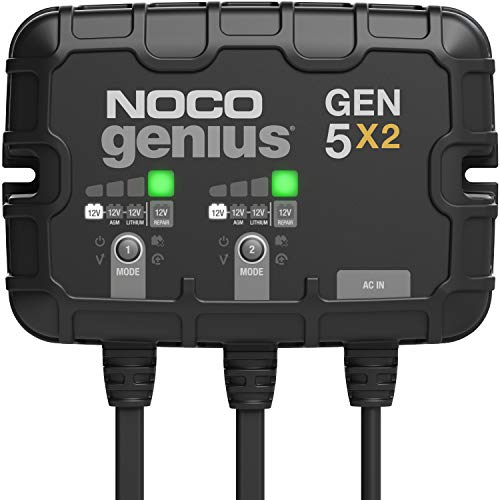
GEN5X2 delivers 10A total (5A per bank) with independent charging modes for each bank. It is compact yet rugged enough for marine environments and supports lead-acid and lithium chemistries. Features include overcharge protection and temperature compensation to adapt to ambient conditions. The GEN5X2 is designed to fit tight compartments while still delivering reliable, per-bank charging.
Best for: boats with limited space needing a compact, capable two-bank charger. Better for: users who value per-bank mode selection and temperature compensation. Caution: ensure battery types are compatible with the selectable modes to avoid misconfiguration.
STANLEY BC25BS Smart 12V Charger

While primarily known for automotive maintenance, the BC25BS offers smart charging with high-frequency control and an emergency 75-amp engine start. It maintains 12V AGM, GEL, and WET automotive or marine batteries via an adaptive charging regime, switching from fast charge to top-off and trickle as needed. It’s useful when you need a portable, versatile charger that can also help with starter batteries during emergencies.
Best for: users needing emergency starting capability and a versatile maintenance charger. Better for: people who require a battery to be ready quickly in emergency situations. Limitation: not a dedicated multi-bank marine charger; if you need strict dual-bank maintenance, consider a purpose-built marine charger.
NEXPEAK NC201 10-Amp Battery Charger

The NC201 is a 10A quick charger and maintainer with 7-stage charging for 12V and 24V systems. It supports lead-acid, AGM, GEL, flooded, and some lithium chemistries, with temp compensation and multiple protections for safe operation. It’s designed to repair sulfation and improve cycle life through pulse repair features and intelligent control.
Best for: boaters who need faster charging for a mix of battery types and a built-in desulfator. Better for: maintainers who want a high-efficiency charger with protection features. Caution: avoid charging totally dead 0V batteries with this device without following the activation guidance for mode selection.
Buying Guide: How To Choose The Right Marine Alternator Charger
What battery chemistry do you use? If you have a mix of lead-acid, AGM, and LiFePO4, look for a charger with selectable modes per bank and compatibility with lithium. If you only have lead-acid batteries, simpler models may suffice.
How many banks and how much current do you need? For two-bank systems, a 5A per bank design works for small boats, while larger boats may require 10A per bank or DC-DC configurations with higher total output to support house loads and engine starting.
Is water exposure a concern? The IP rating is important. For open cockpit or exposed locations, choose IP68 or IP65-rated units. For enclosed spaces, standard marine-grade protection is usually enough.
What about installation and integration? Some DC-DC chargers (like Victron Orion-XS) integrate with alternators and solar panels, which helps optimize charging and prevent alternator overload. Others are standalone and easier to install in tight spaces.
What safety features matter most? Temperature compensation, overcharge protection, short-circuit protection, and automatic mode switching are key to protecting both batteries and electrical systems on a boat.
FAQ
- What is a marine alternator charger?
A marine alternator charger uses the boat’s alternator or DC-DC converter to charge one or more 12V batteries, often with smart controls to protect batteries from overcharging and heat.
- Do I need a multi-bank charger on my boat?
Yes if you have separate starting and house batteries or a larger system with high daily power usage, as it ensures each bank is charged properly without cross-interference.
- Can I mix battery chemistries?
Some chargers support multiple chemistries (lead-acid, AGM, LiFePO4). Confirm compatibility for each bank to avoid charging incompatibilities.
- What is temperature compensation?
It adjusts charging based on ambient temperature to prevent overcharging in heat and undercharging in cold conditions.
- What is an emergency start feature good for?
Emergency start capability helps you jump-start a boat when a battery is critically discharged, a useful feature for off-grid locations.