Looking for a dependable marine battery charger to keep your boat’s electronics ready? This guide compares popular 12V onboard chargers designed for lead-acid, AGM, calcium, and lithium batteries. It highlights who each product is best for, how many banks you need, and where to choose one with temperature compensation and overcharge protection. Perfect for anglers, weekend boaters, and long-term cruiser owners alike, these units help prevent dead batteries and extend battery life. Below you’ll find a quick buying table followed by in-depth product sections and a practical buying guide.
| Product | Banks | Best For |
|---|---|---|
| NOCO Genius GEN5X2 | 2 | Small boats needing multi-bank maintenance |
| NOCO Genius GEN5X3 | 3 | Medium boats with multiple circuits |
| Smart 2 Bank Marine Charger (Zrfmib) | 2 | Budget-friendly dual-bank maintenance |
| NEXPEAK NC201 | 1 or 2 | Versatile trickle and maintenance |
| ProMariner ProSport HD 20A | 3 | Higher amperage and robust protection |
NOCO Genius GEN5X2: Compact 2-Bank 10A Marine Charger
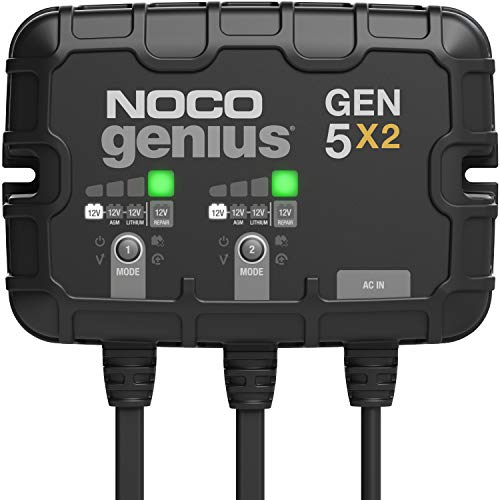
This two-bank charger delivers 10 amps total (5 amps per bank) and is designed for 12V systems in harsh marine environments. It supports lead-acid and lithium batteries with selectable modes for 12V, AGM, and Lithium, plus a dedicated Repair Mode. Best for small to mid-sized boats that need independent charging on dual circuits without sacrificing space or weight.
Who it’s best for: boat owners with limited space who want separate charge control for two battery banks, such as start and house batteries. It’s ideal for shallow-water skiffs or compact sailboats that require reliable maintenance rather than high-speed bulk charging.
Why selected: its compact size and clear mode options simplify maintenance across battery chemistries while preserving battery health with temperature compensation. A practical balance of features for routine marine charging.
Caution: While versatile, the GEN5X2’s total 10A may not aggressively recharge deeply drained packs as quickly as higher-amperage models. For boats with demanding loads, consider higher-bank options.
NOCO Genius GEN5X3: 3-Bank 15A Onboard Charger
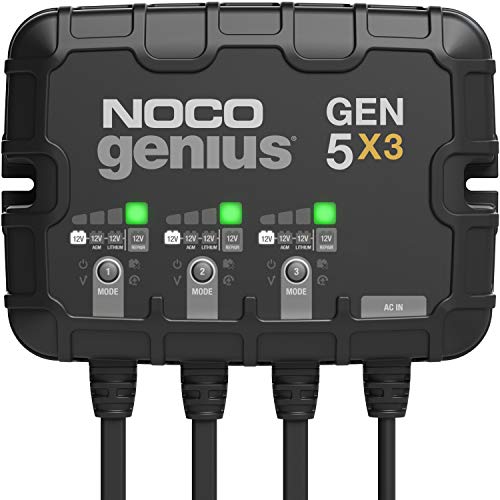
This three-bank model delivers 15 amps total with 5 amps per bank, enabling simultaneous charging of three separate 12V battery circuits. It features selectable charging modes for lead-acid, AGM, and lithium, plus a Lithium Repair Mode. Better for boats with multiple critical battery loads such as trolling motors, navigation, and house systems, where independent maintenance matters.
Who it’s best for: owners of mid-sized vessels with three essential battery circuits and a need for precise, independent charging per bank. It’s a strong choice for anglers or cruisers who rely on multiple power sources for extended trips.
Why selected: offers greater bank separation and flexibility than dual-bank units, while maintaining compact dimensions for helm or engine rooms. It also keeps a focus on battery health with temperature compensation.
Caution: More banks mean more wiring and installation effort; ensure your vessel’s electrical panel can accommodate a third bank without overloading the system.
Smart 2 Bank Marine Charger: 10A/Bank, Waterproof

This two-bank charger provides 2x5A for 12V systems with waterproof, IP-rated construction. It supports 12V SLA/AGM, Lithium, and calcium modes, with independent per-battery mode selection. It also offers a dead-battery recovery feature by holding a mode button. Best for small-to-medium boats needing simple dual-bank maintenance without extra features.
Who it’s best for: boaters seeking a budget-friendly two-bank charger that still offers flexible chemistry support and practical dead-battery recovery.
Why selected: flat pricing and straightforward operation make it appealing for entry-level boat owners or as a spare charger at the dock. A useful option when dual-bank charging is required but space is constrained.
Caution: It’s less feature-rich than higher-end NOCO units; if you routinely run high-draw electronics, a higher-amperage option may be preferable.
NEXPEAK NC201: 10A Smart Battery Charger

With 10A total (12V) and support for 12V and 24V systems, this charger acts as a quick charger and maintainer for automotive, marine, and deep-cycle batteries. It includes 7-stage charging and temperature compensation for better battery health. It accommodates AGM, GEL, SLA, and flooded types, and can service both marine and non-marine applications.
Who it’s best for: boat owners needing a versatile charger that can also serve vehicles or lawn equipment, with a focus on faster fill-ups and long-term maintenance on a single unit.
Why selected: the 7-stage process and multi-chemistry support offer broad compatibility and protection. It’s suitable for owners who want a single charger for diverse battery fleets on board and on land.
Caution: Note the warning about charging currents exceeding recommended limits; adhere to battery type and voltage to avoid potential overcharge risks.
ProMariner ProSport HD 44021: 20A 3-Bank Charger

The ProSport HD 20A triple-bank charger uses microprocessor and software-controlled charging with distributed-on-demand technology to optimize copper usage. It distributes unused charging amps across banks to maximize available charging. This is a higher-amperage option for boats with significant electrical loads across three banks.
Who it’s best for: larger boats with multiple high-power circuits requiring robust multi-bank charging and adaptive current distribution for efficient charging cycles.
Why selected: the advanced charging technology and higher total amperage provide faster, more reliable maintenance across three banks, making it suitable for demanding marine setups.
Caution: The higher power draw requires careful installation and adequate wiring; verify cabling and power supplies are rated for 20A per bank across the system.
FirstPower Pro 2 Bank 10A Marine Charger

This 2-bank, 10A total charger supports 12V lead-acid and lithium batteries with IP68 waterproof protection. It enables independent mode selection per battery and includes a Force Mode for dead batteries. Suitable for boats that require 24/7 onboard charging with reliable protection against the elements.
Who it’s best for: boatowners needing a rugged, all-season charger for two battery banks with a focus on continuous maintenance and dead-battery recovery capabilities.
Why selected: IP68 sealing and per-bank mode independence offer a robust balance of durability and flexibility for marine environments.
Caution: As a dual-bank unit, ensure the system’s total amperage and wiring capacity align with your boat’s electrical demands to prevent overloads.
FirstPower Pro 3 Bank 10A/Bank Charger

This upgraded 3-bank charger provides 10A per bank for 12V systems, enabling simultaneous charging of three batteries with independent mode settings. It features IP68 waterproofing and a dedicated Force Mode to assist with charging dead batteries. Best when multiple critical loads demand reliable, evenly distributed charging.
Who it’s best for: boaters with three essential battery circuits or heavy onboard systems that require consistent, bank-specific charging and maintenance.
Why selected: a comprehensive three-bank solution with strong waterproofing and dead-battery recovery makes it a versatile choice for extensive marine use.
Warning: Heavy-duty configurations require careful electrical planning to avoid overtaxing hull wiring or distribution panels.
Buying Guide: Choosing The Right Marine Battery Charger
What to consider when selecting a charger for your boat’s battery system:
- Banks and amperage: How many separate battery banks do you need? Higher bank counts deliver more independent charging but require more wiring.
- Battery chemistry support: Does the charger handle lead-acid, AGM, lithium, and calcium? Choose a model that matches your battery types for safe charging.
- Waterproofing and durability: Look for IP ratings and robust construction for marine environments and exposure to salt, spray, and heat.
- Mode options: Independent bank modes (12V, AGM, Lithium) and a repair or maintenance mode help extend battery life and recover weak cells.
- Temperature compensation: Chargers with temperature sensors optimize charging efficiency and battery health in varying climates on deck or in engine rooms.
- Dead-battery recovery: A Force or recovery mode can help wake batteries that sit in a deeply discharged state.
- Installation footprint: Compact models save space in crowded bilges or wall-mounted panels, but ensure compatibility with existing wiring and fusing.
- Maintenance vs. bulk charging: Small boats benefit from maintenance-focused units, while larger boats may require higher amperage or three-bank systems for faster service.
FAQs
- What is the difference between a two-bank and a three-bank charger?
Two-bank chargers charge two separate batteries or circuits; three-bank units add a third independent charging path, which is useful for boats with more complex electrical setups. - Should I use a lithium-specific charger for LiFePO4 batteries?
Yes. Lithium-specific chargers regulate charging curves to prevent damage, optimize cycle life, and ensure safe operation for lithium chemistries. - Can I leave a charger plugged in all the time?
Many chargers offer float or maintenance modes designed for long-term connection. Ensure your charger supports continuous maintenance without overcharging. - Is temperature compensation necessary on a marine charger?
Temperature compensation helps adjust charging voltage based on ambient and battery temperature, improving performance and extending battery life in varying climates. - What happens if a battery is completely dead before charging?
Some models include a Force Mode or dead-battery recovery function to begin charging when the voltage is very low, though results may vary by chemistry and condition. - Do I need a separate charger for each battery type?
If your boat uses multiple battery chemistries, choose a charger with multi-chemistry support and per-bank mode control to simplify maintenance.