Answering the need for reliable power separation, these 3-bank marine battery isolators allow you to charge and use three separate battery banks from a single alternator without tying the batteries together. They’re best for boaters who run multiple electrical systems—like starting, house, and trolling motor batteries—or for professional marine setups where reliability matters. This guide highlights five top options, explains who each is best for, and helps you compare features side by side. A quick buyer’s table is included to summarize key details at a glance.
| Product | Best For | Why It Stands Out |
|---|---|---|
| Victron Energy Argofet 200-3AC | Medium to large boats with three batteries | Very low voltage drop; auto 12/24V ranges |
| Victron Energy Argofet 100-3AC | Smaller boats or lighter 3-bank needs | Compact option with strong low-loss performance |
| DB Electrical BSL0003 160 Amp Dual Multi | Rugged, budget-conscious installs | Solid amperage with 3/8-16 terminals |
| AULESSE 140Amp 3-Bank Isolator Kit | Versatile kits for DIY installs | Voltage Sensing Relay with auto/manual modes |
| RECOIL 500 Amp Mobile Isolator | High-current, aggressive power management | Handles high continuous and surge current |
Victron Energy Argofet Battery Isolators 200-3AC

The Victron Argofet 200-3AC enables simultaneous charging of three batteries from one alternator without connecting the banks. It operates in 12/24 Volt auto-ranging mode, so it adapts to common boat electrical setups. It features minimal voltage loss compared with diode isolators, with a voltage drop under 0.02-Volt at low current and around 0.1-Volt at higher currents. Best for boats with three significant battery banks that require efficient charging without cross-connection of batteries.
Who it’s best for: boat owners with three essential battery banks and a need for precise, low-loss charging. Why selected: high efficiency and automatic voltage range handling simplify installations on mixed-voltage systems.
Caution: wiring complexity can be higher than simpler two-bank solutions; ensure cable sizing and routing accommodate three banks.
Victron Energy Argofet Battery Isolators 100-3AC

The Argofet 100-3AC supports three batteries with a 100-amp total capacity and the same low-loss FET design as the 200-3AC. It also uses 12/24V auto-ranging and delivers minimal voltage drop, making it suitable for smaller boats or systems with moderate power needs. Best for: boats with three battery banks that don’t require the higher 200A isolator but still demand efficient charging.
Why selected: compact option that preserves energy while enabling independent bank charging. Caution: lower total current capacity may limit performance on high-demand setups.
DB Electrical BSL0003 160 Amp Dual Multi

The DB Electrical BSL0003 is a rugged 3-bay isolator designed for three-battery systems in marine or commercial vehicles, with a maximum output of 165A. Its dimensions and 3/8-16 terminals support sturdy, durable installations. Best for: users who want a robust isolator with clear compatibility for heavier alternator outputs. Why selected: strong amperage in a compact footprint for mid-to-large boats.
Limitations: data notes a lack of detailed feature specs beyond basic sizing and a one-year warranty; verify compatibility with existing alternators before purchase.
AULESSE 3m Dual Battery Isolator Kit 140Amp
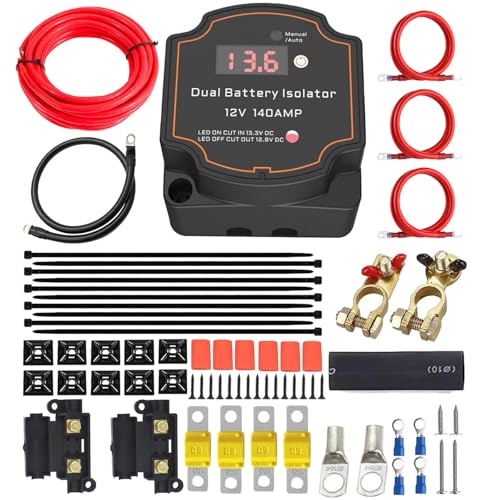
This 140A dual battery isolator kit provides automatic and manual modes via a Voltage Sensitive Relay (VSR). It enables two batteries to be charged separately while running essential accessories from a separate battery bank. Best for: users who need a versatile VSR setup with clear mode control and straightforward installation. Why selected: flexibility in operation modes helps tailor charging to engine-off and engine-on scenarios.
Limitation: primarily designed for dual-battery configurations; for three-bank applications, the kit may require additional components or a different setup.
RECOIL 500 Amp Mobile Isolator

The RECOIL 500 Amp Mobile Isolator handles 500 Amps continuous and 700 Amps surge, designed to prevent discharge from auxiliary banks to the main battery when the engine is off. It is well-suited for high-current installations where multiple devices are active. Best for: high-demand marine systems or commercial vessels with substantial power draws. Why selected: high current handling and surge capability offer robust protection for critical systems.
Caution: larger size and higher current rating may require careful cable routing and heat management on smaller vessels.
Buying Guide
Key considerations help determine the right 3-bank isolator for a boat’s electrical system.
- Current capacity: Match the isolator’s maximum output to the boat’s alternator and total battery load. A higher A rating supports more demanding systems but may require larger wiring.
- Voltage range: Ensure auto-ranging 12/24V support aligns with the vessel’s electrical configuration.
- Voltage drop: Look for isolators with low voltage loss (FET designs generally perform better than diode-based options).
- Installation complexity: Consider mounting space, terminal access, and whether your setup is better served by a simple dual-bank or full three-bank configuration.
- Mode options: Some models offer automatic and manual control or VSR modes; choose based on how you want batteries to charge with the engine running or off.
- Compatibility: Verify that the isolator supports your battery types (lead-acid, AGM, Li-ion) and any specific marine electrical standards you follow.
- Warranty and support: A strong warranty can reduce risk in marine environments where access to service is limited.
FAQ
- What is a 3-bank marine battery isolator used for? – It allows charging and use of three separate battery banks from one alternator without tying the banks together, reducing cross-drain and protecting critical systems.
- Do I need a three-bank isolator for a simple three-battery boat setup? – If you want independent charging and minimal voltage loss, a 3-bank isolator is appropriate; for two banks, a dual-bank isolator may suffice.
- What’s the difference between an isolator and a smart charger? – An isolator separates batteries and prevents discharge, while a charger supplies controlled charging; some devices combine both roles, but their primary functions remain distinct.
- Is low voltage drop important in marine isolators? – Yes, lower voltage drop improves charging efficiency and battery performance, especially at higher loads.
- Should I choose automatic or manual modes? – Automatic/VSR modes simplify operation and are common on marine setups; manual modes give you direct control over when charging occurs.
- Can I install a 3-bank isolator myself? – DIY installation is possible with proper wiring, accessories, and adherence to safety guidelines; consult a marine electrician if unsure.