Answering the common buying question: which DC-to-DC charger is best for marine and vehicle use? This guide highlights five reliable models designed to charge house batteries from the starter battery while protecting essential systems. The top picks are ideal for boaters, RV enthusiasts, and anyone managing dual-battery setups where space, safety, and smart charging matter. The listed products support LiFePO4, AGM, Gel, and flooded batteries, with features like alternator detection and Bluetooth monitoring to simplify maintenance.
Buyer profiles:
– Boat owners seeking compact, marine-grade units that handle LiFePO4 and lead-acid mixes.
– RV travelers needing durable, multi-stage charging with alternator compatibility.
– Car enthusiasts who want safe, automatic charging without risking starter or house battery drain.
Below is a quick summary of the chosen products and why they’re strong fits for these use cases.
| Product | Battery Types | Key Strengths |
|---|---|---|
| Renogy DC to DC Charger 12V 20A | LiFePO4, AGM, Gel, Flooded | Compact, safe startup protection, LiFePO4 activation, simple install |
| Renogy DC to DC Charger 12V 40A | LiFePO4, AGM, Gel, Flooded | Higher current, alternator-detection, robust design |
| Renogy DC to DC Charger 12V 60A Lifepo4 | LiFePO4, AGM, Gel, Flooded | 3-stage charging, strong protection |
| Victron Orion-Tr Smart DC to DC Charger 12V/12V 30A | Dual battery systems, LiFePO4 compatible | Bluetooth monitoring, isolation, professional three-stage charging |
| Victron Orion-XS Smart DC to DC Charger 50A | All common chemistries including LiFePO4 | High efficiency, IP65 rugged, configurable to multiple systems |
Renogy DC to DC Charger 12V 20A

Best for compact installations where space is limited. The charger includes built-in alternator detection, charging only when the engine is running, which protects both starter and house batteries. It supports LiFePO4 activation for peak performance and offers a simple on/off control for LiFePO4 mode. This makes it well-suited for small boats, campers, and compact RVs needing reliable, safe charging without adding clutter.
Who it’s best for: boaters and RVers who want a small, straightforward charger with smart activation. Why selected: its safe startup logic and LiFePO4 activation deliver dependable, low-maintenance charging in tight spaces.
Caution: the 20A current rating may limit charging speed for larger battery banks; consider higher-amperage models if you have big house battery banks.
Renogy DC to DC Charger 12V 40A

Better for medium-sized battery banks and RVs where faster charging is beneficial. It shares the same alternator-detection feature as the 20A model, instantly adjusting modes at startup to safeguard starter and house batteries. The design emphasizes safe spacing between input/output terminals, reducing short-circuit risk in maritime or mobile environments.
Who it’s best for: users with moderate battery capacity and a need for quicker replenishment. Why selected: higher current allows faster recharging while preserving multi-stage charging benefits.
Caution: installation should ensure adequate space for heat dissipation under load; higher current units can generate more heat in hot climates.
Renogy DC to DC Charger 12V 60A Lifepo4
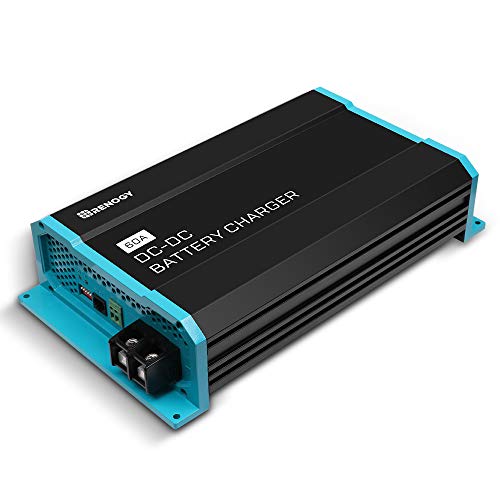
The 60A model is designed for larger home battery banks and more demanding marine or RV systems. It offers 3-stage charging (Bulk, Boost, Float) and strong protection features, including over-voltage, over-temperature, and reverse polarity protection, with input/output isolation to prevent interference with the starter or house circuits. This unit is a solid pick when you need reliable, fully automatic charging for LiFePO4 and other chemistries.
Who it’s best for: dual-battery setups with higher energy demands on boats or larger RVs. Why selected: higher amperage and smart LiFePO4 activation provide faster, safer charging for bigger systems.
Caution: ensure your alternator and wiring can support sustained 60A charging to avoid overheating or voltage drop on long runs.
Victron Orion-Tr Smart DC to DC Charger 12V/12V 30A

Best for professional-grade dual-battery systems where Bluetooth monitoring is valuable. The Orion-Tr Smart DC-DC Charger provides three-stage charging for safe, efficient charging from the alternator to the service battery. It is ideal for boats or vehicles where reliable monitoring and isolation between input and output are required to protect sensitive electronics.
Who it’s best for: users who want smartphone-based status checks and adjustable charging to suit various alternator types. Why selected: renowned Victron engineering and the built-in Bluetooth for easy remote oversight make maintenance straightforward.
Caution: while Bluetooth adds convenience, proximity to other Bluetooth devices in crowded spaces could introduce interference; plan placement accordingly for best connectivity.
Victron Orion-XS Smart DC to DC Charger 50A

Chosen for premium dual-battery systems requiring high power with rugged protection. The Orion-XS 50A delivers up to 700W with 98.5% efficiency and IP65 water resistance, making it a strong choice for harsher marine environments. It supports 12V/12V or mixed systems and features adjustable input/output to match a wide range of alternators and batteries. This makes it especially suitable for larger boats or winterized installations where weather exposure is a concern.
Who it’s best for: serious mariners and heavy-duty RV enthusiasts who need robust, configurable charging. Why selected: excellent efficiency, weatherproof design, and flexible configuration justify its position as a premium Marine DC-to-DC option.
Buying Guide: Key Considerations For Marine DC-to-DC Chargers
- Battery chemistry compatibility: Confirm support for LiFePO4, AGM, Gel, and Flooded batteries. LiFePO4 activation is beneficial for optimizing lifepo4 performance.
- Alternator compatibility: Ensure the charger detects engine running and adapts charging accordingly to protect the starter battery.
- Current rating and battery bank size: Choose amperage that matches your house battery capacity and anticipated draw. Higher amperage speeds up charging but requires adequate wiring and cooling.
- Protection features: Look for over-voltage, over-temperature, reverse polarity, and input/output isolation to prevent electrical interference and damage.
- Installation environment: For marine use, select models with rugged construction and IP ratings (e.g., IP65) to withstand seawater exposure and temperature changes.
- Monitoring and control: Bluetooth or app-based monitoring helps with remote status checks and parameter adjustments, useful for boats and RVs with limited access to the electrical panel.
- Wiring and space: Wall-mount designs and compact footprints simplify installation in tight engine rooms or lockers on boats and RVs.
FAQ
- What is a DC-to-DC charger used for on a boat?
– It transfers energy from the starter battery to the house battery, providing safe, controlled charging while protecting critical systems. - Do I need Bluetooth on a marine DC-to-DC charger?
– Bluetooth offers convenient monitoring and configuration, but wired connections also exist if you prefer a non-wireless setup. - Can these chargers charge LiFePO4 batteries?
– Yes, all listed models support LiFePO4, with some including dedicated activation options for optimized performance. - Is higher amperage always better?
– Higher amperage enables faster charging but requires appropriate wiring, cooling, and alternator capacity. Always match to your system. - What about IP ratings for marine use?
– IP65 or higher is preferable for exposure to water, humidity, and spray in boats and coastal environments. - Do these chargers isolate input and output?
– Most modern units include isolation to prevent interference with the vehicle’s electrical system and house circuits.