Answering the need for reliable power management on the water, these best-in-class marine dual battery chargers ensure fast, safe charging for both lead-acid and lithium batteries. They’re ideal for boat owners, anglers, and skippers who depend on dependable on-board power. This guide highlights top options, who they’re best for, and why they stand out. A concise buyer’s table is included to help you compare key specs at a glance.
| Product | Bank Count | Max Per Bank | Waterproof Rating | Best For |
|---|---|---|---|---|
| NOCO Genius GEN5X2 | 2 | 5 A | IP68 | Marine systems needing compact power with multi-mode charging |
| NOCO GENPRO10X2 | 2 | 10 A | IP68 | Higher power demands, larger boats |
| ProMariner 44020 ProSport HD | 2 | 20 A | Not specified | Heavy-duty, fast charging for multiple batteries |
| Guest 2707A | 2 | 8 A | IP67 | Budget-friendly, reliable dual-bank |
| 2 Bank Marine Charger (anegine) | 2 | 10 A | IP68 | Rugged, force-mode and dead-battery recovery |
NOCO Genius GEN5X2: 2-Bank, 10A Onboard Battery Charger

Best for boats needing compact, multi-mode charging without sacrificing performance. This two-bank charger delivers 5 A per bank while supporting 12V lead-acid and lithium batteries. It’s designed for harsh marine environments and includes temperature compensation to prevent overcharging in hot weather.
Who it’s best for: small to mid-sized boats with limited space that still require robust dual-bank charging. Why selected: the GEN5X2 combines compact size with smart modes (12V, AGM, Lithium, Repair) for versatile battery management. Caution: the device’s overall output is 10 A total; high-demand systems may require the higher-capacity option.
2 Bank Marine Battery Charger 5X2, 10A (5A/Bank) – FirstPower Pro

Better for boaters needing independent charging with flexible mode selection. Each bank can operate in 12V SLA/AGM, Lithium, or Calcium, with IP68 sealing for 24/7 onboard use. It also includes a force mode to wake dead batteries and charge below 1 V.
Best for: boats that require a versatile, rugged option with independent bank control. Choose this if you want clearly separated bank management and 24/7 onboard capability. Limitation: features emphasize mode selection rather than advanced diagnostic tooling.
NOCO Genius PRO10X2: 2-Bank, 20A Onboard Charger

Best for larger vessels with higher power needs. This charger provides a total of 20 A (10 A per bank) and supports temperature-compensated charging with multi-mode options. It’s engineered for demanding marine environments and offers precise maintenance charging for both lead-acid and lithium batteries.
Who it’s for: boat owners with multiple critical loads or larger engines that demand stronger charging. Why selected: higher per-bank output makes it a solid option when 10 A per bank is needed. Caution: larger footprint than the GEN5X2; requires more space and airflow.
ProMariner 44020 ProSport HD 20A Dual Bank

Best for rapid charging on boats with two batteries that must stay ready for launch. ProSport HD uses microprocessor control and distributed-on-demand technology to maximize available charging amps. It’s designed to be a robust, water-ready solution for frequent use.
Best for: users who want a proven dual-bank charger with fast charging and intelligent distribution. Limitation: ProSport HD may lack some newer diagnostic features found in premium NOCO units.
Guest On-Board Battery Charger 8A / 12V, 2 Bank

Best for budget-conscious boaters who still want dependable dual-bank charging. It offers IP67 waterproofing and essential safety features like reverse polarity and over-current protection.
Why chosen: reliable dual-bank operation at a lower cost. Caution: fewer advanced modes and diagnostics compared to higher-end models.
2 Bank Marine Charger (anegine) 10 A/Bank
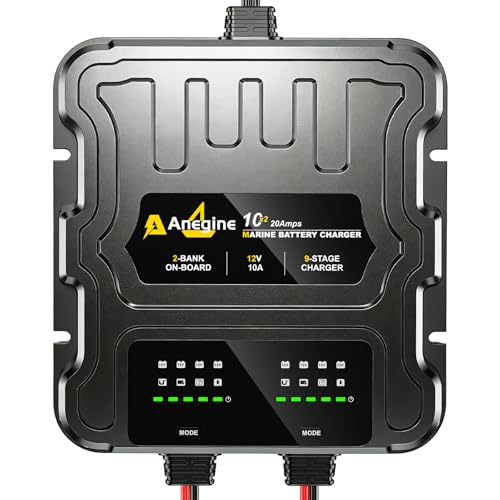
Best for users needing a rugged, IP68-rated charger with dead-battery recovery. It supplies 10 A per bank and supports both lead-acid and lithium chemistries, with force-mode for rejuvenating deeply discharged batteries.
Choose this if you want strong waterproof credentials and a focus on reviving weak batteries. Limitation: technical specs emphasize force mode and robustness more than extensive usability features.
Buying Guide: What To Consider When Choosing a Marine Dual Battery Charger
Power needs: Match total amperage to your on-board loads. For small boats, 10 A per two-bank unit is often sufficient; larger vessels benefit from 20 A per two-bank models.
Battery type compatibility: Look for chargers that support lead-acid, AGM, flooded, and LiFePO4 lithium batteries. Temperature compensation helps protect batteries in extreme weather.
Weatherproofing: Marine environments demand high IP ratings (IP65/IP68) and rugged construction. Consider submersible or fully sealed designs for saltwater use.
Charging modes and automation: Independent bank control and multiple charging modes ease setup for different chemistries. Dead-battery recovery features can save batteries that are deeply discharged.
Installation footprint and ease of use: Compact models fit tighter compartments; consider mounting options, cable length, and whether a display or simple indicators suit your preferences.
FAQ
- What is a dual-bank charger best for? It charges two batteries independently, allowing simultaneous charging for separate systems—such as trolling motor and main engine—without cross-interference.
- Can I use a dual-bank charger with lithium batteries? Yes, if the unit supports 12V lithium (LiFePO4) and provides appropriate charging profiles and temperature compensation.
- What does IP68 mean for marine chargers? It indicates the charger is fully protected against dust and can be submerged in water for extended periods, making it suitable for wet environments.
- Should I choose a higher amperage per bank? Higher per-bank amperage enables faster charging for larger or deeply discharged batteries but may require more space and power draw.
- Is dead-battery recovery important? It helps revive deeply discharged batteries, reducing waste and extending battery life when used properly.
- Do these units require professional installation? Most are designed for DIY mounting, but follow all safety and electrical standards; consult a marine electrician if uncertain.