If you need reliable hot water on a boat, these marine electric water heaters are designed to fit tight spaces, run on standard 120V power, and deliver ample hot water for daily needs. They’re best for liveaboard sailors, weekend boaters, and small-to-mid-sized vessels that rely on shore power or generator use. The top picks prioritize compact size, efficient heat exchange, and corrosion-resistant construction for marine environments. The table below compares five strong contenders to help you decide quickly.
| Product | Brand | Capacity | Power |
|---|---|---|---|
| Kuuma 6 Gallon Water Heater | Kuuma | 6 gal | 120V / 1500W |
| Camco 11841 Kuuma Water Heater | Camco | 11 gal | 120V / 1500W |
| Kuuma 11810 6-Gallon Water Heater | Kuuma | 6 gal | 120V / 1500W |
| Whale F600 Water Heater | Whale | 6 gal | 120V |
| VEVOR 6 Gallon Electric Tank Water Heater | VEVOR | 6 gal | 120V / 1600W |
Kuuma 6 Gallon Water Heater for Boats

Product: Kuuma 6 Gallon Water Heater for Marines and Boats, 120V Electric Tank Unit with Front-M Mount and Rear Heat Exchange for Daily Hot Water Access. Features include a 6-gallon capacity and 120V-60Hz/1500W electrical input. Best for smaller boats or as a primary hot-water source where space is at a premium. This unit is better for skippers needing compact installation with reliable 120V heating. A potential limitation is its smaller capacity if hot-water demand is high for multiple guests or long showers.
Camco Kuuma Water Heater with 11 Gallons

Product: Camco 11841 Kuuma Water Heater with 120V Front Heat Exchange and Back Mount – 11 Gallons. This option is best for boats needing larger hot-water capacity and longer use between fills. It uses 120V at 1500W, delivering more hot water per cycle. Choose this if you frequently run showers and dishwashing on board. A caution: larger footprint may require more mounting space and appropriate mounting orientation for optimal heat exchange.
Kuuma 11810 6-Gallon Marine Water Heater
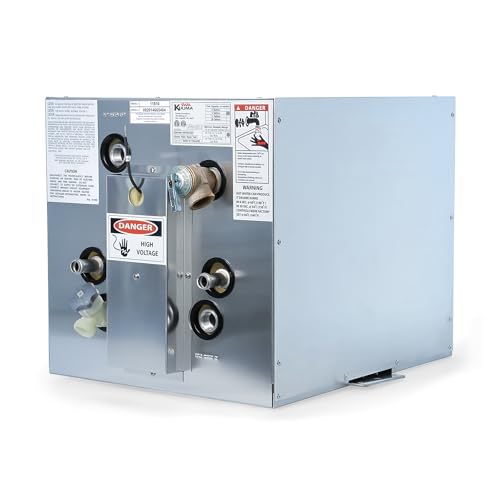
Product: Kuuma 11810 6-Gallon Water Heater, Marine Aluminum Tank with Efficient Heat Exchanger, 120V, Gray. Best for boats seeking a robust aluminum tank and compact 6-gallon capacity with reliable 120V heating. It’s a fit for moderate hot-water needs on mid-sized vessels. Limitation: aluminum tanks can be more prone to galvanic issues if not properly isolated on some boats; ensure proper electrical isolation and sea-water protection.
Whale F600 6-Gallon Water Heater

Product: Whale F600 Water Heater, 6-Gallon Capacity, 120V, Front Heat Exchanger, Galvanized Steel. Best for boats needing a rugged unit with a front heat exchanger and durable construction. Suitable for longer trips or higher hot-water demand due to its sturdy frame. A limitation is its galvanized steel body, which requires proper anode protection and periodic inspection in saltwater environments.
VEVOR 6 Gallon Electric Tank Water Heater

Product: VEVOR Electric Tank Water Heater, 6 Gallon, 1600W with LED Display. Best for boaters needing a compact, modern unit with straightforward controls and a high-insulation design to reduce heat loss. It features a T&P valve and an IPX4 rating for basic splash protection. A caution: 1600W draw may impact shore-power or generator capacity on smaller vessels, so plan electrical load carefully.
Buying Guide
What capacity do you need? For quick showers on short trips, 6-gallon models are often enough. If you frequently host guests or run multiple hot-water outlets, an 11-gallon option may be worth the footprint.
Which heating configuration is right? All listed units run on 120V AC, but some boats can support dual-fuel or faster recovery with more powerful elements. If you have limited shore power, prioritize models with efficient heat exchange and good insulation to minimize runtime.
Material and build quality matter. Aluminum tanks resist corrosion but may require more careful electrical isolation; steel or galvanized bodies add rugged durability but need protective measures against saltwater exposure. Ensure proper mounting and proximity to freshwater lines to minimize heat loss.
Space and installation considerations. Measure available space and verify mounting patterns. Front heat exchanger designs can simplify installation but may require precise alignment with existing plumbing. Check for back-mount compatibility if space constraints dictate a particular orientation.
Safety and protection features. Look for temperature and pressure relief valves, dry-heating protection, and overheating safeguards. An IPX4 rating helps with splash resistance, important on exposed decks or galley areas.
Frequently Asked Questions
- What size marine water heater should I choose?—Choose 6–11 gallons based on hot-water demand and vessel size. Larger boats or guests may justify 11 gallons.
- Are these heaters 120V only?—All listed options run on 120V AC; verify if your boat has adequate shore power or generator capacity for steady operation.
- Can I install these myself?—Basic installation is possible on many vessels, but ensure proper mounting, electrical isolation, and plumbing compatibility. Consult a marine technician if unsure.
- Do these heaters require special maintenance?—Regular inspection of connections, anode or corrosion protection if applicable, and checking the T&P valve operability are prudent maintenance tasks.
- Which heater is best for high-demand use?—Heaters with larger capacities (11 gallons) and robust heat exchangers tend to deliver more hot water in busy scenarios. Consider space and electrical load before choosing.
- Is aluminum tank always better for boats?—Aluminum is lightweight and corrosion-resistant but requires proper electrical isolation. Steel or galvanized tanks offer durability but may need more protective measures.